English edition
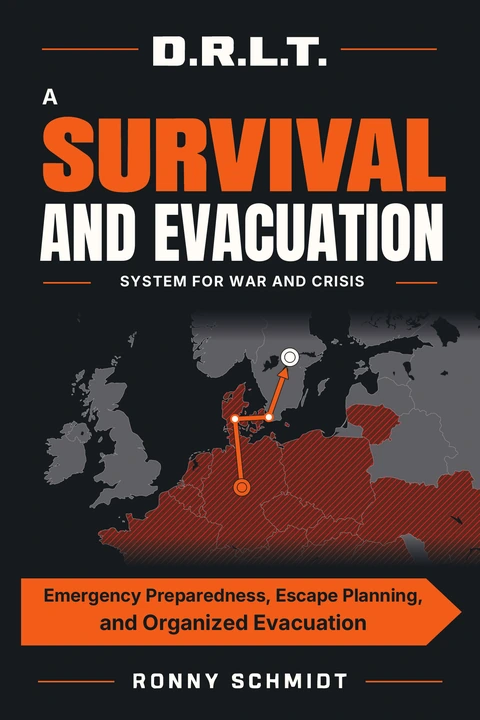
D.R.L.T. – A Survival and Evacuation System for War and Crisis
The book introduces D.R.L.T., a concept for prepared civilian teams, organized evacuation and the protection of people in their care.
Buy on AmazonRonny Schmidt · English edition
Surviving War and Crisis
A nonfiction guide for civilians on remaining capable, evasion and survival in war and crisis, from the onset of isolation to a return to safety.
Combat Survival – Surviving War and Crisis is a handbook for unarmed civilians who want to understand survival in areas affected by crisis and conflict. It focuses on an individual cut off from reliable help: a traveler, a technician working abroad, or an aid worker, for example. The book draws on principles from combat survival and SERE and considers them in relation to the options and limitations of a civilian in this situation.
The 23 chapters connect situation assessment and managing yourself under stress with the practical demands of survival. They cover concealment and evasion, navigation, coping with exhaustion, and protection from cold and wet. Water, food, medical self-care, and available equipment are considered alongside threats from other people. The consequences of a decision matter throughout: an action may conserve strength while also taking time or making a person more noticeable.
A further focus is captivity, questioning, and psychological pressure. The book examines holding on to your identity in isolation, possible opportunities to escape, behavior during a rescue, and approaching secure areas. Its chapters follow the problem from the initial loss of control to the prospect of reaching reliable protection again. Available resources, physical condition, and the situation itself determine which options remain open to an isolated person.
Contents
From the book
The descent into this complete isolation can take many forms: you work for an aid organization in the capital of a country in crisis. During the night, muffled detonations make the windows of your hotel room vibrate. A political coup is sweeping through the streets. Your NGO's internal radio network is dead. Stepping into the corridor, you see the local security staff hastily stripping off their uniforms, dropping their weapons, and fleeing through the rear exit. Down in the lobby, armed men with no recognizable uniforms have already arrived. The international organization's ID card in your breast pocket no longer offers diplomatic protection—it could be a death sentence.
Or you are a technician assigned to an industrial facility abroad. The regional conflict that had been raging 50 kilometers away has swept across the provincial borders overnight. The local plant managers have already fled with their families. Your company's evacuation convoy cannot get through because irregular militias control the roads. You are trapped in a portable office while the plant gate is breached outside, and you realize that your Western appearance makes you the perfect hostage.
During movement, air exchange at clothing openings can also carry heat away. Every step, swing of the arms, and turn of the torso changes the internal volume of your clothing. This repeated compression and expansion pushes body-warmed air out at the cuffs, pant hems, and collar. As the fabric relaxes, it draws cold outside air back into the clothing. This continual exchange can reduce the insulating effect of a jacket or sweater. Adjust the openings so that wind cannot pass freely through them. During exertion, however, excess heat must still be able to escape; how tightly you close the openings depends on the wind, exertion, and how warm you feel.
At the legs, your existing shoelaces may help gather an overly wide pant hem. Do not tuck the outer pant leg into the shoe. Pull it down until it completely overlaps the shoe's upper. Because ordinary pants such as jeans are cut wider than the ankle, pull the fabric on the outside of the leg firmly backward. Flatten the excess fabric against the leg and fold it forward into a Z-shaped pleat until the pant leg fits closely. If enough lace remains after securely tying the shoe, use it to hold the pleat loosely. Keep the shoe fully laced to the extent needed for a secure fit. Another expendable strip of fabric is an alternative. With little tension, wrap the lace around the outside of the folded pant fabric at ankle height. Cross the lace several times and secure it with a firm double knot. The pant leg now fits more closely over the upper and may reduce wind entry and water running into the top of the shoe. This does not make absorbent pant fabric waterproof. After a few steps, check the pleat and binding: they must not constrict the ankle or interfere with your stride. The Z-shaped pleat leaves a small allowance for movement; walking reveals whether this is sufficient and whether the binding sits correctly.
Keeping your account simple: Darkness, irregular meals, constant noise, and repeated questioning can seriously strain memory and concentration. An interrogation may begin without warning, including after being awakened in the middle of the night or under glaring light. You then have to give the same facts under markedly worse conditions. A question may be worded differently later or asked again by another person. As far as possible, recognize the same issue behind the new wording. Your name, actual occupation, reason for travel, and responsibilities already explained form the core. Do not continually add details simply because the same question returns. This conserves limited concentration and reduces contradictions you create yourself. Even a true memory may be incomplete under exhaustion; distinguish uncertainty from a deliberately false statement.
During a quiet period, go through the essential answers you have already given once, in order. Recall what was asked and what you actually said. A few fixed reference points are more useful than ceaselessly repeating a long story. If you have noticed an error, also remember its cause, such as a misunderstood question or a confused time reference. Turn that into a simple correction for the next questioning.
An attack on the place of confinement abruptly ends the existing routine. It may be a rescue attempt by government forces or an assault by another armed group. The captive may initially be unable to tell the difference. Gunfire, doors breaking, flashes of light, dust, and shouted commands make orientation difficult. Entering forces may also be unable at first to distinguish hostage from captor. Keep your hands empty, reduce unnecessary movement, and move into the lowest protected position you can reach from where you are. Once addressed directly, listen to the actual command. Adapt your protective position and next movement to fire, smoke, reachable cover, and instructions you can understand.
Two editions
About the author
Survival & personal safety