

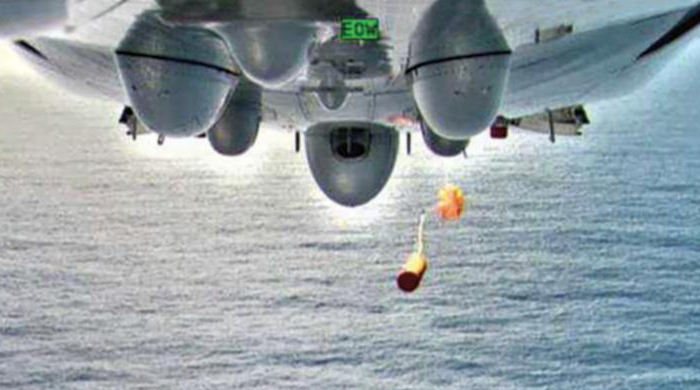
UNI-PAC is an air-delivery system from Life Support International that combines a liferaft, survival equipment and parachutes in one cylindrical container. A P-8 Poseidon can release the package from its weapons bay to shipwrecked or otherwise isolated people. UNI-PAC II and III differ substantially: the documented US Navy II package contains an eight-person raft, while the P-8 III configuration normally carries a 20-person raft.
One container performs several delivery tasks
UNI-PAC II is an adjustable semi-rigid container design for different aircraft and missions. It can contain a raft and survival kit or carry a different equipment combination. Side doors, tail ramps and bomb or weapons bays each require a suitable delivery configuration. The maritime-survival configuration employed from a P-8A is therefore one particular package within the broader II family. An arbitrary UNI-PAC II load is not automatically the eight-person arrangement described here.
The single-container design keeps raft, supplies and deployment components together during flight. A static line initiates parachute deployment when the container is released. This is distinct from the long floating retrieval line that allows people or a small boat to connect to the raft at the surface.
The specific UNI-PAC II package for the P-8
In the US Navy configuration documented in 2021, UNI-PAC II contains an eight-person raft and survival equipment. The complete package weighs 107 pounds, approximately 48.5 kilograms. It also carries 450 feet, approximately 137 metres, of floating retrieval line with water-activated lights. The long line increases the area in which people can make contact with the raft after delivery. The lights mark the connection lying in the water.
Before release, the static line is attached to the aircraft. It operates deployment as the container is released. Parachutes open and decelerate the package. The retrieval line and raft are extracted, the inflation mechanism is activated and the survival items arrive at the surface. These stages work together: deceleration reduces impact, deployment places packed elements in their operating arrangement and the line extends the area in which people can connect to the package.
The static line and floating retrieval line must remain distinct. The first acts between aircraft and package during release. The second supports access at the surface afterwards. In the February 2018 P-8 operation, the described release height was approximately 500 feet, or 152 metres, with a 150-yard trailing line, also approximately 137 metres. That height belongs to this II use. The later III has its own deployment and flight clearance.
III was developed for the P-8 weapons bay
UNI-PAC III is a joint development programme involving Boeing, the US Navy and the Royal Australian Air Force. Its P-8 configuration has the US Navy designation SRU-44/P and entered service in 2021 following five years of development and evaluation. The semi-rigid container combines a larger raft, survival equipment and parachute deployment within an external envelope matched to the P-8. The central design change thus provides more usable contents within an aircraft-specific delivery store.
Production configuration SUR-3818-1000 is 72 inches long and 15.5 inches in diameter, approximately 1.83 metres by 39.4 centimetres. It weighs 315 pounds, approximately 143 kilograms. Its stated operating airspeed is 230 KIAS: knots indicated airspeed, rather than speed over the ground. Geometry, mass and clearance work together. A similarly sized container with a different load does not acquire the same safe separation from the aircraft or deployment behaviour through its shape alone.
III uses water-activated deployment or inflation on impact with the water. The parachute system first puts the package into its intended descent. The configuration includes 675 feet, approximately 206 metres, of frontage line. This line performs the surface access and connection function. Normal raft capacity is 20 people, with a separately specified 30-person overload case. That additional loading changes space and weight distribution on the same raft.
UNI-PAC II and III: capacity, mass and supplies
| Feature | US Navy P-8 UNI-PAC II package, 2021 | P-8 UNI-PAC III configuration |
|---|---|---|
| Raft | Eight people | 20 people normally; 30 in the specified overload case |
| Package mass | 107 lb, approximately 48.5 kg | 315 lb, approximately 143 kg |
| Surface line | 450 ft, approximately 137 m, floating retrieval line with water-activated lights | 675 ft, approximately 206 m, frontage line |
| Provisioning basis | Survival equipment with the eight-person raft | Food, water and communications for up to 20 people over 72 hours in the RAF 2023 configuration |
The British III configuration demonstrated in 2023 carried food, water and communications equipment for 20 people over 72 hours. Other mission loads can also include medical supplies and signalling devices. The 30-person figure is only the raft's overload capacity; the 72-hour provisioning basis remains 20 people.
Up to five III systems fit the intended Poseidon configuration. With 20 people per raft under normal loading, that provides equipment capacity for 100 people. Multiple deliveries can also equip separate groups.
Development, testing and operational use
II was already employed in a real US Navy P-8A maritime rescue in 2018 and was used during joint loading with RAF personnel at Lossiemouth in 2021. III was developed for the P-8 with US and Australian participation. The Royal Air Force tested its own delivery from a Poseidon MRA1 off the British southwest coast in February 2023. The aircraft departed Lossiemouth, flown by personnel from 206 and CXX Squadrons.
The British III configuration delivered a raft, food, water and communications for 20 people over 72 hours into the sea. Poseidon could thereby deliver the survival craft itself after previously needing another aircraft to perform the drop. Search and supply were combined in one platform.
In April 2024, a US Navy P-8A dropped two UNI-PAC III containers to three fishermen stranded on a small island east of Guam. They had spent ten days without communications; the containers supplied medical and survival equipment. This use shows the supply role particularly clearly: people with an existing shelter ashore can also benefit from the contents. A delivery therefore need not result in people boarding a new raft at sea.
Retrieval line, drift and access to the raft
The container, raft and people do not necessarily arrive at the same point. Wind during descent and current after impact move the separate elements. The 137- or 206-metre surface line therefore increases the area in which a person or small boat can catch the system and haul the raft closer. On the II, water-activated lights mark the line in darkness.
Transfer to the new raft begins only after it has fully inflated, remains secured by the line and is actually within reach. Until then, existing load-bearing flotation is the safer platform. After boarding, loose container components and delivered equipment have to be secured so that wind and current do not separate them from the raft again.
Inspection interval and a separate training module
The III configuration has a two-and-a-half-year inspection cycle. Controlled packing and deployment function are maintained before the package is integrated into an aircraft load. II has a separate reusable training module, SUR-3833-00. Repeated delivery practice and emergency provisioning can consequently use different packages. Breaking open and arbitrarily repacking an operational configuration would change the arrangement of raft, parachute and activation.
In the February 2018 US Navy rescue, a police boat conducted pickup a few hours after location. The package bridged the interval between finding and transporting the people.
The appearance of U.S. Department of War (DoW) visual information does not imply or constitute DoW endorsement.