

SEEK-2 was a personal US Navy survival kit for aircrew. Its name stood for Survival, Escape and Evasion Kit. The configuration documented in early 1968 comprised two flexible waterproof packets: Packet 1 contained medical supplies and Packet 2 general survival equipment. Both fitted into the SV-2 survival vest, and initial deliveries went to squadrons in Southeast Asia.
SEEK-2 as part of the SV-2 vest
A surviving example belonged to Mike Krebs, a pilot with VA-34. The squadron operated from the carrier Intrepid against targets in North Vietnam in 1967. The kit remained attached to the survival vest and was intended for both escape over water and survival on land.
In addition to SEEK-2, the SV-2 carried a radio, flares and launcher, distress light, mirror, whistle, shroud-line cutter, survival knife, pistol and ammunition. SEEK-2 supplemented this immediately accessible contact and escape equipment with medical supplies, water treatment, tools and tropical protection.
Flexible vinyl packets with labelled components
SEEK-2 replaced SEEK-1's rigid containers with two flexible vinyl carriers. Inside, individually labelled components sat on a backing surface coated with transfer adhesive. They could be removed and returned to their assigned positions.
The Medical and General division was functional but not absolute. The medical packet contained dressings and care supplies; the general packet held tools and equipment for fire, water, navigation and signalling. Soap, needles and small blades appeared in either area according to their purpose.
Packet 1: medical supplies for a tropical theatre
The early-1968 packing list names gauze, adhesive dressings, tweezers, safety pins, soap, antiseptic and eye ointments, fungicidal powder, lip care and insect and leech repellents. It also includes period tablets for pain, diarrhoea, malaria, infection and motion sickness, together with alertness and salt tablets. Different foil colours assisted identification.
Variations already existed within early production. The first 5,000 kits lacked the fungicidal powder listed later; powder quantities and lip-care sticks also changed. A burning lens was expressly listed as not yet included at that stage. A surviving example therefore has to be identified by production standard.
Packet 2: tools, water, fire and navigation
The General Packet contained a short knife/hacksaw blade, a wire saw and sewing materials. The 9.5 cm blade had a cutting edge and saw teeth; the wire saw measured approximately 53 to 64 cm. Fishing equipment comprised artificial flies, eight hooks, sinkers and about 15.2 m of nylon line.
Water equipment comprised two flexible receptacles, a small sponge and 50 iodine water-treatment tablets. Fire equipment included 16 protected matches, a synthetic flint, wax-impregnated paper, cotton tinder and a candle. The teeth on the short blade could be used against the flint.
Other contents included a headnet, net mittens, sunglasses, two packets of hard candy, four beef bouillon cubes, a wrist compass, signal mirror and miniature flashlight. The radio, pyrotechnic signals and whistle occupied separate positions on the SV-2 vest.
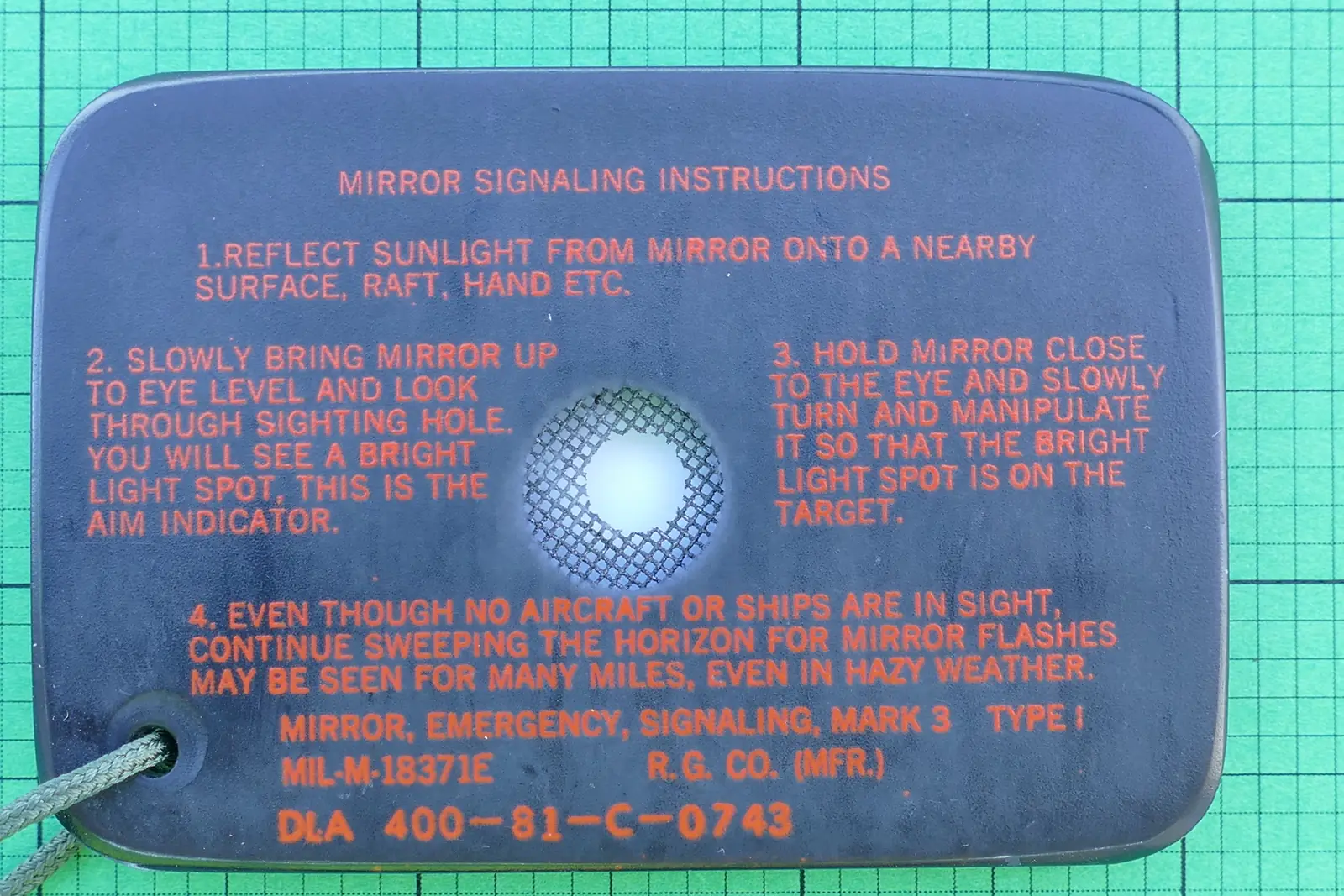
The signal mirror shown
The image on this page shows a Mark 3 Type I from a 1981 contract, not the complete 1967 or 1968 SEEK-2. This pattern, with a sighting aperture and retroreflective mesh, was nevertheless specified for SEEK-2. The mirror belonged to the General Packet; the other SV-2 signalling devices sat outside the two SEEK-2 packets.
Changes during early production
The first 5,000 kits lacked both the light filters and some care items listed in the 1968 packing standard. Mike Krebs's example represents the 1967 state, while the fully documented arrangement describes the Navy standard in early 1968. The two cannot be combined into one undated, unchanging contents list.
SRU-31/P replaced SEEK-2
By 1973, SRU-31/P had replaced SEEK-2. The successor also had medical and general packets but contained approximately half as many items and allowed space for optional additions. SEEK-2 had been designed for several days to about a week; SRU-31/P reflected an expectation of recovery within 24 hours.