

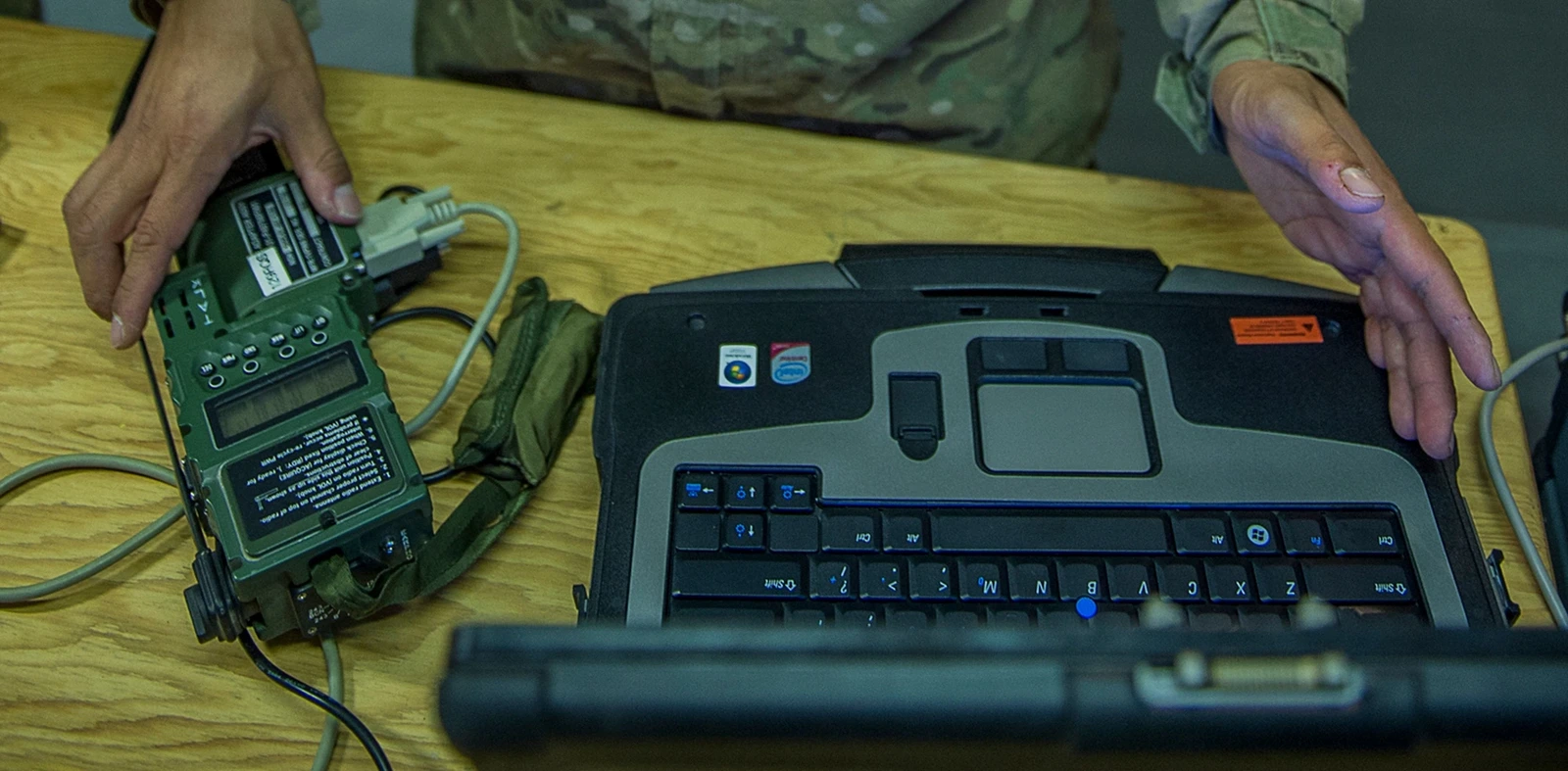
The AN/PRC-112G combines a personal survival radio with GPS, encrypted data messages and a transponder for guiding search aircraft towards it. It is the body-carried side of General Dynamics’ HOOK2 system. The other side consists of a compatible interrogator aboard an aircraft and, for satellite operation, a separate ground station. An isolated aircrew member can therefore communicate position and condition without reading every coordinate aloud over voice radio. The radio configuration, its programming and the available radio path determine which link is actually usable.
A new radio and an upgrade route
In 2003, the US Army’s V Corps purchased 100 PRC-112Gs with associated Quickdraw2 interrogators for its aviation formations and other divisions. That year, the US Air Force ordered 744 new PRC-112Gs and upgrades adding GPS location and encrypted messaging to almost 1,500 earlier PRC-112 radios. These represent two different development routes: a new G radio with integrated functions, and an upgrade of existing sets. The family name alone does not give an earlier PRC-112 all the capabilities of the G configuration.
The 2011 HOOK2 configuration includes either a PRC-112G or a PRC-112B1, a Quickdraw2 and a SATCOM Base Station. The radio remains with the isolated person; the interrogator belongs to the searching forces. The base station provides another link through which position and situation information can be processed before a search aircraft arrives. This network must be prepared before isolation.
Size, frequencies and transmitter power
The 2015 G configuration measures approximately 19.56 × 9.83 × 5.33 centimetres with battery fitted and antenna retracted. Typical radio mass is 0.78 kilograms without the battery. The display, function keys, voice microphone and antenna are on the handheld set, which is designed for single-handed operation. A small text screen and software-dependent menus replace the older AN/PRC-90’s simple selector. Message formats and settings therefore need to match the task before deployment.
The frequency envelope includes 121.5 and 123.1 MHz, the UHF range from 225 to 320 MHz, and the separate 406 MHz SARSAT function. Line-of-sight operation uses 25 kHz tuning steps, while SATCOM uses 5 kHz steps. The G voice configuration has fixed 121.5, 243 and 282.8 MHz channels and two programmable channels. These capabilities are separated by operating mode: the swept-tone beacon operates on 121.5 or 243 MHz. The radio does not freely combine every waveform with every frequency.
Transmitter output also depends on the mode. Average UHF output is one watt, while VHF output is 100 milliwatts. The 406 MHz function uses a minimum of five watts; UHF SATCOM uses five watts with a tolerance of ±2 dB. This explains why a single general endurance figure says little about sustained high-power transmission. Reception, position calculation, short data messages and beacon operation draw differently on the battery.
A GPS receiver inside the radio
The 2015 G configuration has a twelve-channel parallel GPS receiver using L1 C/A code. It updates its own position inside the radio every second, with a stated position accuracy below 25 metres. GPS reception initially establishes the handheld set’s position. An interrogation or a user message then sends that information over an available communication path.
The position can be displayed as geographical coordinates, UTM or MGRS, with up to 250 waypoints available. A heading calculated from GPS movement requires the person to move. At rest, it does not provide a compass heading. This matters in a hide site or a small occupied area: a valid position and a useful direction of movement are separate indications.
The PRC-112G can indicate GPS interference and display its relative strength. It uses C/A code here; an encrypted HOOK2 data channel does not turn satellite reception into military P(Y)- or M-code reception. Without a usable GPS position, voice and data links remain available, but the location has to come from other means.
What Quickdraw2 receives from the handheld set
When switched on, the PRC-112G can respond automatically to a compatible interrogation. The search crew can obtain GPS position and identification data without the person initiating every transmission. Quickdraw2 connects to the aircraft intercom and acts as the other side of this data interrogation. An equipped crew can also track the isolated person’s movement. An obstructed antenna or missing radio path still interrupts the exchange, even when the radio display on the ground shows a position.
On 14 January 2016, this division of equipment was used in a simulated astronaut rescue off Florida. A PRC-112G was aboard the life raft, while a Quickdraw interrogator operated in a C-17A aircraft. The combination supplied position and identification for the simulated survivors as the crew, rescue forces and ground station exchanged messages. The handheld radio was part of a prepared link between the raft, aircraft and supporting forces.
Terminal Area Communications, or TAC, combines direct voice with encrypted line-of-sight data messages. Terminal Area Guidance, TAG, uses the integrated PLS DME transponder and beacon for local guidance. DME supplies distance to the responding radio through interrogation and reply. The beacon instead provides a signal for taking a bearing. GPS interrogation sends the coordinate calculated inside the set. Named compatible interrogators include Quickdraw2, Rockwell Collins RSC 125G and Cubic PLS AN/ARS-6(V12); their particular interrogation functions must match the existing radio configuration. TAC and TAG are also used by the separate CSEL system.
HOOK data operation uses 1,200 bits per second and a 455-millisecond data burst excluding the preamble. Position and text data use 256-bit AES encryption; additional forward error correction protects against individual transmission errors. Canned messages, preprogrammed texts, free text and situation reports are available as distinct formats. A short encrypted burst limits time on the radio channel and protects its contents. The transmission can still be detected. This data encryption does not also encrypt the AM voice channel.
SATCOM and 406 MHz are separate configuration features
The optional UHF SATCOM function connects the handheld set to the HOOK2 base station through a suitable satellite path. Data can therefore be exchanged beyond direct line of sight to a search aircraft. The base station is separate portable equipment operated by the supporting forces, rather than a component inside the PRC-112G. The appropriate software option, prepared receiving station and satellite access belong to this configuration. The GPS satellite supplying position signals is not this messaging path.
406 SARSAT is another option. Adding it to the 2015 configuration requires a factory upgrade; the radio’s general software capability alone is insufficient. The 406 MHz alert travels through Cospas-Sarsat, while HOOK2 data provides direct encrypted dialogue with the intended stations. The analogue homing tone on 121.5 or 243 MHz, the 406 MHz alert and the satellite data connection therefore each need to be checked and prepared on the actual set.
| Link | Other station | Technical purpose |
|---|---|---|
| AM voice | Radio tuned to the appropriate channel | Open dialogue with active transmission and listening. |
| HOOK2 line-of-sight data | Compatible interrogator | Encrypted position, identification and messages. |
| PLS DME / homing tone | Compatible transponder interrogator or direction finder | Local guidance towards the radio. |
| UHF SATCOM | Prepared HOOK2 base station through a satellite | Optional data connection beyond line of sight. |
| 406 SARSAT | Cospas-Sarsat alerting system | Alerting with an appropriately upgraded set. |
Battery, display and preparation
The 2015 configuration uses battery 1794AS0953A/U. Estimated endurance of more than four days depends on a CSAR operational profile. SARSAT Battery Saver operation has a separate figure of more than 24 hours. The G battery indicator calculates its value from elapsed operating time rather than measuring actual state of charge. Estimating the remaining energy reserve therefore requires an appropriately prepared battery and knowledge of its use since installation.
The operating temperature range is −40 to +55 °C; display performance is marginal between −40 and −30 °C. Text entry and menu operation may therefore fail while the radio electronics continue to work. Water exposure has two separate specified limits: 15 minutes at a depth of 50 feet, or 24 hours at three feet.
Two PRC-112G hardware versions
A 2020 GPS hardware change affects PRC-112G part number 01-P46610J002 running software 3.20. Earlier hardware then used software 3.6. These two software images are not interchangeable. The new GPS chipset needs no almanac to save or load, making the earlier preparation’s almanac displays inapplicable. This hardware also provides no power-up built-in test (BIT), so a 3515 test expecting it can report a false failure. GPS-112 Program Loader 4.2.0, however, was designed to support both G hardware versions.
The carried set’s hardware identity, software, programming and installed options must therefore match. The manufacturer ended sales of the PRC-112G product line on 31 December 2023; its announced support period extends to the end of 2028, with repairs dependent on finished goods availability. The replacement product is HOOK3, with configurable automatic activation through G-force or salt-water contact. The PRC-112G, by contrast, must be switched on to answer a compatible interrogation.
The appearance of U.S. Department of War (DoW) visual information does not imply or constitute DoW endorsement.