

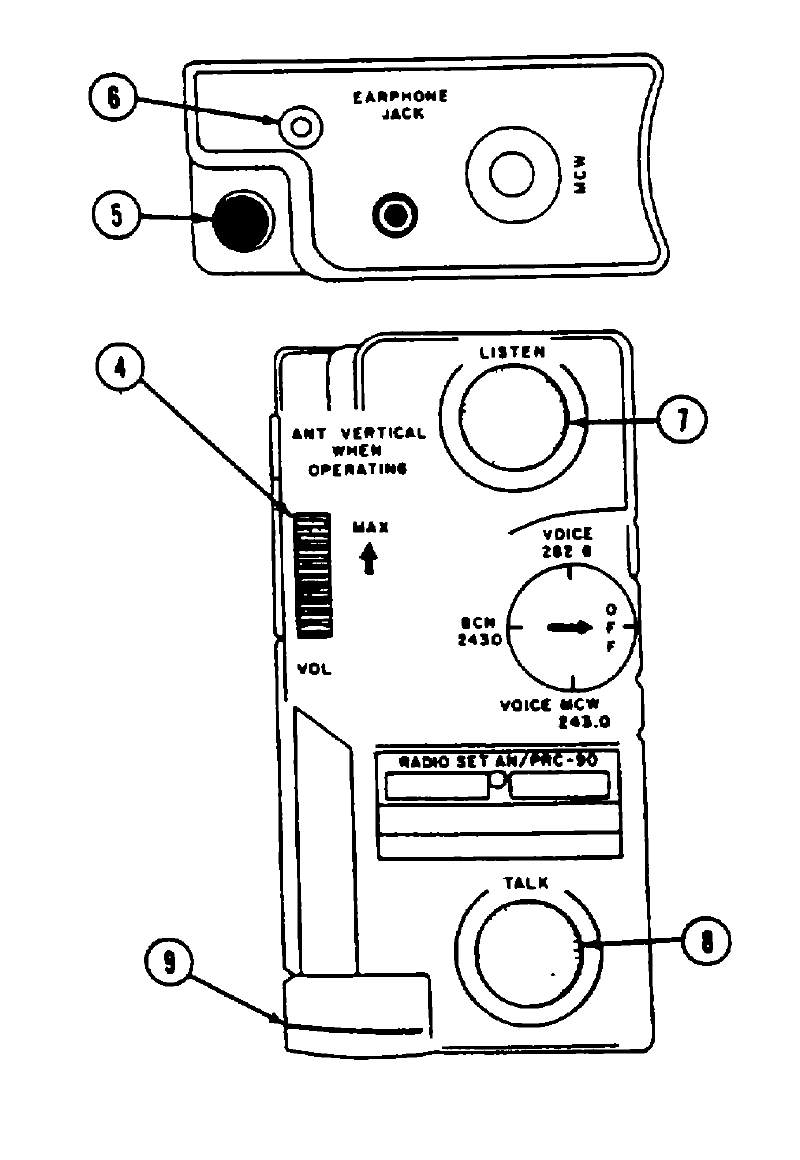
The AN/PRC-90 is a personal UHF emergency radio for aircrew. It combines voice communication on two fixed frequencies with an automatically transmitted homing tone and a Morse key. In the US Navy’s 1990 equipment configuration, it provided contact between downed aircrew and search aircraft; the US Army’s 1992 SARVIP system provided a dedicated radio pocket in the survival vest. This small analogue survival radio could transmit speech, receive replies and provide a signal for a direction finder. The person had to communicate their position, condition and identity.
A radio retained by the person
SARVIP combines a survival vest, an armour insert and carried survival, signalling and communication equipment. Its radio pocket accommodates an AN/PRC-90 or an AN/PRC-112. The radio link therefore belongs to the worn equipment: after leaving the aircraft, the person may still have the radio even when equipment carried in the seat or aircraft is lost. The two named radios are alternative configurations, rather than a requirement to carry both together.
The PRC-90’s principal functions are placed directly on its case. A four-position rotary selector provides OFF, VOICE/MCW 243.0, BCN 243.0 and VOICE 282.8. Other controls include the push-to-talk button, a separate MCW button, the volume control, the TALK microphone and the LISTEN speaker. Antenna and earphone connections are on top. A screw cap retains the battery and seals its compartment externally. There is no frequency-entry procedure or screen menu: the labels identify the mode and channel directly.
The Navy’s 1990 configuration has a half-wave antenna with five telescopic sections. For operation, it is fitted to the radio and fully extended. The set is held upright, with the hand kept away from the antenna. Pointing the antenna tip towards the aircraft degrades radiation.
Two channels and three ways to transmit
243.0 MHz is this configuration’s military emergency channel. The PRC-90 can transmit speech, a keyed tone or its automatic homing signal on that frequency. 282.8 MHz is the additional voice channel. The radio uses amplitude modulation. These are two fixed channels, rather than a continuously tuneable UHF frequency range. Selecting 282.8 MHz requires pressing the button in the selector arrow; this interlock prevents the additional channel being selected by an unintended turn alone.
| Selector position | Function | Effect on contact |
|---|---|---|
| OFF | Power removed | No reception or transmission. |
| VOICE/MCW 243.0 | Reception on 243.0 MHz; speech with push-to-talk, tone with the MCW button | Releasing the transmit button returns the set to reception. |
| BCN 243.0 | Continuous homing signal on 243.0 MHz | The user cannot hear a voice reply in this position. |
| VOICE 282.8 | Voice communication on 282.8 MHz | The other station must also use this channel. |
During a voice call, holding push-to-talk switches the receiver off and the transmitter on. The receiver returns only when the button is released. This explains a common operating error: keeping the button pressed after a distress call shuts out the reply. In either voice position, the user speaks directly into the TALK microphone; the received reply comes through the LISTEN speaker or the connected earphone.
BCN generates a continuous swept audio tone on the fixed 243 MHz radio channel. A suitably equipped search aircraft can take a bearing on the transmitter and home towards it. The signal carries no GPS coordinates, individual digital identity or casualty status. A running homing tone also provides no acknowledgement from the search crew. The isolated person must deliberately return to a voice position to conduct a conversation.
MCW means Modulated Continuous Wave. The top button acts as a Morse key: the set transmits a tone while the button is pressed, then returns to reception when it is released. This permits a message without speaking aloud, reducing the revealing sound of a voice at the person’s location. The radio transmission itself remains on a known channel and can be detected by another compatible receiver or direction finder. MCW is neither encryption nor a concealed data channel.
Listening is a separate action
The volume control changes the sound from the speaker or earphone, rather than transmitter power. With volume fully down, the radio remains on. VOL also does not control the user’s own sidetone during Morse or beacon transmission. To remove power, the mode selector must be set to OFF.
Connecting the earphone disables the LISTEN speaker. In the Navy’s 1990 configuration, a magnet in the earphone connector performs this switching. Replies can then be heard through the earphone without also sounding from the case speaker.
Before use, the case, seals, antenna, battery compartment and contacts are checked. With the antenna installed and fully extended, a voice position is selected and VOL turned up. A slight hiss indicates a basic receiver function. Squealing, rhythmic “motor-boating” or other abnormal sounds indicate a fault. The sidetone during transmission can provide another indication of a radio function, but proves neither usable range nor reception at the far end. Pressing push-to-talk or the Morse button without an installed antenna is not a suitable transmitter check.
The operating mode determines the battery budget
The historical BA-1568/U power source is a 14.0-volt mercury battery. With it, the PRC-90 delivers 400 milliwatts of voice transmitter output and 500 milliwatts in Morse or beacon mode. The volume control does not alter this transmitter output.
Maximum continuous beacon endurance with BA-1568/U is 14 hours. For the Army’s 1992 SARVIP configuration, approximate endurance is 30 hours at 20 °C and 15 hours at 0 °C, with roughly equal periods of transmitting and receiving. A continuously transmitting beacon draws on the battery differently from alternating transmission and reception. Its energy budget therefore uses the continuous-beacon figure.
Cold further limits the power supply. Below about 10 °C, the radio and spare battery are carried inside flight clothing to prevent them becoming thoroughly cold-soaked. For a prewarmed BA-1568/U in the 1992 Arctic SARVIP procedure, operating windows after taking it into the cold are short: a maximum of 30 minutes at 0 °C, 15 minutes at approximately −18 °C and five minutes at −40 °C. The battery is rewarmed as soon as possible after cold exposure. Extended cold-soaking near or below freezing can leave it unable to deliver sufficient power, although the radio electronics themselves are designed for lower temperatures. These short cold-use windows determine access to the prewarmed battery; the 15-hour figure belongs to the different duty cycle with equal periods of transmission and reception.
The battery then in use had a maximum shelf life of 36 months at approximately 21 °C; substantial heat shortened it sharply. Leakage, corrosion, damaged contacts and an over-age battery are concrete causes of failure.
Another power source is the non-rechargeable lithium manganese dioxide BT-70425. Designed as a replacement for BA-1568/U and BA-5368/U, it provides 12 volts and 1 ampere-hour, with a diameter of 28 millimetres, a length of 79 millimetres and a mass of 78 grams. Its operating range is −20 to +55 °C. It offers a different battery chemistry, nominal voltage and temperature design. Radio endurance depends on the specific battery type and duty cycle; the old mercury-battery figures do not describe this combination.
Why a large range figure says little about a ground position
For the Navy’s 1990 configuration under ideal ground-to-air conditions with an aircraft at 10,000 feet, the figures are 60 nautical miles for voice, 80 nautical miles for tone signals and 50 nautical miles for the automatic direction finder. Aircraft height is part of those figures. An elevated receiver can cover a much larger area than a person holding a radio at ground level.
The Army’s 1992 SARVIP configuration uses approximate planning figures of 30 miles for homing and 10 miles for voice. Terrain, vegetation, antenna height and the search platform’s equipment affect the usable line-of-sight radio path. The person first needs a path from their actual position to a compatible receiver or direction finder. A functioning beacon behind an obstructing ridge can consume energy for hours without reaching the intended station.
Distress calls, homing and the limits under threat
The Army’s 1992 procedure starts on VOICE/MCW 243.0 with MAYDAY repeated three times and a crash report giving the aircraft call sign, type, number and last known position. This distress call is transmitted for five seconds, followed by five seconds of listening. If there is no reply and no aircraft can be heard nearby, the procedure moves to beacon operation. Further distress-call and listening attempts are scheduled 15 minutes before and after each hour. This timing provides reception windows between beacon periods. In the historical emergency procedure, it makes a responding station audible again; in an evasion situation, contact times and messages follow the existing recovery arrangement and the threat.
Under hostile threat, a search by friendly forces is accompanied by the possibility of interception. The PRC-90 transmits speech and tones openly. A lengthy distress call, a spoken identity or continuous beacon operation may therefore disclose more than the person’s existing recovery plan intended. The transmission must use a channel monitored by the intended station. Call signs, messages and contact times can be coordinated over the voice channel once that conversation is actually established.
A strong carrier or modulated interference on the selected channel can overwhelm the desired reception. The radio offers the second voice channel and an attempt using MCW as limited alternatives. Changing channel helps only if the other station is also listening there; the Morse key does not remove strong interference on 243 MHz. There is no frequency-hopping mode or arbitrary alternative frequency.
In the SARVIP procedure, the personal radio is used only for voice when the aircraft has an ELT. The separate emergency beacon performs the planned beacon task. This shows the division between an automatic signal and a personal conversation. Whether the beacon remains with the aircraft or the person later moves matters when associating that signal with the survivor: the beacon position and the aircrew member’s location can separate. Modern distress beacons have functions beyond this analogue homing tone.
PRC-90, PRC-90-2 and other survival radios
The AN/PRC-90 has stock number 5820-00-782-5308. The AN/PRC-90-2 is a separate model, numbered 5820-01-238-6603, with its own operating manual, TM 11-5820-1049-12. Both have fixed 243.0 and 282.8 MHz channels for open voice communication and a homing signal on 243 MHz. Their documented shared power source is the 14-volt BA-1568/U, with a maximum of 14 hours in beacon mode. The -2 must be identified as its specific model, rather than using the family name PRC-90 alone as the radio’s identity.
The 1992 SARVIP system accommodates the AN/PRC-112 as an alternative. A system such as CSEL instead combines position determination and data messages with its own recovery network. With the PRC-90, every spoken detail must be actively transmitted and every reply deliberately listened for. When it serves as a continuous homing target for a search aircraft, voice reception is unavailable. This switching determines how the person divides a limited energy reserve between transmitting, listening and homing.