

A signal mirror directs sunlight toward a selected observer. A ground panel stands out against its surroundings and can carry a message. A whistle alerts searchers by sound. In military isolation, the person must also consider who could receive the signal: the intended friendly force, another possible helper or an enemy. The more conspicuous the signal, the easier it is to locate, including for an enemy. The person therefore needs to consider the signalling method, timing, recognition of the other party and conduct during actual contact together.
Prepare the signal path and available means
First check the signalling means that remain available: mirror and aiming device, cloth or signal panel, light with any available filters, whistle and, where carried, purpose-made pyrotechnic signals. Electrical devices need usable power and the correct mode. A prepared filter, accessible panel and familiar controls prevent visible trial and error when a brief contact opportunity arises. Single-use signals are kept for a time when a possible receiver can actually see them.
The signalling position needs a clear path to the intended observer. A tree canopy may conceal the body while also blocking a mirror flash or light from an aircraft. An area open overhead can be clearly visible from the air while a ridge reduces observation from the sides. The person therefore considers the intended receiver's direction and the other exposed lines of sight. Concealment from ground observers does not remove visibility from above. Where possible, the signalling means is used from a protected observation position; the person does not need to stand beside a displayed panel.
Prepared recovery instructions define the signals, channels and replies expected by the parties and when they are valid. In the US Army, personal isolation instructions are called Isolated Soldier Guidance; allied signal instructions can also specify the conditions for using international distress signals. For the person, this means carrying out an existing shared procedure with the means still available. An improvised colour or flash sequence may attract attention but does not convey the agreed content.
Aim a signal mirror at a selected observer
The following sequence applies to a glass signal mirror with a see-through aiming device that produces a bright aiming spot. This spot shows the user the direction of the reflected sunlight. A simple hole in a shiny metal surface does not provide this indication. Looking at an aircraft through a hole alone does not align the reflected beam with that aircraft.
- Initially hold the mirror so that it reflects sunlight onto your free hand or another nearby surface. This finds the actual reflected patch of light; keep your hand and fingers clear of the reflective surface.
- Bring the mirror to eye level. Look through its aiming device with one eye and find the bright aiming spot. Keep the mirror close to your eye and look through the sight toward the intended receiver.
- Slowly turn and tilt the mirror until the bright spot lies on the observed target. The reflection is now directed there. Small changes in mirror angle move it onto or past the target; follow a moving target to maintain alignment.
Where enemy observation is possible, direct the mirror toward confirmed friendly forces or follow their specific instruction. Cover the reflective face while taking the mirror out and putting it away. This prevents accidental flashes in other directions during handling. Other observers in the outgoing light path may still see the reflection during use. If no usable aiming spot appears, check illumination, obstruction of the reflective or sighting surfaces and the operating method of that particular design. Without usable sunlight or with a blocked line of sight, a visible panel or suitable light may provide an alternative, provided the actual receiver can detect it.
Use light signals and infrared correctly
A torch can be aimed toward the expected observer; a strobe can mark a larger area. Select the appropriate mode and prepare any filters and shields before switching on. The unobstructed emission direction must face the receiver. Use the light for the agreed contact or deliberate distress marking, then cover it or switch it off when that use ends. Continuous light consumes power and extends the time during which it can be observed.
An infrared signal requires the receiver to have night-vision equipment sensitive to that spectral band. This does not mean that the light is directed only toward that receiver. On the military MS2000(M2) marker light, white and IR emission are omnidirectional, while blue is directional. The IR filter has a felt liner to prevent visible light leakage; vibration indicates activation and mode without exposing white light for that indication. The filter and shield must remain in the positions specified for this device. Tactile feedback confirms neither a clear light path nor reception. An enemy with suitable night vision may detect the emitted IR too. Blue provides a distinguishable directional light on this model; its colour does not establish friendly identity.
Ground signs with understandable content
A ground sign needs a complete shape that can be read from the expected viewing direction. Light cloth on dark ground or dark stones on pale snow can create clear contrast. Branches, stones or flattened vegetation work when their shape and texture stand out against the surroundings. Straight lines, sharp corners and sufficiently broad strokes preserve the sign when seen obliquely. Use the available area as fully as possible without moving into additional danger. Shadows, vegetation or remnants of several signs can distort the message.
For deliberate conspicuous distress marking, the international ground-to-air code uses these signs:
| Sign | Meaning | Practical use |
|---|---|---|
| V | Require assistance | A clear V shape reports a need for help. |
| X | Require medical assistance | The cross reports a specific need for medical help. |
| N | No or negative | Answer to an understood question. |
| Y | Yes or affirmative | Answer to an understood question. |
| Arrow | Proceeding in this direction | Its point indicates the person's direction of movement. |
A V can be made, for example, from two contrasting strips of cloth or rows of stones meeting at one end. An X needs two intersecting lines. N and Y become useful when a question has actually been understood: in response to a question about whether the person can move, Y conveys an affirmative answer and N a negative one. Without such a question, the answer lacks context. An arrow explains the intended direction of movement; it does not mark a safe route. These signs convey their content to any observer who knows them. A prepared recognition signal for a particular friendly force is therefore not replaced unilaterally with V or X.
Audible signals, smoke and conspicuous distress marking
A whistle or short calls can attract a searcher who is actually nearby even when vegetation hides the person. Listen between signals for a reply or an approach. Wind, terrain and engine noise may mask the sound; more frequent or louder calls do not reliably overcome those obstacles. Sound also reaches an enemy within earshot. A whistle is consequently suitable for a consciously chosen audible distress marker. In prepared military close contact, an agreed call and its corresponding reply instead perform the recognition function.
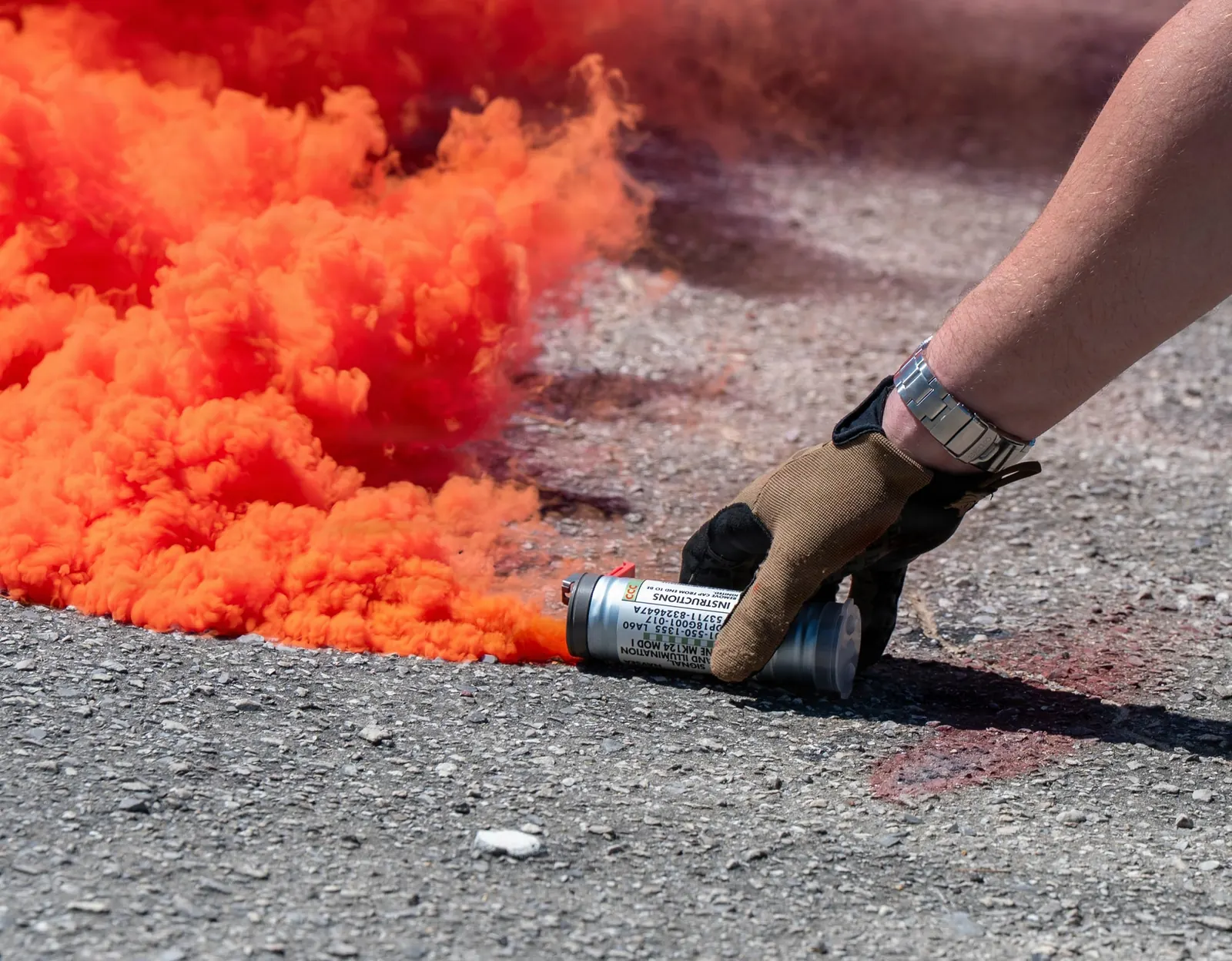
Smoke by day and a visible fire at night are broad attention signals. Wind can displace a smoke plume and make its exact origin difficult to locate; fire and smoke remain visible longer than briefly exposed light. They require fuel, may ignite their surroundings and leave traces. Under enemy threat, they substantially expose the person's location. Prepare a purpose-made pyrotechnic signalling device and use it in accordance with its operating instructions and the valid contact instructions. Do not consume its limited supply while the only possible observer is behind an obstacle or already outside the field of view. Where fire cannot be controlled or prolonged visibility would worsen the situation, an available panel, directed light or whistle for a possible nearby receiver may provide an alternative.
Far and near recognition and authentication
Far recognition allows an initial match before the parties approach closely. A prepared panel by day or an expected light signal may identify the correct location and expected party. Some military procedures use radio or digital messages for this purpose. Near recognition checks the encounter further at the actual contact distance. The usable contact distance depends on visibility and the signalling means: a panel must be legible, while a light or spoken reply must reach the other party.
A concrete military near-recognition example is an IR challenge-and-reply exchange. One party sends the predetermined flash sequence and the other replies with the agreed number of flashes. The isolated person first recognises the expected challenge and then gives the corresponding reply. They neither invent a new sequence nor interpret arbitrary flashes as confirmation. Both parties need compatible viewing equipment and a clear light path. An agreed audible procedure uses the prescribed password or countersign in response to the appropriate challenge. If the expected reply is absent or does not match, the person does not force the approach by walking openly toward unknown armed personnel.
Local recognition may be followed by authentication as the particular person being sought. Authentication uses prepared personal information, for example from an Isolated Personnel Report, or ISOPREP. The other party asks a corresponding authentication question; the person responds under the prepared procedure. The answer is compared with information already held. A name, uniform, panel or correct light colour alone does not perform that personal comparison. The actual procedure governs which information is requested and how repeated attempts are handled. During established contact, a person who does not know an answer or understand a request states that difficulty instead of guessing an apparently suitable reply.
When radio contact or a reply is missing
Without radio, a prepared optical exchange can still work when the parties expect a shared signal and can observe one another. The person keeps the appropriate means ready, watches for the intended contact opportunity and uses the signal in its prescribed context. An unknown aircraft or vehicle does not become the intended friendly party merely through proximity. Where the match is doubtful, the person remains concealed and checks the recognition features and responses actually available.
After an unanswered signal, check the concrete failure points first: was the possible receiver still in view? Did the mirror reflection actually reach the target? Is vegetation obscuring the light or ground shape? Does the selected IR mode require equipment the other party may not have? A receiver may miss or misunderstand the signal, or see it without being able to give an observable reply. Silence is therefore not proof that nobody knows the location. Another prepared means compatible with the actual receiver may replace the unsuccessful attempt. Uncontrolled continuous flashing or calling makes the person visible or audible for longer while leaving the original failure unresolved.
The decision to use conspicuous distress marking comes from the person's own situation. A usable prepared contact and a substantial risk of enemy detection favour a limited, expected exchange. If an injury, cold exposure or another immediate survival threat is rapidly ending the person's ability to act, and the prepared exchange is not established, the person may consciously accept greater visibility or audibility. Select a means that reaches a possible observer and communicates the need: for example V or X during an observable overflight, light for compatible night vision, or a whistle for a nearby searcher. Once the observation path closes or a concrete threat makes further signalling dangerous, end the active signal and reassess from concealment. A ground pattern remains visible afterwards; its continuing location marking must be considered before laying it out.
Use actual contact to prepare pickup
During an available connection, report observed enemy activity, visible obstacles and terrain at the pickup location, the number of people, their actual ability to move and the signalling means still available. Also report failures, such as a damaged light or an exhausted signalling supply, so that the other party does not expect signals from those means. These details determine where the other party needs to look and whether an agreed movement is physically possible.
Until pickup is actually imminent, remain concealed where enemy threat exists. Secure equipment and prepare the requested recognition. For ground contact or a landing, secure weapons, adopt a non-threatening posture and avoid sudden movements. Approach only on the specific instruction. A detected mirror flash, recognised panel or successful authentication alone is not an instruction to run toward a vehicle.
The appearance of U.S. Department of War (DoW) visual information does not imply or constitute DoW endorsement.