

LOS means Line of Sight. In radio communications, the term describes a propagation path in which the direct connection between the transmitting and receiving antennas is significant. Terrain and antenna position strongly affect links involving portable radios.
The sightline and the radio path
A ridge, building or terrain edge can obscure the direct path between antennas. Over longer distances, Earth curvature also matters. Antenna height changes the path's clearance above such obstacles. Atmospheric refraction also affects the path geometry.
Radio waves can diffract around obstacles. Whether the resulting signal components remain sufficient for a link depends on the particular path. This diffraction at an obstacle is distinct from atmospheric refraction.
Why the space around the line matters
Assessing diffraction involves considering the space around the direct path. The first Fresnel ellipsoid, with its foci at the two antennas, is particularly important. Its local cross-section is described by the Fresnel radius; its size depends on wavelength and the distances to both endpoints. An obstacle can intrude into this region while leaving the central sightline clear above it.
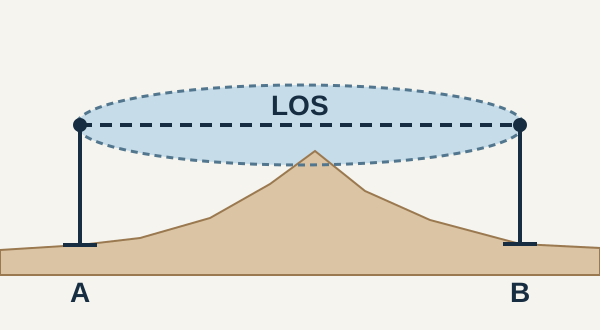
The Fresnel region is used to assess diffraction losses. Radio energy also propagates outside this region.
Reflections and vegetation
Direct and terrain-reflected signal components can combine at the receiver. Because of their different path lengths and phases, the signal components can reinforce or partially cancel one another. Changing antenna position can therefore alter reception. Trees and bushes can introduce additional attenuation.
Relays and links beyond line of sight
A relay receives a signal and passes it onwards, creating additional link segments between the endpoints. In mountainous terrain, ground or airborne relays can enable a connection whose direct path is masked by terrain. Each segment needs suitable radio conditions; an airborne relay also depends on how long its platform remains available.
BLOS means Beyond Line of Sight, and OTH means Over the Horizon. These terms concern links beyond direct line of sight or the radio horizon respectively. A satellite path is one way to achieve this.
The US Combat Survivor Evader Locator, CSEL, distinguishes LOS radio functions, secure two-way OTH data communications and other satellite functions. Receiving navigation signals and having a usable outgoing communications link are different capabilities.