

The US Army maintained three textile Individual Survival Kits for aircrew: Hot Climate, Cold Climate and Overwater. The flight route and expected environment determined the configuration. Hot and Cold Climate used similar outer cases; Overwater required a separate design for its liferaft. The OV-1 Mohawk had a distinct family of rigid seat kits.
A common container with different packing lists
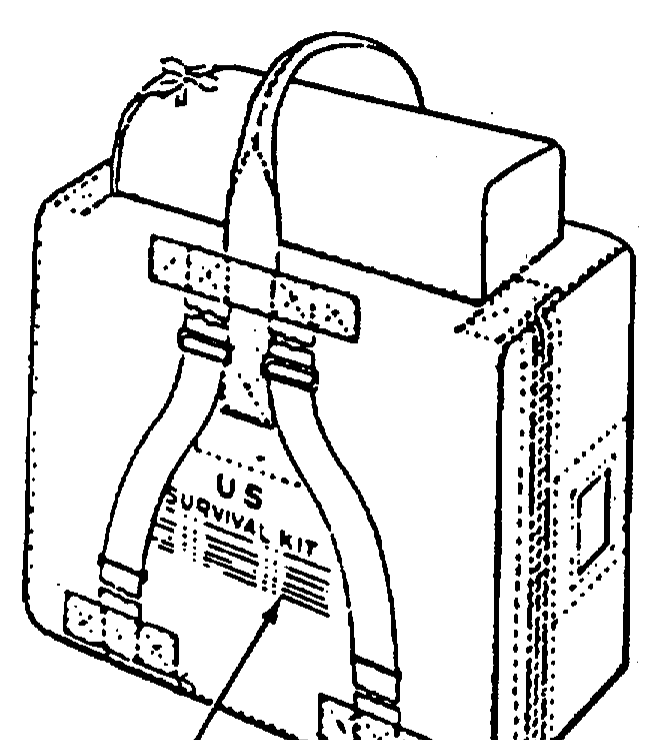
The land versions used a textile outer case with carrying handle, zipper, external pocket and rucksack straps. Two adjustable straps with quick-disconnect hooks attached the kit to a personnel parachute. An inner case organised smaller components, while the packing list specified both contents and stowage position.
Hot Climate and Overwater were each listed at 29 lb, approximately 13.2 kg; Cold Climate at 28 lb, approximately 12.7 kg. The basic ML-4 container measured about 48.3 × 38.1 × 14.0 cm. Cold-weather cases manufactured after July 1985 were two inches deeper to accommodate the new sleeping bag.
The photograph shows the carrying handle, securing straps and markings of a textile Individual Survival Kit. Those external markings had to identify the climate configuration actually packed inside.
Equipment common to all three families
Common contents included an MC-1 compass, signalling mirror, two combined smoke and illumination signals, whistle, first-aid kit, pocket knife, food packets, water bag and survival manual. An insect headnet, multipurpose net, fishing gear, pan, matches, trioxane fuel, sharpening equipment and a small saw were also carried. Later packing standards added items including a magnesium fire starter, Sparklite and a combat-casualty blanket.
The MC-1 was a small mechanical compass. It was stored face down to reduce wear on its pivot and jewel. Maps were not part of the common minimum list. The manual and operating instructions had their own polyethylene bags because the textile outer case itself was not waterproof.
Hot Climate: drinking water, tarpaulin and heavy cutting tool
The Hot Climate Kit, NSN 1680-00-973-1861, added drinking water, a reversible sun hat, sunscreen, tarpaulin, wire and a separate survival tool kit. That tool kit contained a combined axe and machete, sharpening stone and burning lens. Six food packets were specified.
The tarpaulin measured about 3.35 × 2.13 m and had grommets and differently coloured sides. The described grey-and-yellow version combined weather protection with a conspicuous signalling surface; its grey side carried folding instructions for period air-rescue signals. The sun hat likewise had an olive-drab and an orange side.
An older packing list specifies twelve cans of water. A later repair-parts list gives an alternative of 24 drinking-water packets at 125 ml each, totalling three litres. Twelve packets occupied each of the inner and outer packing areas. These records show a change in water packaging rather than a second reserve carried at the same time.
Cold Climate: sleeping bag, poncho and cold-weather tool
The Cold Climate Kit, NSN 1680-00-973-1862, replaced the hot-weather components with a vacuum-packed sleeping bag, poncho, candles and a saw-knife-shovel assembly. Seven food packets were specified; packaged drinking water does not appear in this packing list.
The saw-knife and shovel used the same detachable handle. This saved space but made both tools dependent on one component. The blade was not to be used as an axe in extreme cold because impact could break it.
The sleeping bag in its factory-sealed vacuum package was the largest volume item. If the thin package lost its seal, the bag expanded and no longer fitted its specified packing state. Restoring a serviceable kit required replacement of the package. Cold-weather cases later made two inches deeper addressed this same stowage problem.
The poncho supplemented the sleeping bag as weather protection and a groundsheet. An aluminised blanket provided another cover. Complete winter clothing was not part of the kit's minimum list; protection also depended on the flying clothing already worn by the aircrew.
Overwater: the case and zipper initiated raft inflation
The Overwater Kit, NSN 1680-00-973-1863, had its own outer case. The folded one-person raft and CO₂ cylinder occupied the upper section, with the inner equipment case beneath. A webbing connection about 4.39 m long kept the raft and kit together.
The pull on the outer zipper was mechanically connected to the inflation cable. Opening actuated the gas system, and the expanding raft then opened the case. The Overwater configuration therefore could not simply be repacked into a land-kit case.
The specified rafts were the LRU-17/P or LRU-16/P; the latter had an insulated floor and spray shield. Other maritime equipment included short paddles, a bailer, sponge, repair materials, two fluorescein sea markers, sea anchor and three MK-2 seawater-desalting kits.
Each MK-2 contained eight chemical packs, each rated for 16 US fluid ounces of seawater, approximately 0.47 litres. Three kits therefore provided 24 individual processing units. The Overwater packing list also included three food packets, sun hat and sunscreen, but no sleeping bag or shovel.
Textile kit, survival vest and OV-1 seat kit
The Individual Survival Kits supplemented the survival vest worn on the body. A packed SRU-21/P weighed about 3.4 kg and retained smaller equipment on the aircrew member. A unit could also place a radio and battery in the Hot Climate Kit's outer pocket, but this was not automatically part of the common contents of all three kit families.
The OV-1 Mohawk used a rigid kit in the ejection-seat pan instead of the textile container. The tabulated hot and cold seat configurations each weighed about 15.1 kg; Overwater nearly 20 kg. These variants had their own packing lists and were not simply the same equipment in a different case.
Conversion and identification
Hot and Cold Climate could be converted into one another by exchanging the specified components. The external marking then had to identify the new configuration. Overwater remained structurally separate because of the raft, CO₂ system and inflation mechanism.
Fire starters, blankets, nets and water packaging added over time show that the family continued to evolve. Dating a particular configuration therefore requires its corresponding packing list; an older illustration cannot show every item specified at a later stage.