

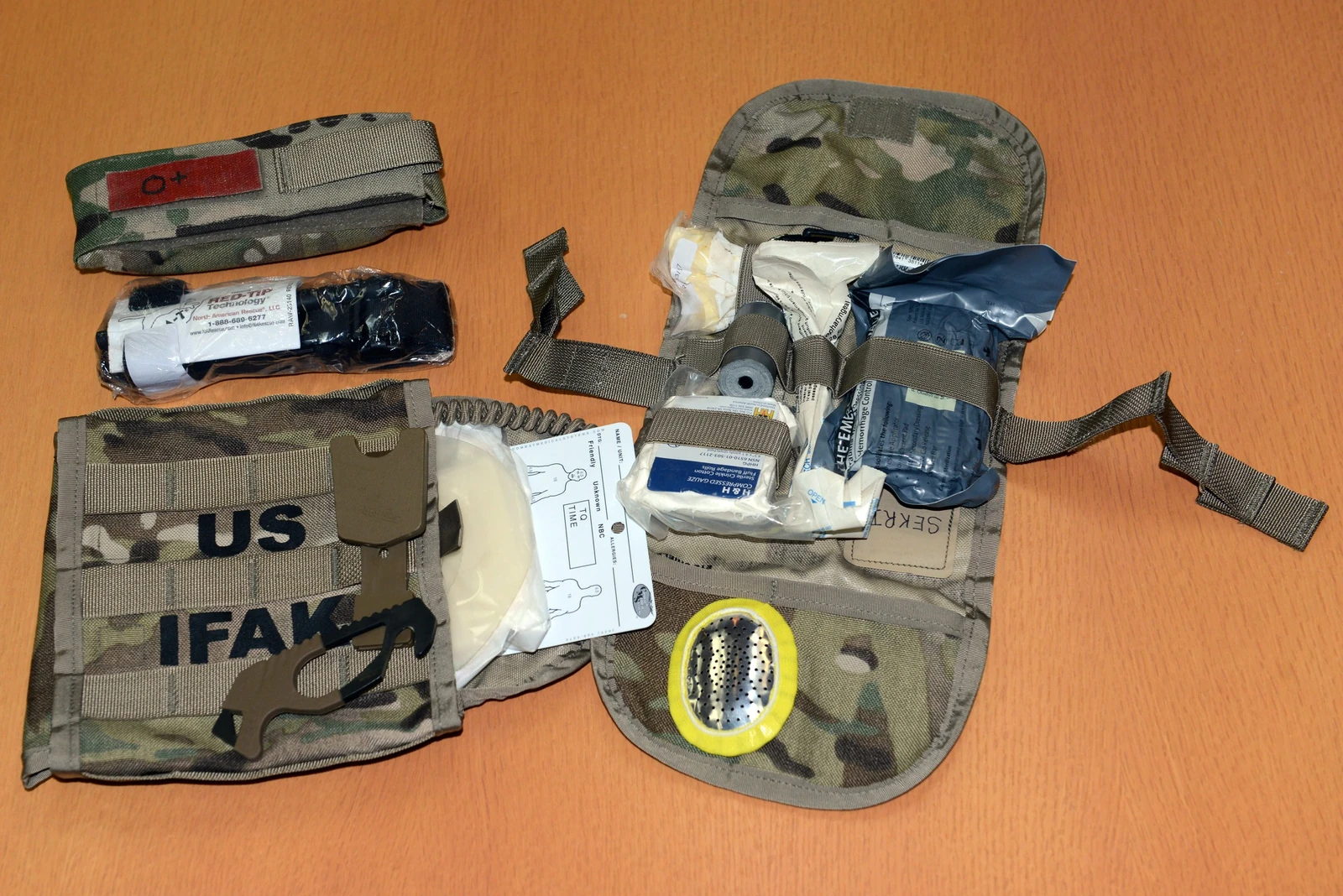
The US Army IFAK II combines a low-profile carrier, an insert that can be withdrawn from either side and two separate tourniquet pouches. Introduced in 2013, the second generation changed access to personal medical equipment as well as its contents. The 2017 configuration carries stock number 6545-01-584-1582 and weighs approximately one pound, or 454 grams. It is designed for use with body armour, a rucksack and inside vehicles; the medical concept is explained in the article on the IFAK.
From an ammunition pouch to a purpose-built carrier
The first generation, fielded in 2005, used an existing MOLLE II pouch for 100 rounds of SAW ammunition. It held a folding insert with a retaining cord. This avoided developing an entirely new carrier, but placed the shape of an ammunition pouch where medical supplies also had to be accessible with an injured arm. The bulky pouch interfered with other equipment and could catch on vehicle latches when Soldiers needed to leave an attacked vehicle rapidly.
The Natick Soldier Systems Center therefore developed a flatter, two-piece arrangement. In 2012, 30 new kits were evaluated during a training rotation at Fort Polk. Their lower profile allowed placement at the small of the back beneath a MOLLE Large or Medium rucksack. From September 2013, the second generation was issued to deploying forces through the Rapid Fielding Initiative. The basic medical supplies remained, with a second tourniquet, chest seal, eye shield, strap cutter and documentation equipment added.
Carrier, pull tabs and a tethered folding insert
The carrier secures the kit to the Soldier's equipment. The insert containing the medical supplies lies folded inside it and is pulled out sideways. Both ends have pull tabs, allowing the same insert to be reached with either hand. Small flaps on the tabs provide additional tactile feedback. A hand reaching behind the back can distinguish the extraction tab from an ordinary equipment strap without first seeing it.
Once withdrawn, the insert remains connected to the carrier by an elastic tether. It can be brought forward and unfolded without immediately becoming a loose package that may slip out of the hand. The tether provides retention while allowing movement needed to reach the packets. If other equipment traps it, the withdrawn insert may still be unable to reach a useful working position.
The unfolded insert organises individual packets on fabric panels. Retaining bands hold items including dressing packets and the adhesive tape roll; refolding returns it to a compact bundle. The 2013 photograph shows the carrier and externally mounted strap cutter on the left, with the withdrawn insert, dressings, casualty card and eye shield on the right.
Two tourniquets outside the main bundle
The IFAK II contains two Combat Application Tourniquets. The second was added because of an increase in bilateral injuries during dismounted operations. Both are held in individually removable pouches that can be attached to the IFAK or other equipment. The tourniquets therefore remain accessible before opening the complete folding insert. The main carrier can remain flat while the tourniquets occupy suitable access positions.
At introduction, one tourniquet could also be carried outside its separate pouch in a trouser or sleeve pocket. This kept one device independent of the body armour. Mounting both tourniquets on the same equipment layer means that both can be lost or made inaccessible with it. The second carriage position therefore belongs in the access check.
The 2017 configuration and its functional groups
The 2017 kit configuration includes an elastic bandage, ordinary gauze, a Combat Gauze hemostatic dressing, two-inch adhesive tape, a nasopharyngeal airway and four examination gloves. The kit also includes a Bolin Chest Seal, a Fox eye shield, the rescue strap cutter and a permanent marker. A casualty card likewise belongs to the second generation; the version identified in 2017 is DD Form 1380 dated June 2014. This is a dated kit configuration with the following functions:
| Functional group | Arrangement in the kit | Access function |
|---|---|---|
| Immediate limb bleeding control | Two tourniquets in separate pouches | An individual device can be reached before unfolding the main kit. |
| Wound dressing and securing | Gauze, Combat Gauze, elastic bandage and adhesive tape in the insert | Wound material and the means to secure it remain separately accessible. |
| Chest and eye protection | One chest seal and one rigid eye shield | The flat adhesive item and the shaped protective component require different packing spaces. |
| Access and handling | Strap cutter, nasopharyngeal airway and gloves | The cutting tool and individual medical items can be removed deliberately without emptying every packet. |
| Record of care | Casualty card and permanent marker | Recognised injuries, interventions and times remain with the person. |
The strap cutter has a blade recessed inside its hook; a protective sheath secures it to the carrier. It can open fabric straps or clothing without bringing an exposed knife point toward the casualty. The rigid eye shield must retain its curved shape so that it does not press on the eye. The chest seal remains in its own packaging until needed, protecting the adhesive surface. The insert should therefore not be overfilled to the point that rigid or flat components are distorted.
Carrier, sterile packets and issued contents
During issue in 2013, some inner compartments were deliberately left free for Combat Gauze issued separately because of its limited shelf life. A new carrier could therefore be fully assembled while the gauze had yet to be supplied. The complete 2017 configuration includes one such packet. Checking the kit requires matching the carrier and insert with the items actually present; a closed outer pouch does not reveal whether its gauze compartment has been filled.
A personal extraction check uses the fabric hardware and separate training supplies. The insert is withdrawn in both directions, brought forward and unfolded. The user then checks that retaining bands engage the individual packets and that the refolded kit fits back into its carrier. An extra packet bulging out of the bundle can impede sideways withdrawal. Loosely inserted items may fall out when it is opened and be difficult to recover in darkness or during movement. Medical packets remain closed during this hardware check.
Check access with body armour and rucksack
Rear placement leaves the front of the body armour free for other equipment, but requires an unobstructed extraction path at both ends. The rucksack, waist belt and other pouches are therefore worn together with the IFAK before each hand separately locates its tab and withdraws the insert. This reveals whether an accessible grip also allows enough movement to remove the bundle. A strap may leave the tab visible while still pressing the folded package against the carrier.
The elastic tether keeps a withdrawn insert attached to the carrier. If the medical package has to be retained when body armour is removed, the tether must be detached and the insert secured at a new carriage position. Otherwise the contents remain tied to the discarded armour even after the insert has been pulled out.
The appearance of U.S. Department of War (DoW) visual information does not imply or constitute DoW endorsement.