

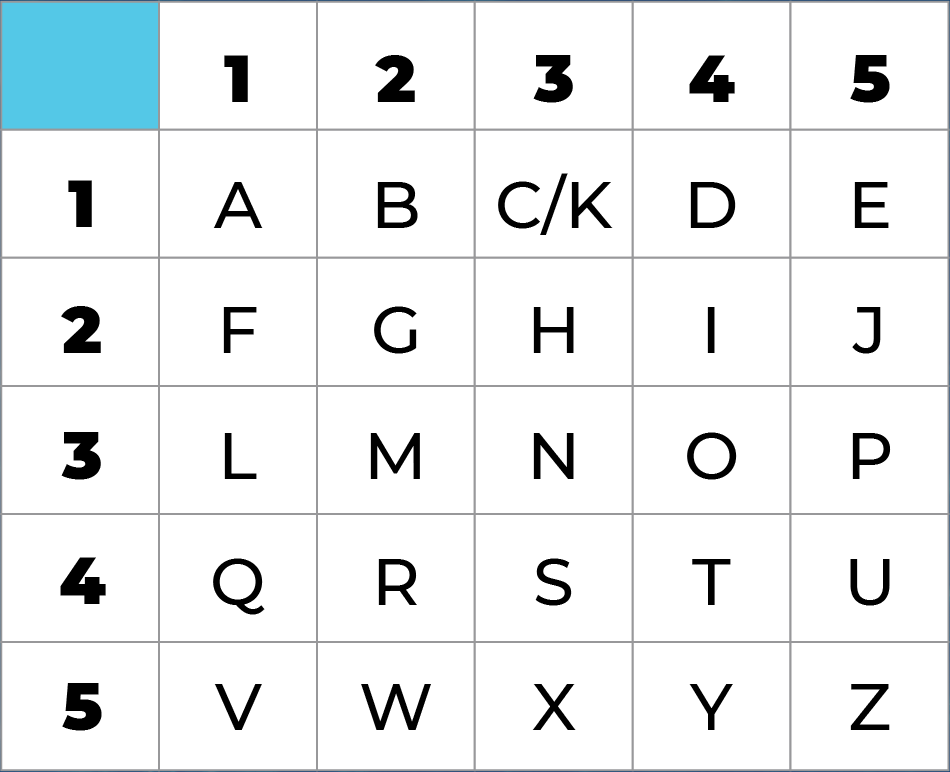
The tap code allows separated prisoners to transmit letters when conversation is impossible. Each letter is represented by two counted groups of taps: its row first, then its column in a five-by-five square. The form explained here combines C and K in one cell and was used by American prisoners of war in North Vietnam.
In captivity, this kind of link can allow messages and instructions to pass between separate cells. It requires neither a voice connection nor a writing instrument. Both participants must, however, know the same letter arrangement and be able to distinguish the individual groups of taps.
The alphabet: five rows, five columns
The letters appear in alphabetical order. K has no separate cell and is transmitted as C, so the third row begins with L. I and J remain separate letters. The first column, A–F–L–Q–V, provides a way to remember the five rows.
| Row / column | 1 | 2 | 3 | 4 | 5 |
|---|---|---|---|---|---|
| 1 | A | B | C / K | D | E |
| 2 | F | G | H | I | J |
| 3 | L | M | N | O | P |
| 4 | Q | R | S | T | U |
| 5 | V | W | X | Y | Z |
C and K have the same tap value: 1/3. The word context determines which letter is intended. Umlauts, the German ß and punctuation are not included in this matrix.
Sending and receiving: always row before column
To send a letter, first find it in the square. Its row number determines the first group of taps. After a short pause, send the second group using its column number. Leave a longer pause before the next letter. This separates the two parts of one letter from two successive letters.
When receiving, first count the taps up to the short pause. This gives the row. The second number takes you across that row to the required letter. Three taps, a short pause and two taps give M: row 3, column 2. Reversing the order would give H in row 2, column 3 instead.
For the word HUT, transmit H = 2/3, U = 4/5 and T = 4/4 in sequence. H therefore consists of two taps, a short pause and three taps. After the longer letter pause, four and five taps give U, followed by four and four for T.
If the two groups for M run together without a perceptible pause, five taps remain, and the pair 3/2 can no longer be recovered from them. Missing a tap or counting an extra one can also produce another valid letter.
Transmission and the difference from Morse code
Historically, prisoners tapped messages through cell walls; pipes can also carry a tapping impulse to a nearby recipient. Whether this works depends on the individual impulses arriving distinctly enough to be counted. The encoding itself is not tied to a wall: the same counted groups can also be conveyed audibly, visually or by touch.
Morse code distinguishes short and long signals. The tap code instead uses the number of impulses in two groups, so there is no need to produce short and long tapping sounds.
Numbers require an additional convention
The letter square contains no digits. One US SERE version therefore supplements it with slow counting for individual digits: 36 is sent as three taps followed by six, while zero is sent as the letter O, or 3/4. This is an additional procedure alongside the letter coordinates.
The recipient needs to recognise when digits are being sent. Otherwise, a sequence of three and four taps could mean either the coordinate pair for O or the digits 34.
Contact in captivity and its limits
American prisoners of war in North Vietnam used the code to pass messages and instructions from cell to cell. Within that prisoner community, familiar abbreviations also developed, allowing longer messages to be shortened. Sender and recipient needed to know the same abbreviations.
Anyone who knows the square and can count the groups can read the letters too. Receiving an intelligible signal also does not establish the sender's identity. Transmission itself adds a risk of detection: an impulse that reaches another prisoner may also be noticed by guards.
The appearance of U.S. Department of War (DoW) visual information does not imply or constitute DoW endorsement.