

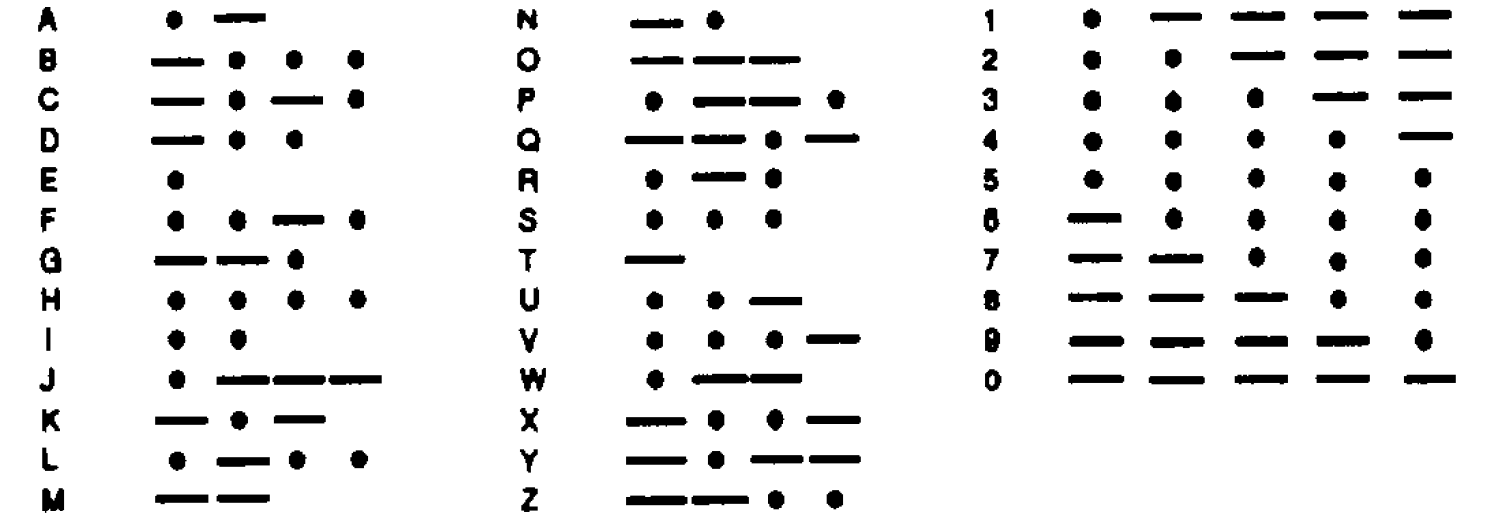
A captive can transmit a short message through the duration of eyelid closures: brief for a Morse dot, longer for a dash. Open eyes provide the gaps. This can reach a visible fellow captive when speech, hands or writing materials are not freely available. A complete message requires more than letters: recognisable boundaries, a change between sending and receiving, and a way to repeat missing or incorrectly read parts.
Recipient, content and a shared set of signs
Direct exchange requires an actual view of the eyelids. The recipient must distinguish closure from reopening; seeing a face alone is insufficient when the eyes are obscured or deeply shadowed. Both people need the Morse patterns and a shared language. Eye movement carries the characters, while language gives them their content.
A short, specific report is prepared, such as the number of sick fellow captives or necessary information about one's own condition. Its complete meaning is settled first, then divided into words and characters. An abbreviation known only within one group saves movements but can remain an unfamiliar string of letters for another prisoner. A short intelligible word is therefore chosen for someone who does not know the abbreviation.
With a known counterpart, the beginning, message ending, response and request for repetition are also agreed. An available head or body movement can provide feedback if both know its meaning. A nod then carries that agreed meaning; an arbitrary visible movement is not automatically an acknowledgement.
Signal state and timing ratio
In the version described here, closed eyes form the mark. Brief closure followed by reopening makes a dot. A dash holds the eyes closed for approximately three times as long. The recipient reads the ordered pattern of short and long marks. Looking sideways is not used to provide additional letters in this method.
| Part | Eyes | Duration |
|---|---|---|
| Dot | closed | 1 unit |
| Dash | closed | 3 units |
| Mark gap | open | 1 unit |
| Letter or digit gap | open | 3 units |
| Word gap | open | 7 units |
These values are ratios. The pace is chosen so that closure, holding and reopening remain visibly distinct. Two rapid closures with barely visible reopening may look like one longer mark. The basic duration remains reasonably consistent within a short message, so that a later dot is not read as an earlier dash.
The character gap lasts three units in total; the word gap lasts seven. After the last mark, the corresponding open-eye gap is held without adding a short gap beforehand. Three short marks separated by short gaps form S, ···. With a character gap between each, the same movements form three E's, · · ·. Their separation changes the content.
Letters and digits for messages of one's own
The tables provide all patterns for A–Z and 0–9. Each entry is one character: its marks are transmitted in the order shown, followed by the character gap. H, ····, and Y, −·−−, for example, both have four marks. Their duration patterns distinguish them.
| Letter | Morse | Letter | Morse |
|---|---|---|---|
| A | ·− | N | −· |
| B | −··· | O | −−− |
| C | −·−· | P | ·−−· |
| D | −·· | Q | −−·− |
| E | · | R | ·−· |
| F | ··−· | S | ··· |
| G | −−· | T | − |
| H | ···· | U | ··− |
| I | ·· | V | ···− |
| J | ·−−− | W | ·−− |
| K | −·− | X | −··− |
| L | ·−·· | Y | −·−− |
| M | −− | Z | −−·· |
| Digit | Morse | Digit | Morse |
|---|---|---|---|
| 0 | −−−−− | 5 | ····· |
| 1 | ·−−−− | 6 | −···· |
| 2 | ··−−− | 7 | −−··· |
| 3 | ···−− | 8 | −−−·· |
| 4 | ····− | 9 | −−−−· |
A message of one's own is converted into these patterns character by character. Where German words are used, the participants may agree to spell umlauts and ß as AE, OE, UE and SS. An Ä then becomes separate A and E characters with a character gap between them. That spelling is part of their shared text convention.
Distinguishing the beginning, message end and reply
A word gap shows that a word has ended, but another word may still follow. Direct exchange therefore also needs a recognisable message ending and an agreed change to the reply. The following Morse control signs can be used in a shared agreement for that purpose. The exchange chosen here is a specific application through eyelid closures.
| Morse group | Agreed function |
|---|---|
−·−·− | Start of a transmission |
·−·−· | End of one message |
−·− | The other person may reply |
···−· | Understood |
··−−·· | Not understood: repeat |
········ | Sender’s error |
···−·− | Exchange finished |
Each control sign is sent as one continuous group. The starting sign −·−·− receives only the short gaps between its five marks. Sending K and A with a character gap instead produces two ordinary letters. Likewise, ·−·−· for the message ending and −·− inviting a reply are two separate control signs with a character gap between them.
With sight actually available, the sender begins with the agreed starting sign. The prepared text follows: marks within a character, character gaps within a word and word gaps between words. The sender closes with the message-end sign and the invitation to reply, then keeps their eyes open to read feedback. If both people close their eyes to send at the same time, they will miss each other's response.
The recipient first reads the pattern of short and long closures up to the character gap, identifies its letter or digit, and joins characters until the word gap. Even after the message ending, they wait until the invitation to reply has been fully read. Readback uses the same complete sequence: starting sign, received text, message ending and invitation to reply. The original sender resumes transmission only after that returned invitation.
A chosen message: 3 SICK
The worked report gives a number and a condition. The digit 3 is one word, SICK the second. Its patterns are:
| Character | Morse group |
|---|---|
| 3 | ···−− |
| S | ··· |
| I | ·· |
| C | −·−· |
| K | −·− |
For 3, three short closures are followed by two long closures, with one short open-eye gap between each. The eyes then remain open for seven units. S starts the next word with three short closures. Three open units separate S, I, C and K. Within each character, the gap remains one unit. After K come the agreed message ending and invitation to reply; the sender opens their eyes to read the response.
The recipient can now send 3 SICK back using the same patterns. This reply also begins with the starting sign and ends with the message ending and invitation to reply. The original sender reads through to that invitation rather than blinking at the same time. If the returned number and word match their text, they send the agreed understood sign followed by the sign ending the exchange.
Interrupted sight and misread characters
A turned face, an obstruction or shadow across the eyes may hide part of a pattern. Losing sight within a character can conceal the transition between closed and open. The recipient may then be unable to determine the mark's duration or how many closures occurred during that interval. Previously read characters remain available; the obscured section is treated as missing information.
Even with continuous sight, incorrectly grouped marks can form a valid different letter. T is a long closure, −. If a short closure follows before the character gap, it becomes N, −·. An ordinary extra blink can therefore enter the message. Distinguishing the intended pattern requires its beginning, a consistent rhythm and the correct ending gap.
With numbers, one misread duration can change the meaning. If the third short mark in ···−− is read as long, the result is ··−−−: 2 instead of 3. An understood response would not reveal the error, because the recipient has read a complete number. Sending 2 SICK back makes the mismatch immediately visible to the original sender in the content.
Repeating and correcting
For missing or unclear reception, the agreed repetition request ··−−·· asks for a new transmission. In this exchange, it is followed by the invitation to reply −·−: the short negative response has ended, and the original sender may resume. An agreed body response likewise needs a recognisable ending. The original sender's eyes remain open during that response.
If 2 SICK is read back in the example, the original sender waits for the returned invitation to reply and rejects the mismatched content. They begin with the agreed starting sign and transmit 3 SICK again in full, followed by the message ending and invitation to reply. The new number thus belongs to the newly started complete report. An unexplained appended CK could instead be the remainder of an earlier word or part of a new pattern. The recipient now reads the corrected message back and again returns the invitation to reply. Only after the original sender has actually read 3 SICK do they acknowledge the matching content with understood and end the exchange.
If the sender notices an incorrect mark themselves, they first hold the three-unit open-eye character gap to end the preceding group. In the agreed exchange, eight short marks follow as the error sign, then another character gap and the new starting sign. The interrupted short message is sent again in full. The recipient discards the incomplete version and reads from the new beginning. Eight ordinary irregular blinks do not perform this function: the error sign also requires its recognisable continuous pattern.
If no reply appears, the sender initially observes whether the counterpart still has sight and an opportunity to answer. An averted face or interrupted encounter explains the absence differently from an explicitly read repetition request. Only a response actually received provides the agreed information about reception.
A camera is a one-way channel
During a forced television interview in North Vietnamese captivity, the American naval aviator Jeremiah Denton blinked TORTURE. While speaking, he repeated the word with his eyes. US Naval Intelligence later examined the recording. The visible report of abuse could thus be read independently of the spoken interview.
In front of a camera, later examination is invisible to the sender. An invitation to reply cannot connect a future viewer to an actual response. Repeating a complete short word instead provides several visible occurrences of the same content. If movement hides one pattern or editing cuts it short, another may remain complete. A viewer identifies characters from the closure and reopening sequences actually present; knowledge of the alphabet alone cannot reconstruct missing footage.
When a counted channel fits better
If movements of the same kind can be counted but their short and long durations cannot be distinguished, another coding principle fits better. The five-by-five tap code carries a counted row group and a counted column group. Visible movements can carry these too, provided both people know the matrix and the separation of the groups. Merely counting the marks of a Morse pattern does not convert it into that code.
The closures also remain visible movements to a guard. Someone who knows Morse and recognises the grouping can read the same letters and numbers. Long regular sequences also increase the time during which that structure can be observed. Choosing a short necessary message limits this visible exchange; the public character code does not encrypt its content.