

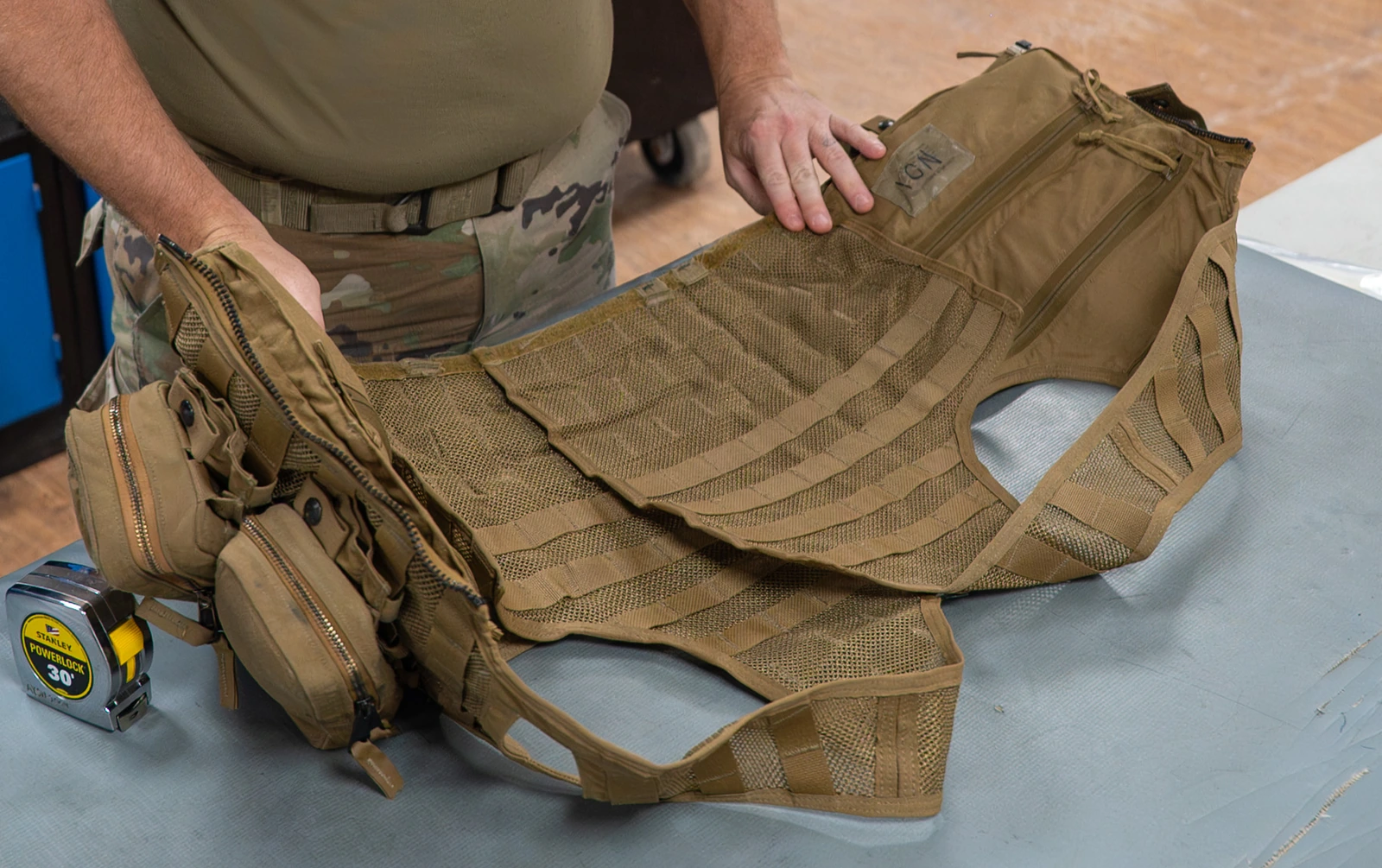
AIRSAVE Type I combines aircrew survival equipment carried close to the body with an extraction harness and interfaces for ballistic protection, flotation and an underwater egress device. The 1999 US Army configuration described here is intended for helicopters and fixed-wing aircraft without ejection seats. Armour, a flotation collar, breathing device and different pockets are added for the mission. The photograph shows a later AIRSAVE vest inspected by the US Air Force in 2025. It illustrates the mesh carrier, webbing and modular pockets but is not identified as the 1999 Type I configuration.
Type I identifies the version with an extraction harness
The system designation A/P22P-18(V) stands for Aircrew Integrated Recovery Survival Armor Vest and Equipment. The Type I vest, CMU-33A/P22P-18(V), is listed under stock number 8415-01-442-1991. The 1996 design already distinguished Type I with a Hoisting Harness and Type II without it. The harness is therefore a characteristic of the particular version. A similarly loaded pocket vest gains that capability only through the designated harness and its attachment points.
In the Army configuration of 1999, AIRSAVE was intended to replace earlier survival vests while accommodating different aircraft and crew roles. The vest can be worn alone, with soft armour, with the matching soft and .30-calibre hard armour, or in a separate .50-calibre configuration. The flotation collar, emergency breathing device and Safety Restraint Tether are additional components. AIRSAVE consequently does not identify an invariably identical complete load.
| Component | Specific task and interface |
|---|---|
| Type I vest with modular pockets | Carry survival equipment and attach it to designated webbing rows |
| Removable Hoisting Harness | Retain the body through dedicated straps and attachment points for extraction or restraint |
| PRU-60A/P22P-15 Soft Armor | Carry ballistic aramid inserts in front and rear casings |
| PRU-61A/P22P-15 Hard Armor | Connect front and rear ceramic-composite plates to the soft-armour system |
| LPU-34/P Low Profile Flotation Collar | Carry two independent flotation cells outside the vest |
| SRU-36/P HEED | Provide limited compressed air for trained egress from a submerged aircraft |
| Safety Restraint Tether | Provide a separate backup connection for particular emergency external extractions |
Mesh carrier, fixed inner pockets and detachable external pockets
The original olive-green carrier uses raschel-knit nylon mesh with a fire-resistant chemical finish. The mesh also forms the inner pockets. External pockets and inner-pocket flaps instead use aramid Oxford cloth. Stiffeners are designated for radio, breathing-device and pistol pockets. These shaped equipment carriers therefore differ from general stowage pockets. The base fabric itself is not a ballistic protective insert.
The vest has four sewn-in inner pockets. Overlapping panels under both arms and at the back lace together to adjust the common basic pattern to the wearer. The removable harness lies inside and is guided by its own retainers. Horizontal webbing rows run outside. A strap behind a modular pocket interweaves through its attachment and the vest's webbing loops before being secured by snap fasteners. This permits changes to pocket layout while the attachment engages several interlocking sections.
The contemporary Army basic issue included five General Pockets, one Radio Pocket and one Knife Pocket. Pistol and HEED/HABD pockets were additional requisitioned options. SRU-36/P HEED and SRU-40/P HABD have separately designated pockets. Inside stowage provides places for water bags and the general and medical kits. These inner pockets are difficult to reach after flight equipment has been donned; immediately required egress and signalling items therefore belong in appropriately accessible locations. The general carriage and access question is explained in the survival vest entry.
Illustrated pocket positions are examples; the actual load is matched to crew station and aircraft. CBR equipment also has a designated carriage position: the Army helicopter arrangement places the NBC unit on the vest's upper left shoulder. In the Apache configuration, it is instead strapped to either arm.
Protective modules go beneath the pocket vest
PRU-60A soft armour has front and rear casings containing multi-layer ballistic aramid inserts. The inserts have water-repellent nylon covers. Shoulder hook-and-loop fasteners and adjustable side straps connect the casings. The contemporary design addresses fragments from 37 mm HEI rounds. The casing and the ballistic insert remain separate components with different care requirements.
For local cleaning, remove the ballistic inserts from the textile casings and wipe their nylon covers with a damp cloth. Do not soak the inserts or expose them to bleach, starch or high heat. High heat can shrink components, while prolonged UV exposure can damage aramid. Fuel or grease in the casing also remains combustible even though the aramid cloth itself burns at higher temperatures. A dirty casing and a dirty ballistic insert consequently need different treatment.
PRU-61A adds front and rear plates made from ballistic ceramic-composite material. The design addresses the .30-calibre threat, specifically 7.62 × 63 mm AP. These plates are worn with soft armour. The front plate sits in the lower receiving pouch of the front soft-armour casing and is additionally retained by hook-and-loop fastening. The rear plate has its own encasement; retaining and support straps connect it to the vest's Loop-Loc interfaces. Medium and Large versions have their own carriers and inserts.
The separate Army .50-calibre hard armour is worn without soft armour in this system configuration and is therefore a different combination from PRU-60A with PRU-61A. Additional layers beneath the plates alter fit and quick-release access. AIRSAVE can also be worn without armour, but an empty armour interface gives the mesh carrier no corresponding ballistic protection.
The front zipper has plastic teeth and a metal slider and opens from top or bottom. Its arrangement accommodates access for discarding hard armour. The .30- and .50-calibre combinations have different designated zipper positions so that lower access to the front plate remains available. The rear plate attachment has its own beaded pull handle that releases its quick-disconnect connections together. The front plate then has a separate handle. Similar conspicuous inflation handles on the flotation collar operate another system.
The harness carries the body load
The Type I harness uses nylon webbing approximately 44 mm wide and chest and leg loops with friction adapters. The snaplink, lift strap and front or shoulder attachment points form part of the extraction path. The vest holds the harness in its guides; ordinary pocket webbing does not carry that load to the body. Equipment-pocket attachment and a connection for lifting a person are therefore different structures within the same carrier.
The harness supports a prepared rescue-hoist recovery. For overland missions, a restraint function as a Gunner's Belt is also designated. The adjustable chest, waist and leg arrangement has to fit with the other equipment; loose leg or rear tether ends are stowed so that they do not snag during egress. A shifted or damaged pocket following separation initially affects the items it carries. Damage to load-bearing harness webbing instead affects the person's extraction and restraint capability.
LPU-34/P adds two independent flotation cells
The Low Profile Flotation Collar is intended for constant wear with compatible flight clothing and equipment in aircraft without ejection seats; its flotation function supports the person at the water surface. It comprises an exterior cover, inflation shell and two independent inflatable cells. Four straps attach it to the survival vest; an additional chest buckle retains the collar in position. In the contemporary Army configuration, LPU-34/P was tested and authorised only with AIRSAVE. Similar attachment opportunities did not automatically make SARVIP or another available vest the same authorised combination.
Each cell has its own manual inflation device and oral valve. The beaded handles act through their connections to separate the outer zipper and activate the CO₂ inflation device. As the cells inflate, the cover continues to separate so that they can expand and provide head-out-of-water buoyancy. Oral valves permit topping up or alternative inflation of a cell. The cells are not a breathing-air reservoir; their CO₂ serves the flotation function.
The collar is listed at 3 lb 14 oz, approximately 1.76 kg. Its nominal buoyancy of 65 lb corresponds to approximately 289 N; the pound figure describes buoyant force rather than a body-weight limit. Two independent cells retain a reserve if one side is damaged.
HEED supplies breathing air through a demand regulator
The SRU-36/P Helicopter Emergency Egress Device consists of a high-pressure aluminium cylinder and a breathing regulator with a mouthpiece. The listed air quantity is 1.8 cubic feet, approximately 51 litres of air; cylinder charge pressure is 1,800 psi, approximately 124 bar. That air-quantity figure is not the small cylinder's external volume. The device contains compressed air, whereas the collar's flotation cells inflate with CO₂.
Inhalation produces negative pressure in the regulator's demand chamber. A diaphragm moves the valve lever, opens the valve and lets cylinder air flow towards the mouthpiece. When inhalation ends, the diaphragm and valve return and airflow stops. Exhaled air leaves through the regulator's exhaust ports. A flexible exhaust disc then closes against water entry.
The SRU-36/P was designed to provide seven to ten breaths at approximately 6.1 m water depth and 13 °C water temperature. HEED forms part of trained underwater egress. Initial and annual refresher training were specified for SRU-36/P. Its pocket, retention lanyard with quick-disconnect capability and accessible regulator have to work with the rest of the worn assembly.
The load combines function, retention and a carriage limit
The generic Army load of 1999 includes a radio with battery, distress-marker light with battery and flashguard, signalling mirror, whistle and signalling kit. Other items include a pocket knife, compass, thermal blanket, insect repellent and sunscreen, water-storage bag, aircrew survival/first-aid kit and contemporary named medical equipment including a non-pneumatic tourniquet. Two different fire starters are specified. The water bag's three-US-pint size corresponds to approximately 1.42 litres of capacity.
Additional personal items were limited to a total of 5 lb, approximately 2.3 kg, and secured to pockets with nylon cord at least 30 in, approximately 76 cm, long. Balanced distribution and unobstructed control movements form part of the load arrangement. The cord retains an item with its carrier after removal; the interwoven pocket attachment instead retains the pocket on the vest. One connection can remain intact while the other has failed.
The Type I basic configuration with harness has a listed weight of 5.2 lb, approximately 2.36 kg. The flotation collar, armour configuration and specific additional load change the worn assembly.
The additional SRT belongs to a particular extraction method
The Safety Restraint Tether is a separate nylon loop approximately 1.22 m long, with six bar tacks. It is carried in a General Pocket. The 1999 configuration provided it as backup retention during an emergency external extraction on AH-1F, AH-64A and OH-58D(I), when interior space is insufficient and no other pickup aircraft is available. The connection runs from a designated aircraft attachment point to the person's extraction harness. This performs a different function from rescue-hoist recovery or retaining individual survival items.
This extraction method depends on a suitable aircraft, designated attachment points and actual crew coordination. The SRT's structural condition is assessed through the nylon webbing and six bar tacks: wear, melted areas, cuts, fuel or oil saturation and loose or missing bar tacks preclude the designated use. Extra retaining cords tied to an ordinary pocket do not restore that load path.
The appearance of U.S. Department of War (DoW) visual information does not imply or constitute DoW endorsement.