

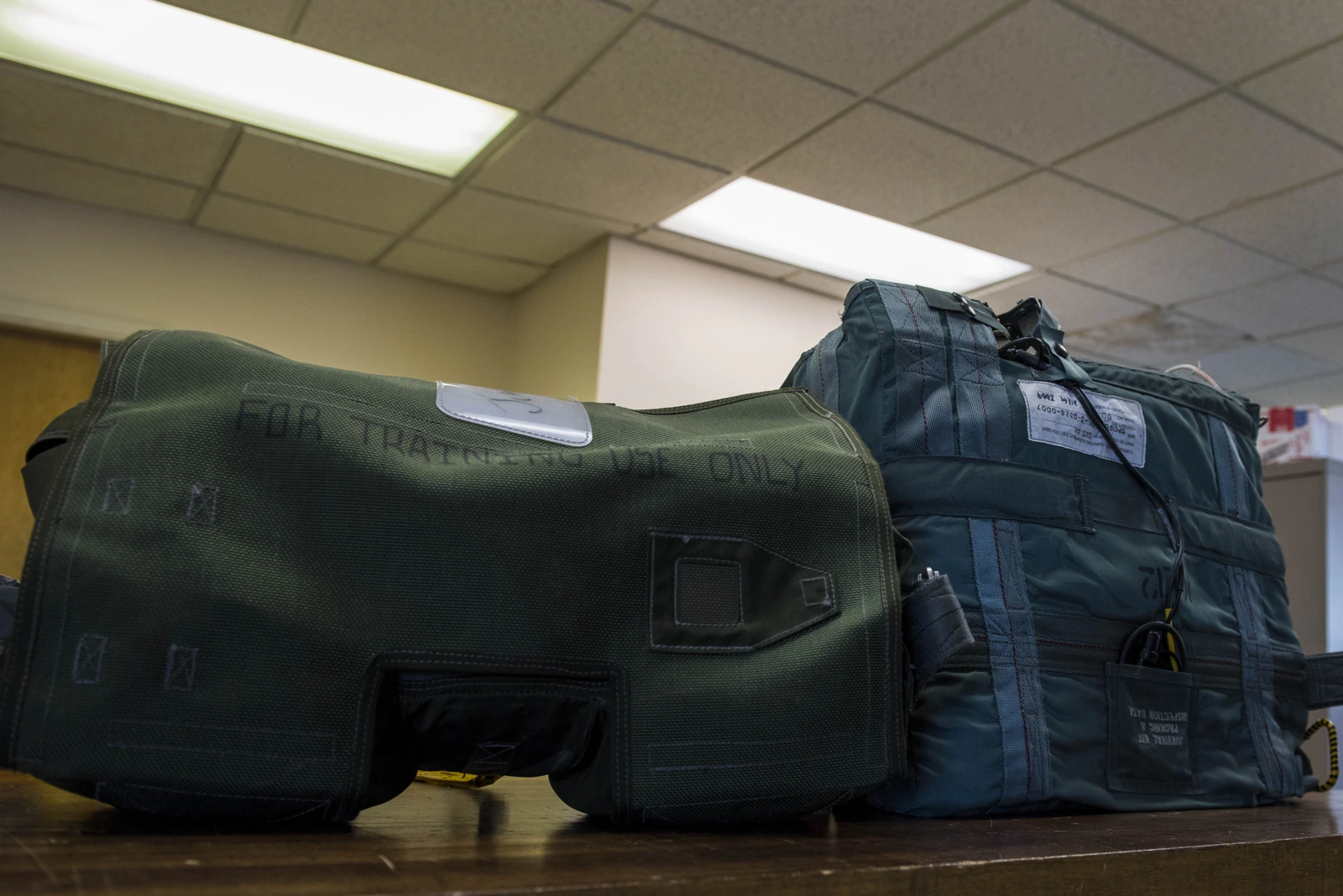
Arctic survival equipment for fighter pilots has to cover two very different conditions: the tightly constrained space inside an aircraft and unprotected exposure after escape. Flying clothing and the survival vest worn on the body are supplemented by a seat kit whose larger protective items are deployed outside the cockpit. In January 2024, Canada, Norway, Sweden, Finland and New Zealand tested this combination at Resolute Bay. The ICE-PPR trial considered existing Aviation Life Support Equipment kits, cold-weather clothing and the work performed with them in the field together.
Vest, seat kit and clothing perform separate tasks
The equipment examined in the trial comprised the Life Preserver and Survival Vest, or LPSV, worn by the pilot and a seat pack beneath the pilot's seat. In aircraft such as the F-18, F-35 and JAS 39, smaller survival items and flotation remained on the vest, while the sleeping bag, snow shovel and other bulky cold-weather equipment occupied the restricted seat-pack space.
A concrete Canadian example was the CF-18 equipment described in 2021. This included climate-appropriate flying clothing and boots, together with an immersion suit. The emergency pack contained a locator radio rated for extreme cold, signaling equipment and additional cold-weather items: hat, face cover, mittens, sleeping bag, snow shovel and fire-starting tools. The description assumed an uninjured pilot for full access; injuries could already make opening and donning the equipment more difficult.
The immersion suit limits water entry after immersion and the accelerated heat loss that follows. The sleeping bag and additional hand or head coverings instead serve the longer protection task after escape. Flying clothing must remain wearable in the cockpit and during escape; bulkier cold protection is added afterwards. A person who loses or cannot reach the seat kit initially retains only the equipment actually worn and its accessible pockets.
Hand protection and equipment handling
Polar research had already identified dexterity as a separate design issue in 2018. Small switches, zippers, buttons and tools have to be operated although mittens obstruct fine movements. Removing the mittens allows the fingers to cool further. Injury during bailout, ditching or a crash landing may also disable an arm or the preferred hand. A kit that can only be opened and donned with two bare, fully functional hands therefore depends on abilities that may be impaired after escape.
Testing therefore covers more than insulation. Zippers and packages have to open while gloves are worn, and additional garments must fit over flying clothing. Trials also record how long the hands remain exposed and whether enough strength and dexterity remain for further work.
Heat and water preparation also draw on that hand function. Among the equipment problems examined in 2018, small metal stove components and transferring liquid fuel were particularly troublesome: the work often required bare fingers while cold metal, air and spilled fuel exposed the unprotected skin. Outdoors, an underpowered stove can also heat water very slowly. Melting snow uses fuel and time, while handling the stove can also cost body heat. Stove, vessel and hand protection form a working combination whose components cannot be assessed independently.
The F-35A at Eielson: insulation in a restricted seat kit
A separate US development illustrates how the packing problem becomes a technical constraint. In preparation for the F-35A at Eielson, Alaska, the 354th Fighter Wing worked on an Arctic seat kit in 2019. The F-35A container was smaller and differently shaped than the ACES II equipment used for comparison there. Items had to occupy the spaces available in the prescribed packing arrangement; simply stacking them vertically or horizontally was insufficient. The restricted envelope had to hold both an insulating item and the remaining survival components.
In April 2019, a lighter sleeping bag could initially be fitted alongside the other components. Its cold protection was insufficient. Better-insulated sleeping bags either did not fit the container or failed to recover their original shape after heavy compression.
Eielson's procurement decision signed in March 2020 called for components of an Emergency Survival Shelter Sleep System, or ESSSS. The full system family comprises poncho, trousers, boots, mittens and balaclava. The F-35 seat-kit requirement expressly requested only the poncho and trousers components, in a total of 80 sets. These two components supplemented clothing already worn; the five-piece family description is therefore not a contents list for that F-35 pack.
Compression trials drove the selection. Tested sleeping bags either could not fit alongside the remaining equipment or failed to recover their intended shape after heavy compression. The selected synthetically insulated poncho-and-trousers system could instead be vacuum-packed into an aircraft-specific shape and was intended to recover its form on opening. Additional wearable insulation thus replaced a bulky sleeping bag. The stowage envelope remained a fixed interface while the form of thermal protection changed.
Poncho and trousers supplemented the flying clothing already worn, rather than enclosing the pilot only during a halt as a sleeping bag would. Selection therefore considered both recovery after vacuum packaging and donning over flying clothing.
Chamber and field expose different bottlenecks
During a US chamber test on 5 November 2019, four members of the development team entered two cold chambers. They initially wore standard cold-weather clothing issued to pilots. Observers measured the time required to don the additional equipment from the kit; the participants then remained in the chambers for six hours. Their condition was checked every 30 minutes. This sequence made the transition from flying clothing to additional protection a measured part of the trial.
The Canadian trial series added exposure and work in actual Arctic conditions. CF-188 equipment testing in 2019 identified steel-toed boots, insufficiently insulating gloves and difficult hook-and-loop or zipper closures as separate weaknesses. Pack and worn clothing therefore had to be tested together.
In the 2024 ICE-PPR field trial, pilots used their ALSE equipment to construct temporary shelters, stay warm and address basic survival needs. The research team tracked core temperature and temperatures at fingers and toes; surveys supplemented the measurements with experience of using the equipment. Even while the torso remained adequately protected, a pilot's hands could already be losing the ability to operate equipment.
An international comparison of existing equipment
ICE-PPR combines polar research on environment, human performance, platforms and situational awareness. In the 2024 trial, the five participating countries examined gaps in existing survival kits and cold-weather clothing. They compared their respective combinations of equipment and training. The comparison therefore covered both protective items and establishing shelters and sustainment with the particular kit available. In 2025, the comparative results of the 2024 trial remained unpublished.
The appearance of U.S. Department of War (DoW) visual information does not imply or constitute DoW endorsement.