

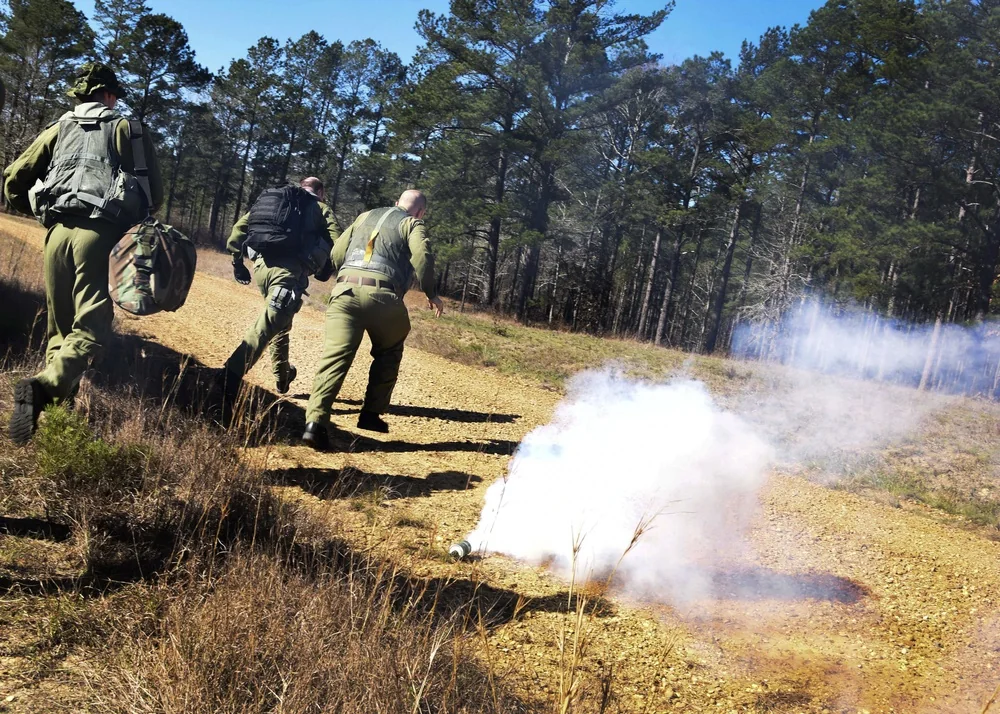
Canadian SERE training primarily prepares vulnerable aircrew to survive with their remaining equipment after a crash or emergency aircraft exit, avoid capture and resist exploitation by an adversary. Arctic survival, land survival and sea survival have distinct training tasks. Conduct After Capture addresses the situation in which the person is already under another party's control.
Aircrew training and the national risk profile
The Canadian Forces School of Survival and Aeromedical Training, CFSSAT, trains aircrew and selected Canadian Armed Forces personnel. Within Air Operations Survival, Air Ops Survival Land, AOS-L, Air Ops Survival–Survival Evasion Resistance Escape, AOS-SERE, and Air Ops Survival–Arctic Aircrew, AOS-AA, cover different tasks. Aircrew Sea Survival at the Canadian Forces School of Search and Rescue, CFSSAR, provides a separate element. A person lying in snow after an emergency exit must be able to use their cold-weather equipment; a person landing in adversary-controlled territory must also prevent the search for water or shelter from leading to capture.
The aircrew risk comes from sudden separation from the aircraft, support and possibly other crew members. The emergency may begin with injuries, lost equipment and an adversary searching the area. Canadian captivity preparation also considers the potential value of a captive to the adversary: knowledge of the mission, capabilities and other forces can be exploited after detention. An intact crew cannot be assumed, nor can an uninjured pilot or a functioning radio.
| Designation | Starting situation | Personal task |
|---|---|---|
| AOS-L | Isolation on land | Establish shelter and sustainment using personal equipment and usable local material. |
| AOS-SERE | Isolation with a risk of capture and exploitation | Combine survival and evasion under threat; prepare for being under another party's control. |
| AOS-AA / Arctic Aircrew Survival | Emergency in Arctic cold | Use the aircraft or seat pack that is actually available, limit heat loss and prepare signals. |
| Aircrew Sea Survival | Ejection or crash into water | Manage one's own survival situation in the water. |
| Conduct After Capture | Captivity or detention | Survive, manage stress and limit exploitation by the adversary. |
Surviving while an adversary searches
An earlier Canadian field model was called Advanced Survival, Evasion, Resistance and Escape, ASERE. It combined evasion of an opposing training force with movement over uneven ground, carried equipment and lack of food. Simulated capture, transfer and Tactical Questioning, meaning questioning in the immediate tactical context, formed part of the training. The participant must therefore remain able to move and evade a search despite physical strain. After capture, they must deal with external control and pressure to provide information.
During evasion, the route also depends on where the person can obtain supplies. Someone who spends their remaining strength on a long detour may then be unable to establish shelter or continue. Someone focused entirely on hunger may neglect to observe the terrain. Personal assessment therefore begins with the body's condition, remaining material and the threat: what distance is still manageable, where is a sheltered halt possible, and what sustainment can actually be reached along that route? A merely suspected water source does not justify movement whose distance or adversary situation the person cannot assess.
Canadian survival preparation addresses the relationship between cold, fatigue, sleep and declining attention. Cold can impair hand dexterity; interrupted sleep increases exhaustion, which in turn makes establishing shelter and sustainment harder. In practice, this means simplifying tasks before performance declines further: secure remaining material, establish the protection immediately required and reassess before starting more demanding movement. Several isolated people can distribute equipment, water and work. An injured person changes the manageable distance and need for protection. If they cannot walk, the group must assess whether it can move them with the means available or should remain at a sheltered location for the time being.
A fire can provide warmth and be used to prepare food, but its light and smoke may reveal the location. A Ranger wilderness course in which a person maintains a fire therefore addresses a different task from evasion during an adversary search. Under threat, the person must first assess whether clothing and other protection are sufficient for the necessary halt and whether a fire would increase the likelihood of detection.
Arctic aircrew survival with limited emergency equipment
The Arctic Aircrew Survival Course addresses an aircrew emergency in which people must establish their own shelter after an aviation accident in extreme cold. Practical aircrew courses include snow shelters such as snow caves and igloos, using the equipment carried in one's own aircraft and signalling with flares and local material. The equipment available depends on the platform. A small ejection-seat pack offers different possibilities from the equipment carried in a larger aircraft.
A Canadian CF-18 emergency equipment model illustrates the person's initial tasks. Alongside flying clothing, boots and an immersion suit for protection on entering the water, the described seat pack includes a hat, face cover, mitts, sleeping bag, snow shovel and fire-starting tools, as well as an emergency radio and flares. After leaving the aircraft, the person must first establish which of these items they can reach and use. Injuries or lost material may prevent access. Available head, face and hand protection is put on before cold hands make even simple fastenings and devices difficult to operate. The sleeping bag and clothing provide thermal protection, while the shovel allows snow to be worked to establish shelter.
While building shelter, the person must keep their clothing dry and ensure it continues to keep them warm. Snow on clothing can melt and reduce its insulation; excessive work and too many closed clothing layers can cause sweating. More body heat is then lost during subsequent inactivity. Arctic training therefore also covers adjusting work rate and layers during activity and keeping snow off clothing. With limited material, completing a simple shelter early may be more useful than exhausting oneself and soaking clothing while attempting a more elaborate structure.
Signalling remains a separate task alongside protection. Flares can show the location to a searcher who is actually present. Marks made from snow, rocks or other local material need a recognisable contrast with their surroundings and must be visible from the searcher's viewing direction. Concealed marks or those covered by new snow lose that function. An emergency radio is useful for contact only if it is still available, operates and reaches a suitable counterpart. If contact fails, protection and personal sustainment must continue.
What the Ranger field phase contributes
Enhanced Wilderness Survival Training, EWST, shows how Canadian soldiers practise sustaining themselves alone in the wilderness. In a coastal course for Army soldiers, Canadian Rangers first taught shelter, fire, tool use, food and water skills. Participants then spent three nights individually at remote locations. They had their clothing and limited equipment, including an axe and sharpening stone; a radio and satellite phone were part of the training arrangements. In the field, they had to establish shelter, build a fire and secure a water source themselves.
The field phase requires participants to continue essential work as their strength declines. It showed how hunger, interrupted sleep and exhaustion can narrow attention to merely keeping a fire going while other necessary tasks are neglected. The person therefore needs to specify their next action, such as improving shelter or providing water, instead of remaining absorbed in the existing fire. Daily visits by a Ranger and medic were part of course supervision. EWST develops independent environmental skills; an adversary search and captivity are tasks addressed by SERE and CAC preparation.
Conduct After Capture: personal action under external control
Conduct After Capture, CAC, is called Conduite après la Capture in Canadian French. It covers survival in captivity and resistance to exploitation. The Canadian framework distinguishes prisoner-of-war captivity, detention by a foreign government and hostage-taking. Control of a hostage can, for example, be used to put pressure on others; military questioning may seek usable knowledge. The person therefore needs to recognise what is being demanded and who would benefit from the requested action. Even a short detention can end free access to equipment, movement and communication.
Canada's CAC concept includes general preparation, mission-specific preparation and enhanced preparation for a high risk of capture or exploitation. The latter group is also defined by whether capture could give the adversary significant advantages or compromise friendly interests. Physical toughness is therefore only one consideration. An aircrew member may possess mission knowledge valuable to the adversary without holding a senior command position. Protecting information here means avoiding additions about the mission and forces merely to satisfy a personal need to explain oneself or gain recognition. Even a casual description of routines can contain tactical information.
Canadian captivity preparation begins with recognising one's own stress reactions. Coping skills are then developed and rehearsed before being applied in simulated captivity. They include controlled breathing, deliberately relaxing tense muscles and managing internal self-talk. Their practical purpose is to interrupt an impulsive reaction and free attention for the immediate task. Repeatedly rehearsing personal failure in one's mind ties attention to the past situation. Focusing instead on a manageable next task helps the person act deliberately again, for example by checking their clothing or using an available opportunity to rest.
Mental activity is another skill: mentally work through a familiar task, recall memories in an ordered way or develop a personal project in one's thoughts. Faith and prayer can serve this purpose for people who draw on them. These activities require no material and can occupy periods in which movement and contact are restricted. During questioning, however, attention stays on what is actually being asked or demanded; mental withdrawal must not replace awareness of the immediate situation. The aim is to manage one's own condition while others control time, space and contacts.
At the Conduct After Capture Training Centre, CAC instructors perform different roles in exercises. For a captive, questioning, transfer and longer detention bring different demands: transfer changes the surroundings, questioning places pressure on statements, and longer detention restricts rest, movement and self-directed activity. An earlier Canadian CAC model combined gradually increasing demands with recovery periods. Participants applied rehearsed coping skills in simulated captivity.
Position, contact and actual pickup
In the described CF-18 model, the aircraft's position during ejection can be passed through the datalink. Only suitable, authorised recipients can use this information directly. It also represents the ejection location, whereas the pilot may subsequently be lying elsewhere or moving. Dropping a Survival Kit Air-Droppable, SKAD, requires precise coordinates for the affected person or visual contact. Weather, an available aircraft and its range limit this resupply; dropping material is not yet a pickup.
On a NATO operation, the common Personnel Recovery framework supplements these national survival skills. Prepared information about expected personal movement, the Evasion Plan of Action, EPA, helps available recovery forces search for the person. The Isolated Personnel Report, ISOPREP, provides information for identification and authentication: checking whether the person reached is actually the one sought. For the isolated person, this means being able to perform the specified contact and recognition procedures with the equipment actually carried. If the radio is missing, prepared non-electronic contact options and personal movement according to the available plan become more significant.
If a suitable connection is established, the person's current position, physical condition and restrictions relevant to pickup are needed. A necessary change of location also changes the search approach; the position must be updated while contact exists. Prepared far and near recognition signals help the counterpart locate the person or recognise them by comparing the agreed signal. Authentication serves a different purpose: it checks identity. The specified personal answers or recognition information are used only to the extent requested, instead of disclosing all prepared information without being asked. Overt signals can also reach an adversary; their timing and type therefore follow the prepared procedure and actual situation.
Physical pickup begins only when the parties actually meet. In the NATO model, a ground team may identify the person, assess their transport needs and bring them to an air, land or maritime platform. The person performs the agreed recognition, follows the recovering team's specific instructions and reports restrictions preventing boarding or movement to the vehicle. An injured person may need different transport assistance from someone able to walk.
Sea survival and rescue personnel
Aircrew Sea Survival at CFSSAR addresses aircrew and other participants who must survive in the water after ejection or a crash. Water, retained protective equipment and survival aids that can actually be reached determine the person's starting situation. SAR Techs, by contrast, train for a rescue occupation: they must reach people in remote or inaccessible areas and provide immediate life-sustaining care.
The appearance of U.S. Department of War (DoW) visual information does not imply or constitute DoW endorsement.