

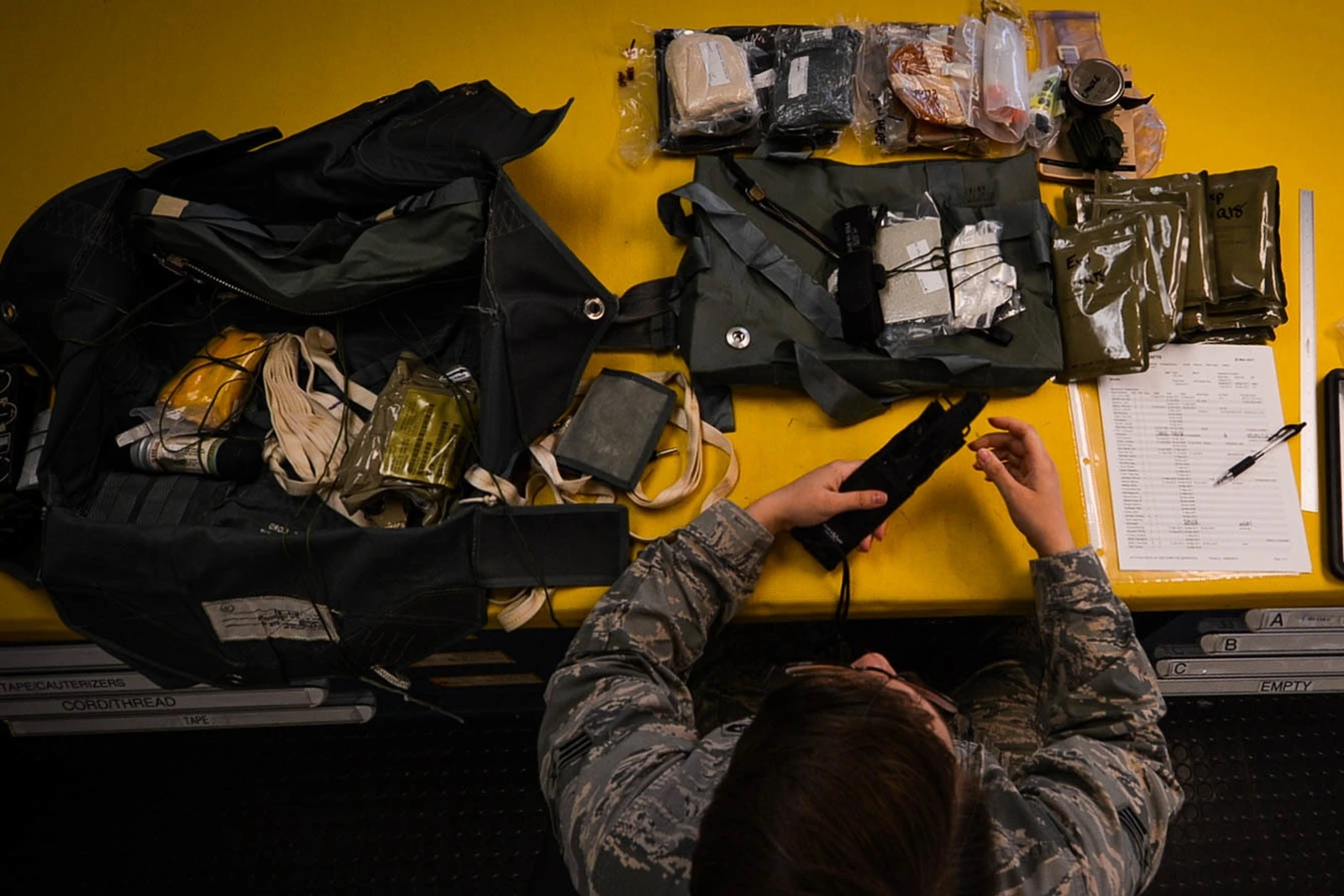
In 1982, the Canadian Forces faced a specific equipment problem with their new CF-18: the existing sleeping bag and liferaft would not fit together inside its rigid ejection-seat survival kit. The Hornet provided approximately 1,000 cubic inches of stowage space, compared with 1,500 in the CF-104 used as a reference. The smaller container had to accommodate equipment that would protect the pilot after ejection both on the water and in cold conditions. Two interim options, for summer and winter use, were developed first.
The adaptation began with an assessment of the complete Aviation Life Support Equipment, or ALSE. Personnel from the Directorate of Aerospace Support Engineering at Canadian National Defence Headquarters and the Medical Life Support Division of the Defence and Civil Institute of Environmental Medicine (DCIEM) in Toronto examined ergonomics, protection and escape systems. They had to match the equipment to the intended Canadian operational tasks and integrate it with equipment already in use. Changes therefore extended beyond the packed contents to the harness, life preserver and oxygen-system connections.
The Hornet arrived with a system shaped by carrier operations
The US Navy F-18 configuration was strongly influenced by aircraft launch and recovery aboard carriers. Its life-support and escape concept addressed aircrew in a ditched aircraft, including the possibility of being underwater. It was also matched to ancillary equipment already used by the US Navy.
For Canada, some of the adaptation needed lay precisely at these connections. The American Torso Harness was incompatible with the life preserver used by Canadian jet aircrew. Retaining that life preserver therefore required a change to the connection between pilot and ejection seat. The seat kit also had to meet Canadian survival requirements after ejection, despite having one third less stowage space than the CF-104 example.
Changing the harness changed the worn combination
The American Hornet had the SJU-5/A, a variant of the Martin-Baker Mk 10 ejection-seat family. It was adapted to the MA-2 Torso Harness. This vest-like harness was donned before entering the cockpit; Koch fasteners connected it to the parachute and lap belt. The Canadian assessment criticised its limited adjustment and restraint, particularly under negative acceleration. This is the flight load that lifts the pilot out of the normal seated position.
Martin-Baker developed the Simplified Combined Harness, SCH, for the SJU-5/A. Canada planned to use it in place of the Torso Harness. The SCH stayed in the seat and was donned there. It combined restraint during flight with the parachute harness; the parachute itself was housed in the ejection seat's headrest. Additional straps formed the parachute harness, while the central quick-release buckle was mounted on the negative-g strap.
The five-point arrangement accommodated different clothing combinations, including winter flying clothing, immersion suits and chemical protective garments. The harness had to restrain the pilot while allowing the movement needed to see out of the cockpit. The central buckle was also intended to permit one-handed separation, including when cold had impaired hand function. Normal separation from the parachute and seat in the assessed Torso Harness combination, by comparison, required four independent actions.
The oxygen regulator's integration changed as well. In the US Navy configuration of the period, an individually issued regulator was chest-mounted and supplied pure oxygen only. The CF-18 was to have a harness-mounted diluter-demand regulator, providing an air–oxygen mixture or pure oxygen on the principle already used in Canadian jets. Cockpit stowage was also provided for.
The life preserver also had to allow access to the raft
The American Torso Harness was paired with an underarm life preserver. In the Canadian assessment of this combination, boarding the raft after an ejection into water was difficult without unfastening the front of the preserver. That opening could also cause the loss of the raft, life preserver and seat-kit contents.
The Canadian CF-18 was instead to receive the life preserver already used in Canadian jets, matched to the SCH. This design included an automatic inflation valve.
1,000 cubic inches for survival equipment and emergency oxygen
The Rigid Seat Survival Kit, RSSK, was constructed from bonded fibreglass shells in a clamshell arrangement. Its approximately 1,000 cubic inches of stowage convert to about 16.4 litres; the 1,500 cubic inches in the CF-104 comparison to about 24.6 litres. An emergency oxygen bottle was also stowed in the RSSK.
In the US Navy configuration described, the upper shell stayed with the person after the kit contents were deployed. This rigid body could cause injury on water entry or ground impact. Protruding hinges could also puncture the raft during boarding.
The Canadian configuration was to retain the upper shell, and therefore emergency oxygen, when the contents were initially deployed. The shell could subsequently be separated on its own. The connections for separate lid removal were the oxygen regulator hose connector to the seat kit and two quick-release fittings on the harness.
Together, the Canadian sleeping bag then available and the liferaft demanded more space than the RSSK could accommodate. Canada nevertheless needed both: the raft for an ejection over water and the sleeping bag for a subsequent period in cold conditions.
Summer and winter initially needed separate options
Two interim arrangements for summer and winter use had therefore been developed by 1982. The seasonal division bridged the packing shortfall while DCIEM worked on a combined “Global” configuration. This was to contain both sleeping bag and liferaft, together with other protective equipment meeting Canadian requirements.
1984: reducing packed size and testing deployment
By 1984, the development need had produced a specific packing solution. A vacuum-packed North Face CF600 sleeping bag was installed in the Global Seat Kit and trialled in the CF-18 RSSK. In that form, the sleeping bag fitted within the restricted space alongside the other equipment.
The trials took place at Comox and included a T-33 seat kit with one inch removed from its height, equivalent to 2.54 centimetres, alongside the CF-18 RSSK. Both kits successfully deployed their contents.
At the same stage of development, a contract had been let for enough sleeping bags to equip all CF-18s.
Work continued on the worn equipment
Further work on worn combinations was proceeding in parallel in 1984. Following interface problems with the yoke life preserver and the manufacturing complexity of the maritime life preserver, Canadian aircrew flotation equipment was to be rationalised. Equipment standards and operational requirements were to be established first. The eventual development goal was a common life preserver, with the variants needed by different aircrew.
The order in which the anti-g suit and immersion suit were worn was also under investigation. Canadian aircrew were to wear the anti-g suit over the immersion suit during a six-month trial. For the reverse combination, DCIEM had developed a connector to be trialled by 410 Squadron personnel. Both arrangements combined protection against acceleration with protection during immersion; their comfort needed comparison for Canadian operations.
For the winter flying suit, DCIEM was investigating more compact synthetic insulating materials to reduce the bulk of the worn layers. The assessment covered thermal properties, flammability, heat transfer and drying times.
The appearance of U.S. Department of War (DoW) visual information does not imply or constitute DoW endorsement.