

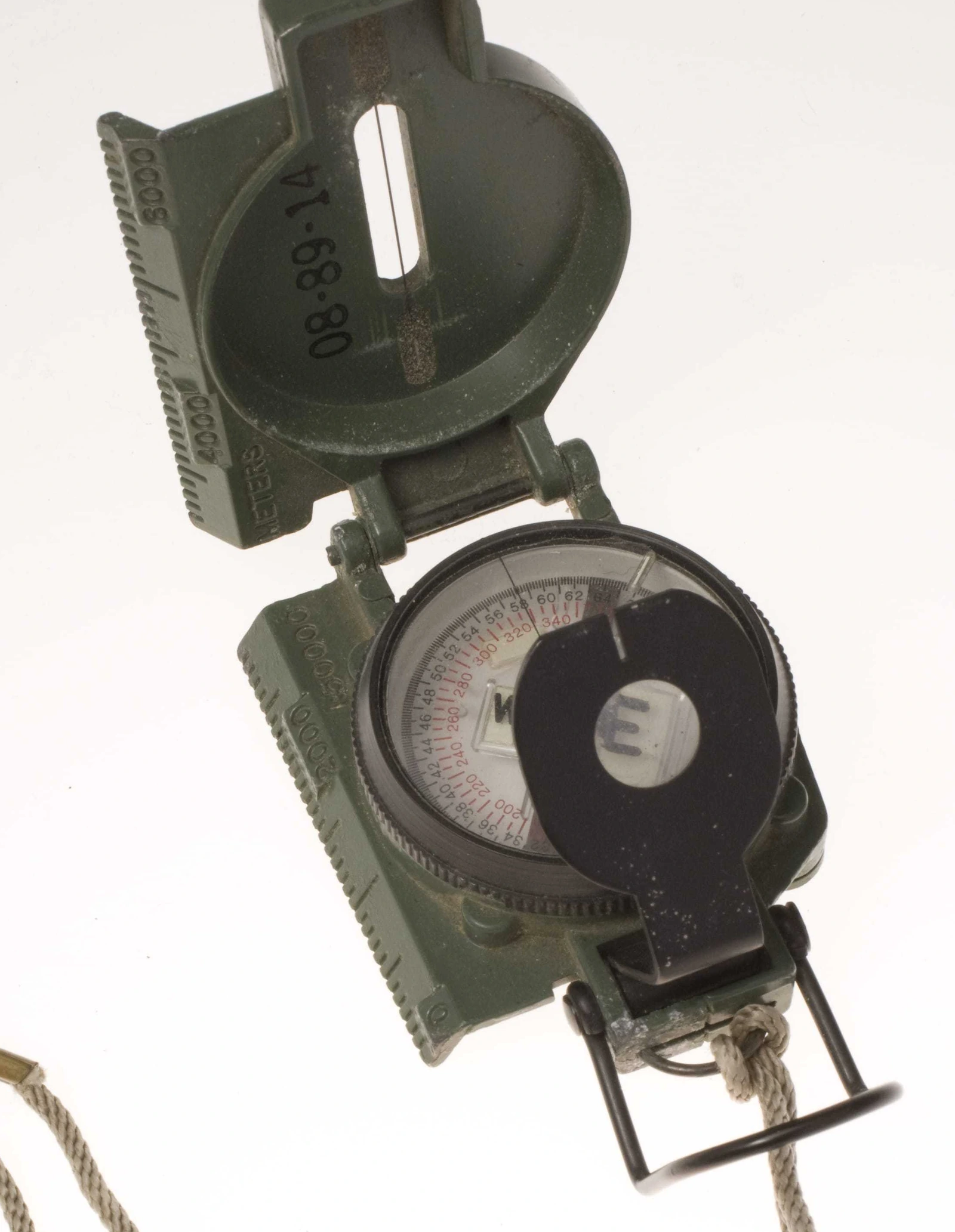
The Cammenga 3H is the current tritium version of the US military lensatic compass. It combines a freely turning magnet with a sighting wire, reading lens, ratcheting bezel and seven self-luminous markers. The olive-drab 3H carries stock number 6605-01-196-6971. The photograph shows a lensatic compass in the CIA Museum that was used by Agency personnel in Afghanistan after 9/11. The museum does not identify it as a Cammenga 3H, but the components characteristic of the pattern are clearly visible.
Sight, lens and magnet work as one instrument
The sighting wire is mounted in the hinged cover. At the opposite end are the lens bracket, sighting groove and magnifier. The moving dial carries the north arrow and angular scales, while the black index line above it is fixed to the case. The reading is therefore the angle between the case alignment and the magnetic field.
For a precise bearing, the base is held level at eye height and the cover is raised vertically. The lens bracket sits about 30 degrees from vertical so that the dial remains free. Sighting groove, wire and target are aligned; the value beneath the index line can be read through the lens at the same time. The head and compass remain in the same position throughout the reading.
Pressing the lens bracket fully down lifts the dial from its pivot. This transport lock unloads the bearing while the compass is carried. The dial must be completely released for every measurement. If the bracket remains too low or is damaged, the indication may appear steady even though the magnet cannot settle freely. To close the compass, the lens bracket folds against the crystal first, followed by the cover; the thumb loop holds the folded instrument shut.
Copper damping instead of a liquid fill
The dial turns on a synthetic sapphire jewel bearing. A copper shell surrounds the oscillating magnetic assembly. Movement of the magnet induces eddy currents in the conductive copper; their magnetic field opposes that movement and makes the oscillation decay quickly. Once the dial stops, most of the braking effect disappears, so the magnet is not held at an arbitrary angle.
This design needs no damping liquid. The 2003 MIL-PRF-10436N specification requires the dial to settle within six seconds after a deflection of 540 ±20 mils. It must remain free at eight degrees of case tilt, with friction error no greater than 20 mils. Fast settling alone therefore does not prove correct operation: a jammed dial also stops quickly. The stated 3H operating range is −50 to +150 °F, approximately −46 to +66 °C.
Degree scale, mil scale and bezel
The inner red scale is divided into 360 degrees, with marks every five degrees and numbers every 20 degrees. The outer black scale uses the military 6,400-mil circle: each graduation represents 20 mils and the numbers appear every 200 mils. Thus “16” means 1,600 mils and “32” means 3,200 mils. Both scales are read against the same fixed index line.
The stated accuracy of the 3H is ±40 mils, or ±2.25 degrees. The finer 20-mil scale interval is only the graduation and must not be confused with measurement accuracy. The ratcheting bezel serves a different purpose. It has 120 tactile steps of three degrees each and carries a luminous line. This allows a chosen direction to be preset mechanically; the bezel does not apply a magnetic-declination correction to the magnet.
To prepare a night bearing, the bezel line is first aligned with the luminous marks on the cover sight. The bezel is then turned counterclockwise by the desired magnetic azimuth divided by three. When the north arrow is later brought back beneath the luminous line, the cover sight points along the preset bearing. Accidentally turning the bezel changes this preset relationship, not the magnet’s direction of north.
Seven tritium elements for night reading
The luminous markers are small glass tubes containing tritium gas and phosphor. Radioactive decay excites the phosphor, so the tubes need neither a battery nor previous exposure to light. They mark the sight, north arrow, bezel and the east and west points. These essential references remain visible in darkness even when the full printed number scale is difficult to read.
Brightness falls with age. The military design calls for at least twelve years of luminous service; Cammenga describes about ten years of good use and substantially weaker light after ten to twelve years. An older 3H may therefore remain mechanically sound but be difficult to read at night. Depending on the production run, the date inside the cover appears as year, month and lot number or as a year with a sequential day number.
M-1950, 3H and Model 27
M-1950 identifies the US lensatic pattern used since the 1950s and produced by several manufacturers. The 3H is Cammenga’s self-luminous tritium version. Model 27, stock number 6605-01-571-6052, uses phosphorescent paint. Its markings must first be charged with a light source and then glow for a limited time.
The black B3H, often sold as the “SWAT” version, works on the same principle as the olive-drab 3H. Separate versions are also balanced for the northern and southern hemispheres. This is more than a marking difference: the vertical component of Earth’s magnetic field changes with latitude and can tilt an incorrectly balanced dial until it drags against the case.
Dimensions, pouch and shock tests
The 2003 procurement requirement limits the closed compass to nine × eight × four centimetres and 170 grams. The set includes a lanyard, draining pouch, belt attachment and moisture-resistant short instructions. The case and transport lock protect the bearing and magnetic assembly, while the pouch keeps the compass accessible on worn equipment.
“Shock-resistant” also has a precise meaning in the specification. The compass is dropped from 90 centimetres onto a ten-centimetre layer of dry sand. A separate one-metre drop onto a rigid steel surface applies to the luminous-vial test. After a hard impact in use, free dial movement, the transport lock, sight and reading lens should be checked before the next bearing.
Recognising magnetic interference
Steel equipment, a nearby weapon, a vehicle or electrical currents can alter the magnetic field at the reading position. The dial may settle cleanly and still point in the wrong direction. Suspected objects should therefore be moved away or the bearing repeated at another position. If the reading changes with distance from the suspected source, the first measurement was affected. The 3H supplies a magnetic direction; position, distance travelled and map location still have to be established from a map, terrain features or an electronic navigation device.