

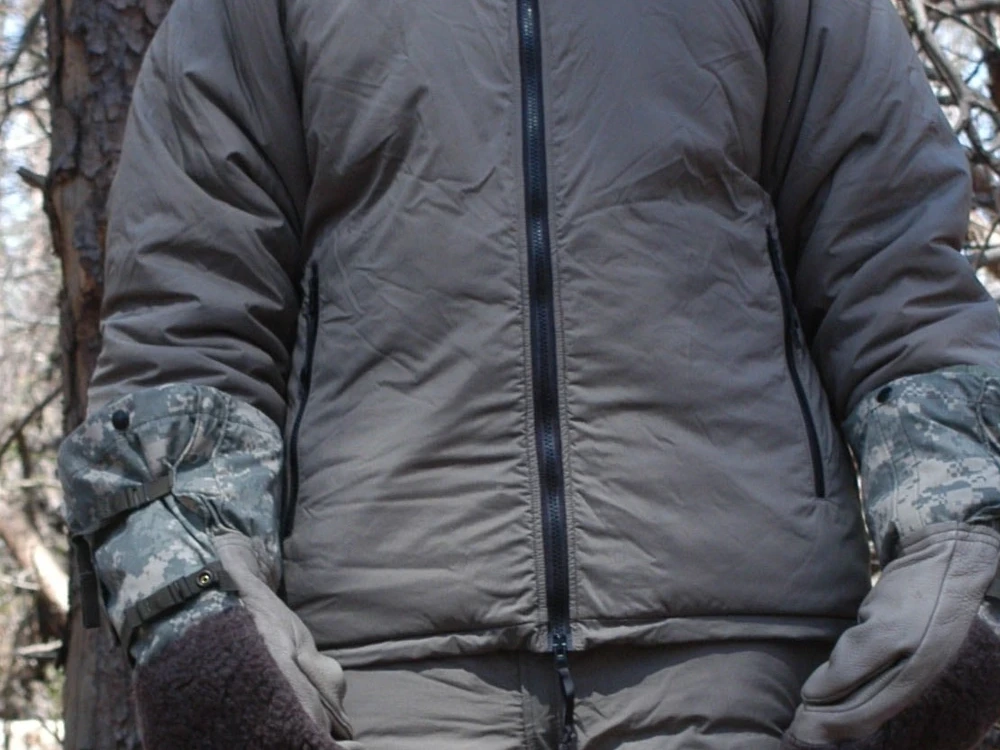
The US Army's Extended Cold Weather Clothing System Generation III comprises twelve garment types arranged in seven functional levels. Thin base layers, fleece, wind and rain shells, and heavily insulated overgarments can be combined for different workloads, weather and rest periods. The thickest insulation is cut to fit over body armour and layers already worn. It can therefore be added during a prolonged halt without first removing the entire load carriage system.
A specific functional set with seven levels
Gen III development was field-tested by the 10th Mountain Division with approximately 18,000 systems in Afghanistan during autumn 2006 and winter 2007. Design objectives included greater breathability, reduced packed volume and integration with load carriage and Interceptor Body Armor. The 2014 configuration described here comprises light and medium-weight underwear, fleece jacket, wind jacket, softshell jacket and trousers, rain jacket and trousers, and a highly insulated parka and overtrousers. Detachable braces are listed as an additional component.
The seven levels are functional groups. Level 4 consists only of a wind jacket, whereas Level 5 comprises jacket and trousers. Level 2 can be worn directly against the skin or over Level 1. The numbering therefore does not require all seven levels to be worn simultaneously. A separate cap, gloves and boots are outside this twelve-garment core.
| Level | Components | Main function |
|---|---|---|
| Level 1 | Lightweight long-sleeved undershirt and drawers | Transfer moisture from the skin towards outer layers |
| Level 2 | Mid-weight shirt and drawers in grid fleece | Light insulation and moisture transfer, as a base or intermediate layer |
| Level 3 | Fleece jacket | Additional insulating air volume |
| Level 4 | Wind jacket | Light wind-resistant and water-repellent outer shell |
| Level 5 | Softshell jacket and trousers | Movement shell with high moisture-vapour transfer and reduced noise |
| Level 6 | Extreme Cold/Wet Weather Jacket and Trousers | Waterproof protection for prolonged or heavy rain and cold, wet conditions |
| Level 7 | Extreme Cold Weather Parka and Trousers | Additional bulky insulation, particularly when static |
Base layers and fleece: moisture transfer and insulation
Level 1 uses very light polyester described as silk-weight. Its long-sleeved top and drawers fit near the body without constriction. Flat seams reduce chafing; thumb loops keep the sleeves down while further layers are pulled on. The material is intended to move moisture from the skin towards the next layers. It is therefore part of moisture management, while its small thickness offers little insulating volume of its own.
Level 2 consists of polyester grid fleece. Its raised structure creates additional volume and surface area compared with a thin smooth layer. The shirt has a neck zipper and thumb loops. The neck can be closed or opened for ventilation; the grid material works as additional light insulation over Level 1 or as a base layer itself. Whether moisture can actually leave the system then depends on the outer layers and their ventilation.
The Gen III sequence is designed around these synthetic base and intermediate layers. Cotton underwear or a cotton-blend ACU layer damp after strenuous work retains additional moisture beneath the functional layers. During subsequent inactivity, that wet layer reduces thermal protection. How well the new parka retains warmth therefore also depends on the garments worn underneath and how damp they are.
The Level 3 fleece jacket adds a considerably larger air volume. Its high-loft structure resembles synthetic fur; insulating air remains among the fibres and between layers. A full front zipper and internal mesh pockets form part of its construction. The jacket itself offers little wind protection and no dependable rain barrier. In exposed wind, a suitable outer shell therefore complements its insulating volume. The actual heat losses in cold conditions depend on wetness, wind and ground contact as well as insulation.
Three different responses to wind and wet weather
The Level 4 wind jacket forms the light outer shell. It has a simple collar rather than a hood and mesh-lined pockets for ventilation. Wind-resistant, water-repellent material limits air movement around the underlying layers. The small amount of fabric keeps packed volume down. Gen III has a separate waterproof level for prolonged heavy rain; water repellency gives the wind jacket only limited capability for that task.
Level 5 is the softshell for movement. Its jacket has a stowable hood usable with a ballistic helmet, adjustable cuffs, underarm zippers and mesh-lined pockets. An extended tail overlaps the trousers and limits snow entry. The flexible shell combines wind and water resistance with greater moisture-vapour transfer and less clothing noise than the stiffer wet-weather shell.
The softshell trousers supplement this jacket with detachable braces, articulated knees, thigh pockets and adjustable ankle cuffs. Lower-leg zippers improve access to the boots. The seat can open without removing the trousers completely.
Level 6 is the waterproof shell for sustained rain, cold and wet weather and alternating freezing and thawing. Its jacket has a stowable hood and pass-through pockets; the trousers likewise have lower-leg zippers. The system applies stronger protection against incoming water here while retaining the base and insulation layers underneath. During a prolonged wet halt, this function matters more than outer-jacket thickness alone: a thin closed rain shell can protect existing insulation from further wetting.
Level 7 goes outside and can be added over existing equipment
The Level 7 parka and overtrousers add loft insulation. They are sized to fit over body armour and other layers. The trousers have full-length side zippers. They can consequently be donned or removed over boots and existing softshell trousers without first removing the lower layers completely. The parka adds protection around the upper body in the same external position.
This outer position preserves insulating volume. An undersized shell or tight load carriage would compress the parka and reduce the air it can trap. Full-length side zippers allow the overtrousers to be donned over boots and Level 5; the parka is likewise pulled over the layers already worn.
Level 7's exterior is wind- and highly water-resistant and protects against moderate moisture. Its primary task remains additional insulating volume. Level 6 is the designated waterproof component for prolonged heavy rain. Bulky insulation and a rain barrier are thus separate functions; selection cannot rest solely on which jacket looks thicker.
Load and activity determine which components are needed
The 2014 weight table lists approximately 5.8 kg for the complete system. Rounded maximum reference values across the listed sizes and models include approximately 0.34 kg for the wind jacket, 0.73 kg for rain jacket and trousers together, and 2.0 kg for the Level 7 parka and trousers. Level 7 therefore accounts for a substantial share of weight and packed volume even though it is usually not worn during strenuous movement.
The 2014 wear examples combine Levels 1, 2 and 5 for active movement at 0 to 30 °F, approximately −18 to −1 °C. A static combination for the same temperature band uses Levels 2 and 5 with the Level 7 parka added. A static extreme-cold combination uses Levels 1, 2, 3 and 5 with the complete Level 7. Which components are actually needed depends on wind and wetness as well as heat produced through work.
As work increases, neck, front and underarm zippers allow ventilation to change before an entire layer is removed. That heat production falls when movement gives way to a halt; additional insulation is closed or added again. Keeping the thickest combination on throughout strenuous movement can cause overheating and increased sweating, while a thin movement ensemble can provide insufficient air volume during a prolonged halt.
Camouflage and the fire-resistant version are separate characteristics
The 2014 configuration included UCP and the contemporary OEF Camouflage Pattern, also abbreviated OCP. The fleece jacket was listed in Foliage Green 504 or Tan 499, and Level 7 in Urban Gray. Level 5 included separate FR OCP jackets and trousers alongside UCP and OCP versions. FR identifies the fire-resistant version of that component. OCP alone identifies the pattern and does not replace the additional FR designation.
The versions have their own stock numbers and sizes. Fit remains part of function: overly tight layers compress insulation and obstruct movement; oversized open cuffs or hems allow wind into the layers. The outer garments need enough room for the underlying layers and any body armour still worn.
Distinguishing wetting, damage and compression
When rain no longer beads on the face fabric, its outer surface becomes saturated. This adds weight, increases drying time and impairs moisture-vapour transfer, but it does not by itself prove that the waterproof barrier in Level 6 has torn. Conversely, renewed water repellency cannot repair a hole or failed seam tape. Those faults require a repair compatible with the particular fabric and barrier.
Insulation can also look intact while performing poorly. Heavily soiled or persistently compressed fleece and Level 7 recover less loft, while damaged zippers prevent a layer from closing securely or being added quickly. Before use, the useful checks are therefore loft, zippers, hook-and-loop closures and the completeness of the required combination. The heavily insulated garments should be stored dry and under as little compression as possible.
The appearance of U.S. Department of War (DoW) visual information does not imply or constitute DoW endorsement.