

During the Second World War, Britain's MI9 developed very small compasses for escape and evasion. They were intended to remain with the individual without attracting attention. Some consisted only of a magnetised metal strip; others were concealed in buttons, belt buckles or small brass housings. In every design, the magnetic part still had to move freely to align north.
Magnetic strips and buttons suspended by thread
The simplest “swinger compass” was a small diamond-shaped steel strip. Thread through its central opening provided the suspension. Two small holes marked the north end and one marked south; on some versions the north marks contained luminous paint.
The Bakelite button compass, also called a weskit compass, used the same principle. A magnet was embedded in the plastic, with two luminous dots marking north and one marking south on the reverse. The button was suspended freely from thread when used. Its form concealed the compass, but it did not remove the need for a steady, unobstructed suspension.
Two buttons forming one compass
The brass service fly button used two matching buttons as indicator and support. The lower button carried a small spike; the upper had a corresponding recess and the magnetic marking. Placed on the spike, the upper button could rotate. When separated, both parts resembled ordinary trouser-fly buttons.
This design worked only with the complete pair. If the lower button was tilted or the rims touched, the upper button could not turn freely.
Housed miniature compasses
Other models placed the magnet, pivot and display inside a small brass housing. Early rotors used a perforated steel disc under glass; later designs used a star-shaped pointer. A coloured or dotted mark identified north. Some housings were only about thirteen millimetres across.
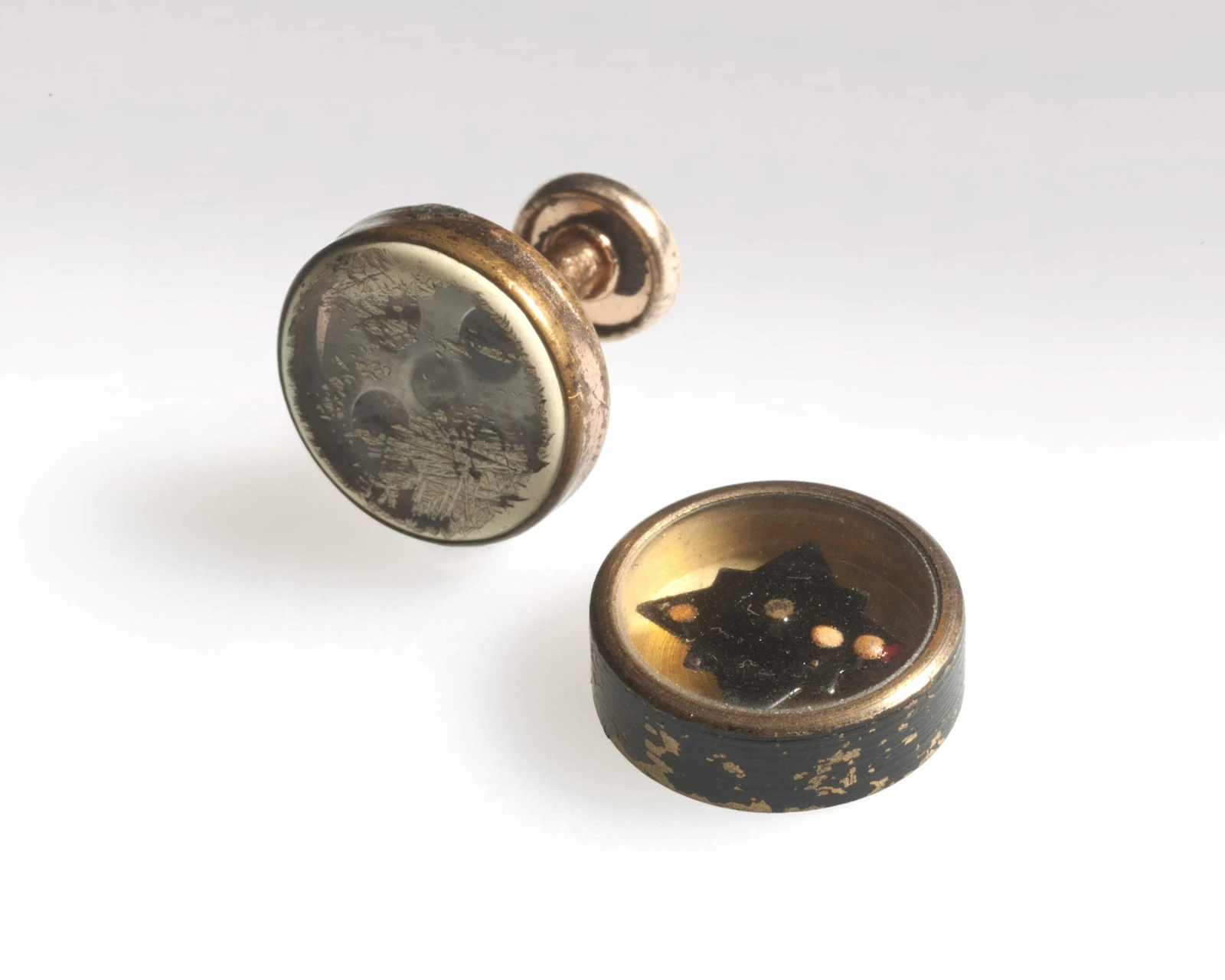
The photograph on this page shows two concealed compasses from the American OSS collection, not the British MI9 examples described in the text. The star-shaped pointer of a housed compass is visible on the right. The image demonstrates the same design principle: a complete miniature rotor in an inconspicuous form.
Uniform buttons and collar studs as concealment
One British RAF button had an unscrewing back that exposed a glass-covered miniature compass. Other button compasses opened through hinged lids. Some threaded covers even opened clockwise, contrary to the usual expectation. The wearer therefore needed to know the mechanism of the particular model carried.
Another design concealed the display beneath white paint on the glass face of a collar stud. Removing the paint at the intended point made the compass readable. Until then, the exterior remained that of an unobtrusive clothing fastener.
Clear enclosures for tropical use
For tropical theatres, housed miniature compasses were also sealed inside transparent plastic. The display remained readable through the enclosure while moisture was kept away from the metal housing and pivot. Some enclosures were only slightly larger than the compass; others included tape for wearing around the neck.
Compass needle and pivot in a belt buckle
An RAF belt buckle carried a removable compass needle and its pivot. The needle sat in a sliding holder on the centre bar. To use it, the wearer removed the needle and placed it on a small folding spike. It could then align like a simple compass needle.
Nearby steel objects and magnets can deflect these small compasses. A blade or other magnetic item should therefore not lie beside a suspended needle or rotor when a direction is read.
Documented provenance of individual examples
The surviving objects come from very different contexts. An early rotor belonged to Australian soldier Richard Sydney Turner, who escaped from a transport train after capture in Greece. Australian Army nurse Sylvia Muir collected two button compasses during Japanese captivity. Other miniature compasses survive in RAF escape kits associated with both European and Pacific service.
These provenances do not show that every compass was used in a successful escape. They do show how MI9 adapted the same basic function—an inconspicuous direction indicator—to uniform, climate and method of carriage.