

The E-3-J was a personal survival and escape kit from the Second World War. A surviving example in the Australian War Memorial consists of a cotton-canvas belt pouch and a gold-coloured tin. It contains medical supplies, water-treatment tablets, a small food reserve, tools, fishing equipment, a compass and matches, a signal mirror and several instruction sheets. A Malay glossary connects this general emergency equipment to its intended theatre.
Belt pouch, tin and documented contents
The canvas pouch has a belt loop at the back and two press studs at the front. The tin and its individually packed contents sit inside it. The belt loop kept the kit on the person independently of a rucksack or a container fixed inside an aircraft.
The documented contents include a chocolate D ration, Halazone tablets for the period method of treating water, a folding water bag, a combined waterproof matchbox and compass, fishing line and hooks, safety pins, a sharpening stone, a hacksaw blade, a signal mirror, needle and thread. A contents list, instructions and a survival-hints booklet accompany the equipment.
Water, fire, food and direction finding
The E-3-J combined a folding water bag with Halazone tablets for the period method of chemical water treatment. Matches and a compass shared one waterproof container. Its carried food was a chocolate D ration, supplemented by fishing line and hooks.
Medical supplies from the 1940s
The medical portion includes adhesive dressings, iodine swabs, sulfonamide medicines, adhesive tape, Benzedrine and morphine. Their labels associate them with wounds, diarrhoea, severe fatigue and very severe pain. This selection belongs to the medicine and operational assumptions of the 1940s; it is not a recommendation for a modern emergency kit.
The Malay glossary identifies the regional purpose
Among the tools and consumables is a “Malay Glossary for Airman”. It was intended to support basic communication by a downed aircrew in a Malay-speaking area. The booklet distinguishes the E-3-J from a wholly generic survival kit and shows that MIS-X assembled material for particular theatres.
The kit also included a contents list, two instruction sheets and a survival-hints booklet. The museum record identifies these papers as original components.
What the illustrated MIS-X shipping table establishes
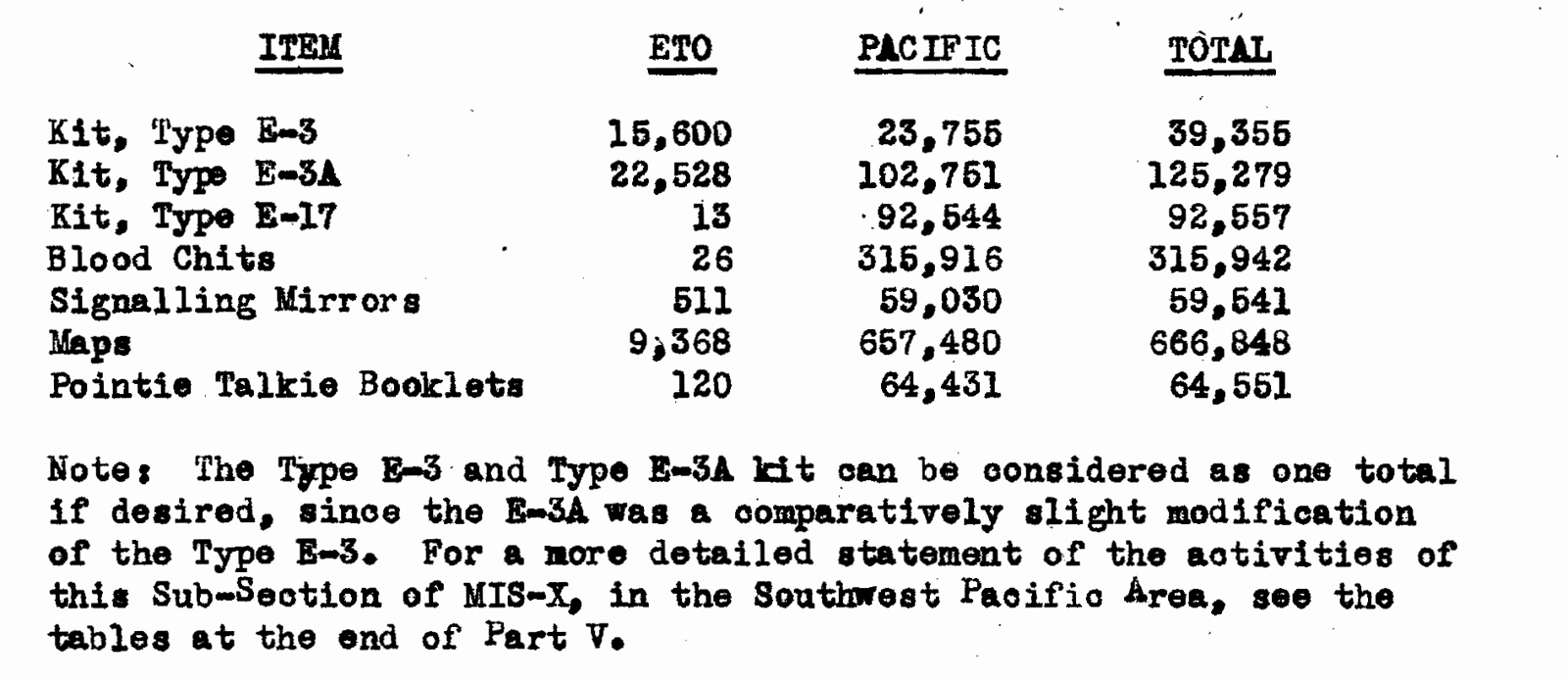
The image on this page does not show the E-3-J kit. It is a MIS-X shipping table compiled through August 1943 and lists E-3 and E-3A kits alongside maps, blood chits, signalling mirrors and Pointie-Talkie booklets. Separate quantities are given for Europe and the Pacific.
The E-3-J does not appear as a separate line in this table. The figures therefore establish the scale of related MIS-X supply, not a production total for the example described here. The separate entries for maps, language aids and mirrors also show that one tin was only part of the wider escape-and-evasion equipment.
An aircrew kit with Australian provenance
The surviving example has collection number REL31567. It later belonged to Australian officer Austin Yeats Ellerman, who was captured at Singapore in 1942 and worked on the Thailand–Burma Railway. He received the E-3-J only at the end of the war from the crew of a Catalina flying boat.
This provenance does not show that Ellerman escaped from a camp with the kit or used it during captivity. It connects an aircrew survival kit with its later Australian owner and preserves a specific example of regional MIS-X equipment.