

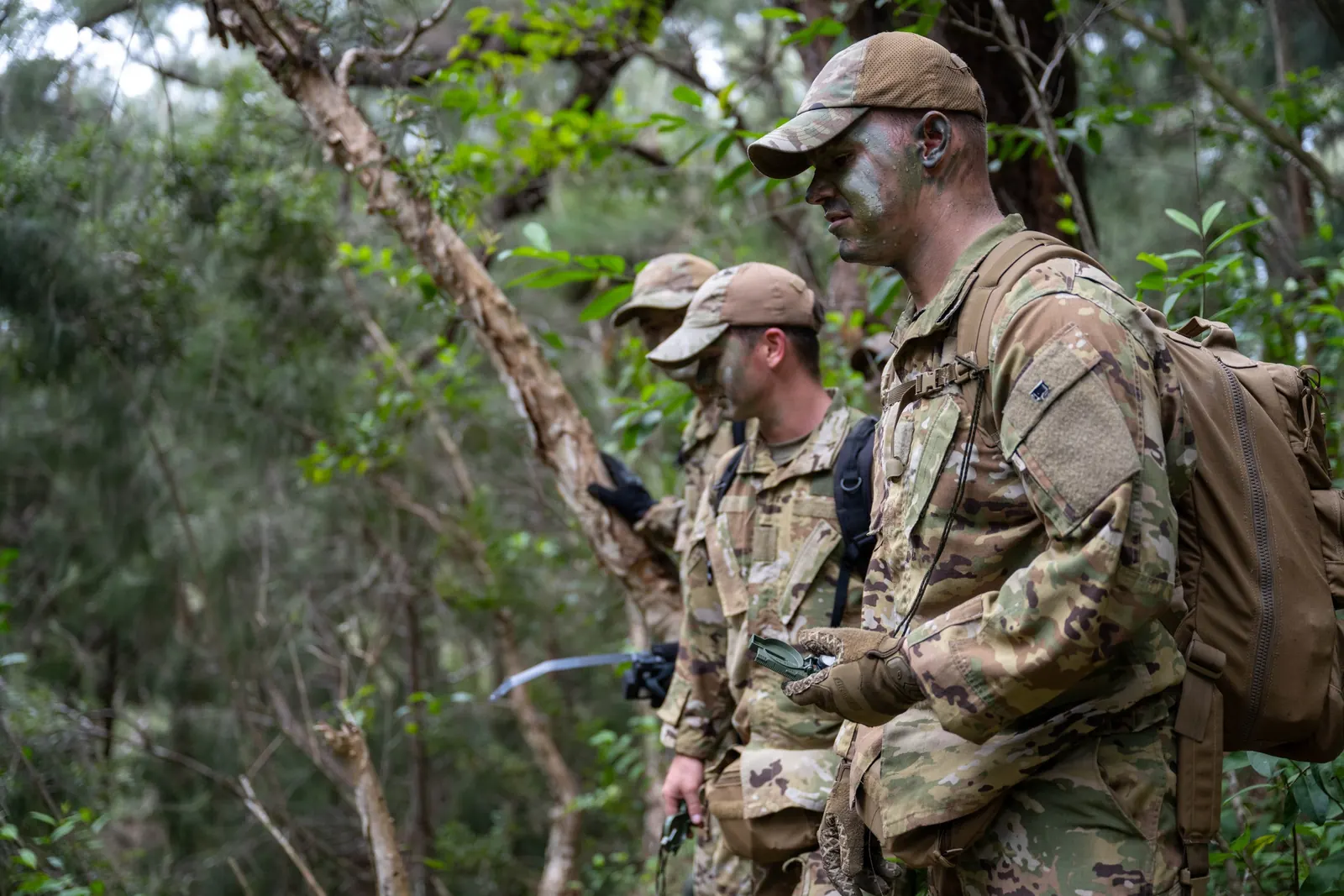
Evasion is the action taken by militarily isolated personnel to avoid detection and capture and return to friendly control. After a crash, an attack or separation from a unit, the task begins with the means actually available and the person's physical condition. Every further move needs an achievable purpose: leave an immediate threat, clarify the situation, obtain essential supplies or make a return possible.
From the isolation event to a first concealed halt
Several hazards can converge at a crash site or the scene of a fight. Vehicles, smoke, noise or abandoned equipment can draw attention to the area; hostile forces may already be there or approaching. The first requirement is to get out of the immediately threatened location and reach available concealment. The first halt should allow a view of the surroundings without requiring an exposed return to the scene. A depression overlooked from every side, or a dead end between obstacles, can cut off the next move despite providing good concealment from view.
The person's condition is then checked in practical terms. Clothing and visible parts of the body are inspected for injuries and bleeding. Pain, restricted movement and instability when standing change the next step: can both legs support body weight? Can the person step securely, lower their body and get up again? Can their hands grip and operate the necessary equipment? Someone who can barely bear weight cannot plan a long journey over steep ground. Where a serious injury is apparent, the necessary self-aid takes priority over such a movement check.
With more than one person, it must first be clear who is actually present. After an attack, attention can remain fixed on casualties, vehicles or disengagement while another member's separation goes unnoticed. Those present are checked for injury, mobility and equipment; the movement intention must also account for the slowest person. A lone individual has to arrange observation, sustainment and rest themselves. They cannot plan a continuously occupied watch running alongside their own extended rest.
Establish location, hostile activity and available means
The location assessment starts from the last confirmed reference: a known part of the route, a recognised terrain feature or the point of separation. This is kept distinct from what is merely assumed. A hollow, a patch of woodland or a single building may resemble several places. Treating that resemblance as a confirmed location also puts the next direction on a false basis. Recognisable terrain and human-made features are therefore compared with one another. Moving to a further observation point is useful only if it is reachable and the additional view does not require exposing the person's silhouette.
Observation concerns activity and movement options. Where are people or vehicles moving? From which direction are engine noise, voices or weapon sounds coming? Does a sound stay in one place, pass by or approach repeatedly? Roads, buildings, smoke and visible tracks may indicate use. These observations are assessed by location and change over time. A briefly empty road says little about forces beyond the next bend. Equally, a single distant engine is insufficient reason to assume that the enemy has found the person's position.
The inventory covers what is actually present after separation. Water containers, clothing, protective items, food, navigation aids and communication or signalling equipment are checked for loss and damage. Water quantity and the container's ability to hold it determine the carried reserve; damaged straps may make safe transport harder. Radio checks include the antenna and power supply; signalling equipment is checked for access when needed. Loose equipment is secured against loss and rattling before the next move.
Adapting the evasion plan to the situation
A prepared Evasion Plan of Action, or EPA, records intended actions in the event of isolation and makes them available to friendly organisations. These may include intended directions of travel, areas where the person plans to stay and recovery options. After separation, the plan is checked against location, condition and the observed threat. A planned pickup point may have become unreachable, or the enemy may now be using a route. The person must then choose a course of action they can carry out with their remaining means.
The next objective must be specific enough for the person to recognise when that leg has been completed. A concealed area for observation, a reachable opportunity for sustainment or a linkup with friendly forces that the known situation makes attainable are such objectives. An alternative is considered for the route. If the intention amounts only to an uncertain direction towards friendly forces, the location assessment must first be improved. A long journey based on that assumption consumes strength and expands the area within which the person must subsequently reconstruct their position.
Three decisions about staying and moving
The first decision concerns the present location. A concealed halt is useful when it allows observation and recovery of strength without an identified hazard making it unsuitable. Searchers actually approaching that area can force a move. A confined streambed can also become dangerous in heavy rain if rising water removes the only way out. In those circumstances, an attainable exit from the danger determines the next move. Someone who keeps walking simply through restlessness gives up useful concealment without being able to name a better location.
The second decision arises when a route is uncertain or has to be abandoned. An unexpected edge of a settlement may mean that the assumed location is wrong. If hostile activity or an obstacle that cannot be crossed safely makes the intended passage unusable, that leg is reassessed from concealment. Which place was last positively recognised? What alternative is reachable with the water and mobility remaining? Additional distance, exposed ground and difficult footing all count. A detour that exhausts an injured person or leads to another unknown obstacle does not resolve the first problem.
The third decision concerns pursuit pressure. Nearby visible searchers require a different response from a sound whose source is unclear. While the immediate danger allows it, a brief concealed observation halt provides information for the next action. If searchers are seen approaching the person's hide, the person must be able to leave the threatened area. Prolonged blind running consumes water and strength, makes observation harder and may itself draw attention to the movement. A necessary rapid move therefore need not become a continuing forced march; the situation is checked again at the next usable concealment.
Combine movement with observation
A moving body is easier to notice than a motionless concealed person. Before each exposed leg, the person checks which concealment can be reached next and what can be observed about the route from the starting point. Ridges, open slopes and gaps in vegetation can outline the body clearly. Natural concealment is used without exposing the head or the entire silhouette against an edge. The detailed use of these features is explained in terrain edges and silhouette disruption.
Observation halts are made at concealed points during movement. To listen, the person has to stop the rustling and footfalls of their own movement. Newly observed activity may require another route or a longer halt. Low light, weather and reduced hostile activity may favour movement; poorer visibility and difficult ground can also reduce the person's orientation and secure footing. The advantage of a dark stretch must therefore be weighed against the ability to find and reach the next objective.
Shiny objects, device displays, alarms and rattling equipment create additional indications. They are checked before departure. Changes to the surroundings also remain part of the movement decision: broken vegetation, lost objects and repeatedly used approaches may reveal a stay. The procedures and limits of trace reduction are a separate subject; within the evasion sequence, their demands on time and the person's remaining capacity must be considered.
Concealed rest as part of the onward journey
The US term Hide Site describes a concealed place where a person can reassess their situation and equipment, rest and prepare the next move. A Hole-up is needed when physical condition requires a longer halt for water, food, equipment maintenance and rest. For either, selection must go beyond nobody being able to see the person at this moment: can approaches be observed? Is there a reachable way out? Is the place beside a regularly used route or close to somewhere people already have a reason to visit?
Dense vegetation may conceal the person while blocking their own observation. A deep hollow may shield them from view while collecting water in rain. Elaborate preparation costs time and alters the surroundings. Existing concealment used with minimal alteration reduces those disadvantages. Necessary activities and movement within the area are limited; a daily journey along the same approach may create a visible path. Detailed Hide Site and Hole-up selection is explained in evasion hides.
A lone evader arranges the halt so that essential equipment is within reach and they are prepared for the next move. They cannot observe while asleep. Before resting, they therefore need to assess the location, approaches and their own exit particularly carefully. Continued sleep loss, however, degrades attention and decision making. Increasing pain, fatigue or repeated stumbling means they need to reassess whether they can still complete the planned longer route.
Preserve water, rest and equipment
Water needs and exhaustion determine how far a person can continue purposeful evasion. Route selection therefore considers the water already held, expected consumption, reachable supplies and the effort needed to get there together. A water source beside a used route may be close while still requiring additional observation or another approach. A long detour to a merely assumed source can consume the existing reserve. The next leg is therefore sized according to an attainable supply opportunity and the distance the person can still cover with their present reserve.
Pace and rest are chosen according to terrain and condition. A distance that would be easy uninjured may be too long with pain, a load and lost sleep. Clothing and the load should not unnecessarily restrict movement or promote overheating. Damaged straps, leaking containers and chafing equipment are addressed at a suitable halt while the necessary means remain available. Losing water or further aggravating a foot injury may reduce later movement options more than the time spent on that halt.
The person needs to allow time for food and its preparation during the halt. Obtaining food requires additional journeys; processing it takes time and may create noise, odour or light. If they visit other locations, they also need to account for the outward and return journeys and the extra exertion. Carried food reduces this effort. Like the other equipment, it is secured against loss and damage so that the supply needed for the next stage is still available after a short move.
Worked example: separated, injured and without radio contact
A soldier is separated from his team during disengagement. He knows the last shared section of the route and a more distant area intended for linkup. His radio is damaged.
He first leaves the immediately threatened location and reaches concealment. There he finds that one leg hurts but he can still step securely. He checks visible injuries, his ability to handle equipment and the water remaining. From concealment he sees vehicles on his originally planned route. He cannot see where the route leads beyond that point or conclude from the activity that his own team is reachable there. He therefore abandons the direct route towards the linkup area for the time being.
He now replans the route from the last confirmed terrain feature. An alternative offers more concealment but is longer and includes steep ground. With a painful leg and little water, he does not commit to the whole route at once. He first selects a nearer concealed area from which he can better assess the continuation. Before moving, he secures his equipment and checks which concealment is attainable at the end of the leg. At an unexpected obstacle, he halts concealed instead of attempting a blind crossing under time pressure.
At the new location, his leg, water and observed activity are reassessed. If mobility has worsened, he needs a usable place for rest and sustainment; if he can continue, he selects the next attainable objective. Only when friendly forces can be reliably recognised and contacted can this become an agreed return.
National approaches and their practical effects
German evasion training requires participants to avoid the enemy and reach pickup points independently. In one German training model, small groups of two or three move with limited equipment under hostile pressure. They agree routes and pace, manage water and strength and maintain observation during necessary rest. Several people can share these tasks. A lone soldier has to carry them out in a sequence that their own means allow.
British training also addresses evasion in built-up areas. A slow, methodical search there can threaten someone who judges a single room solely by the concealment it offers at that moment. Observable approaches and exits consequently matter as much as concealment itself. British recovery planning also assesses the suitability of actually available forces, their equipment and the isolated person against environmental and hostile threats. Once contact is made, the person needs to report condition and available means accurately: these may determine which location they must reach themselves and what kind of pickup is feasible.
Use communications and signals at a workable opportunity
Available communication equipment is used according to prepared operational instructions insofar as the set and connection permit it. Before transmitting from a hide, hostile direction finding has to be considered; a visible or audible signal can also disclose the location. Necessary equipment remains prepared for a useful opportunity. Repeated unsuccessful attempts consume battery power and may create further indications.
Once contact is established, the person reports current location and how it was determined, number and condition of personnel, observed hostile activity and available signalling and movement means. An assumed position is identified as such. EPA and ISOPREP serve different functions: the EPA helps others understand evasion intentions, while the Isolated Personnel Report supports formal identification and authentication. Identification data secured before the mission cannot replace the present location. Even a precise position still requires a separate identity check before recovery forces expose themselves for the pickup.
The connection may initially allow the person to receive guidance, coordinate supplies or plan further movement. Pickup also depends on available forces, their capabilities and the situation at the recovery location. Changes in condition, position or threat are reported over the existing connection. The person follows the instructions actually received when moving so that the recovery force meets the expected person at the correct location.
Contact and pickup by friendly forces
Reaching friendly forces independently requires deliberately establishing contact. A vehicle or a uniform alone is insufficient to identify them. The person observes reachable forces and tries to establish their affiliation before approaching. Friendly soldiers may also perceive an unfamiliar armed individual as a threat. Calm movement and a recognisably non-threatening posture help establish contact; rushing towards them with a weapon ready can aggravate the situation.
For an agreed pickup, equipment and loose items are secured beforehand and the intended signalling devices kept ready. The person remains concealed until recovery is imminent, helps the force identify their position and follows its instructions. They approach a vehicle or aircraft only when directed. Visible obstacles, ground slope and other hazards at the recovery location also matter and can be reported to the force. The practical pickup follows the platform actually used and its crew's directions.
Isolation ends with the actual return to the control of a friendly organisation. Necessary health care and national reintegration follow. That transition may be made through the person's own unit or through designated recovery forces. The relationship between reporting, locating, supporting, recovering and reintegrating is explained in Personnel Recovery.
The appearance of U.S. Department of War (DoW) visual information does not imply or constitute DoW endorsement.