

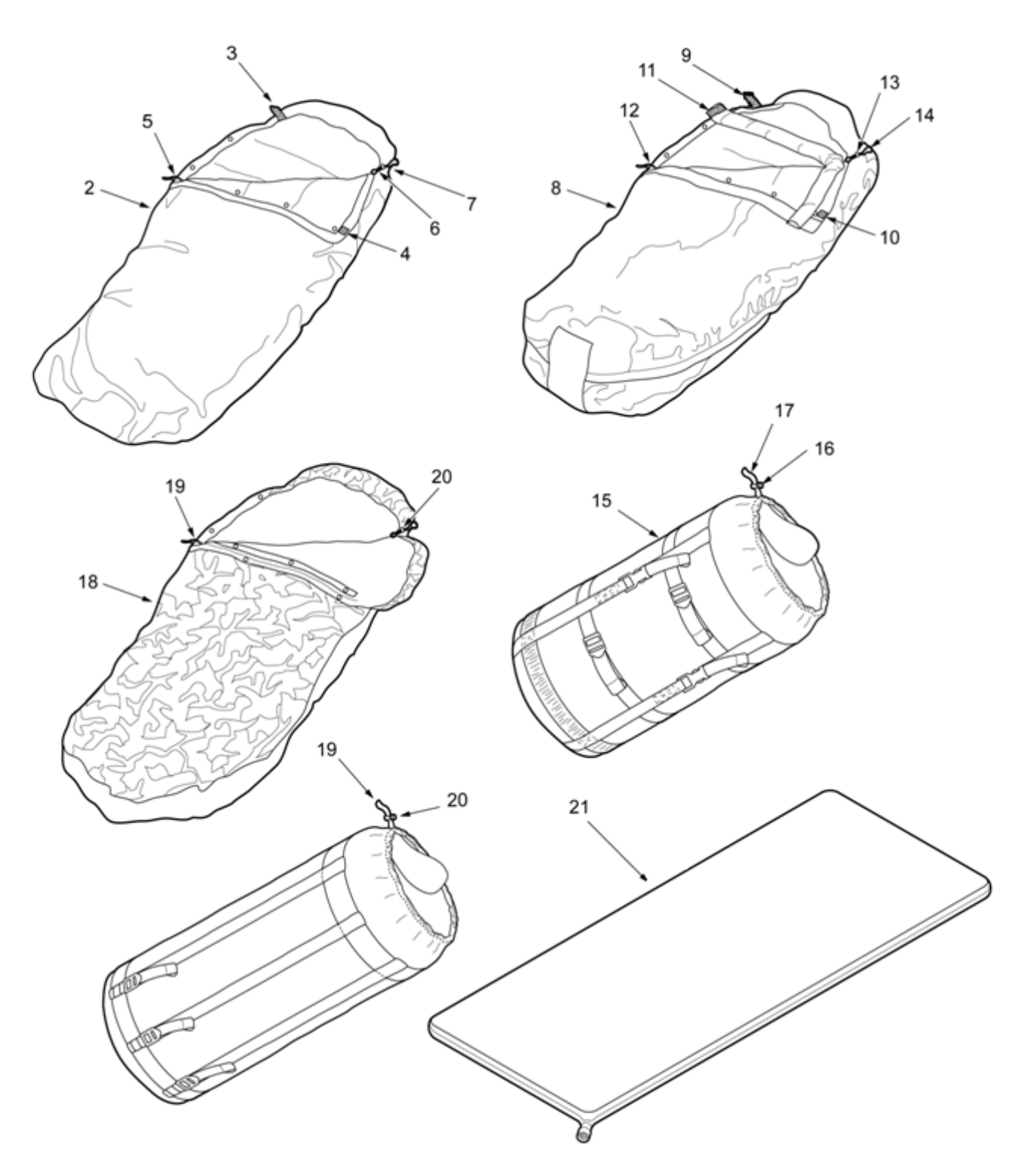
The US Army's original Modular Sleep System consists of two independently usable sleeping bags, an external bivy cover and a compression sack. Each component of the green-and-black version with Woodland cover has a distinct task: the Patrol bag provides lighter insulation, the Intermediate Cold Weather bag adds loft for lower temperatures, and the bivy cover keeps out wind and precipitation. An insulating sleeping mat is outside these four principal components and is still required to reduce heat loss into the ground.
The original four-part set
The original 1994 sleeping-bag design distinguished the Patrol bag as Type I, the Intermediate Cold Weather bag as Type II and the joined bags as Type III for extreme cold. Type III is a combination of the two existing sleeping bags, rather than a third additional bag. The four-part green-and-black set is listed under stock number 8465-01-445-6274. Its Woodland bivy cover remains a separate component; the insulating filling is in the two sleeping bags.
| Original component | Stock number | Function |
|---|---|---|
| Patrol Sleeping Bag, Camouflage Green 483 | 8465-01-398-0685 | Lighter independent insulation; outer sleeping-bag layer when combined |
| Intermediate Cold Weather Sleeping Bag, Black 357 | 8465-01-398-0687 | Heavier independent insulation; inner sleeping-bag layer when combined |
| Bivy Cover, Woodland | 8465-01-416-8517 | External waterproof, moisture-vapour-permeable weather cover |
| Compression Stuff Sack, Black | 8465-01-398-5428 | Gather and compress the bulky components for carriage |
Insulation lies between water-repellent nylon shells
Both sleeping bags have a mummy shape and their own hood. In the original construction, the inner and outer shells are hydrophobic nylon ripstop with a water-repellent finish. The insulation is resin-bonded batting made from hollow continuous-filament polyester. The fibres and the air retained among them give the material its bulky insulating behaviour. The filling is held so that it should not migrate freely inside the bag and leave isolated cold areas.
The hood has at least the same insulation as the rest of the sleeping bag. An internal insulated flap or tube lies against the zipper to limit heat loss along the closure. It is also intended to keep the slider from catching the lining while closing. The cold-weather bag adds a quilted insulated collar across the upper chest. This limits air exchange between the body compartment and the hood. In the original design, its anatomically shaped footbox contains at least twice the insulation amount used in the remainder of the bag.
Loft is the actual air-filled thickness of the insulation. After removal from the compressed sack, shake the sleeping bag vigorously so that this volume can expand again. Filling underneath the user's body is compressed while lying down. Even with well-expanded insulation above the body and a thicker footbox, a separate pad is still needed to insulate the person from the ground.
The black cold-weather bag goes inside the larger green Patrol bag
For the original combined version, the black Intermediate bag goes inside the green Patrol bag. Matching snaps alongside the zipper openings connect them. First open both hoods fully; the black hood sits inside the green one. This attachment holds the bags as a common assembly, while the external bivy cover then deals with wind and wet weather.
The original inside measurements show the difference between the two components. From the bottom of the footbox to the top of the hood, the Patrol bag measures approximately 229–234 cm and the Intermediate bag approximately 216–221 cm. At their widest point, measured flat from side seam to side seam, the Patrol bag is approximately 91–94 cm and the cold-weather bag approximately 88–90 cm. These measurements include the hood and describe bags measured internally after being turned inside out. They are not a guaranteed user's body-height range. The larger outer bag leaves room for the additional inner layer.
Entry and exit in the original combined configuration use the outer Patrol bag's zipper. Reversible pulls allow operation from inside and outside; the two sliders also permit ventilation at the head or foot end. The non-locking closure is designed for rapid egress as well: quickly spreading the two sides of the opening above the slider forces it downwards. This is a feature of that closure design and requires an intact, accessible zipper.
The hood is adjusted with its cord and barrel lock; a knot in the hood cord would hinder rapid exit. If a zipper fails, the existing snaps can hold the bag provisionally closed. This leaves a less protected strip along the opening and also limits operation from inside.
The bivy cover and ground insulation close different gaps
The sleeping bags' water-repellent ripstop deals with light moisture. The separate Bivy Cover goes outside for rain, wet snow, wind and ground moisture. The same cover can take the Patrol bag alone, the cold-weather bag alone or both joined. Its moisture-vapour permeability permits moisture transport through the cover; it does not automatically dry insulation already wet.
The face opening remains the route for breathing. Exhaling into the closed sleeping compartment adds moisture to the lining and filling. Excess warmth can be vented through the zipper before heavy sweating introduces more wetness. In cold conditions, frost can accumulate inside the bivy cover when water vapour reaches the cold surface. Brush this frost out before packing so that ice is not carried inside the assembly and melted into water during later warming.
Both bags are compressed beneath the sleeper's body. A foam or other suitable sleeping mat therefore provides the barrier against conductive heat loss to the ground, although it is outside the four principal components. If the mat is missing, a dry and sufficiently thick layer of available material can limit the loss. The waterproof bivy cover cannot replace that insulation; a mat, in turn, does not keep rain and wet snow off the sleeping bag.
Weight, packed volume and the compression sack
The original Patrol bag weighs approximately 3 lb, about 1.4 kg; the Intermediate bag is approximately 4 lb, about 1.8 kg. The original maximum of 7 lb, approximately 3.2 kg, applies to the two joined sleeping bags. The bivy cover, compression sack and a sleeping pad add to the carried load. A seven-pound figure consequently does not describe a complete four-part set with a pad.
The black compression sack is made from coated 200-denier nylon. Uncompressed, it is approximately 71–76 cm long and 30–36 cm in diameter. At least six longitudinal straps shorten the filled cylinder, while reinforcement around both ends carries the load. The two sleeping bags and bivy cover were intended to compress to no more than one cubic foot, about 28 litres, and fit the sleeping-bag compartment of the large field pack. At a halt the bags must be unpacked and shaken so that the filling can recover its loft.
Temperature ratings, clothing and later versions
The original design assigned the Patrol bag to milder conditions and the Intermediate bag to greater cold. The combined sleeping bags included additional clothing in their design conditions: the requirement down to −30 °F, approximately −34 °C, assumed expedition-weight polypropylene underwear and cushion-sole socks; the range down to −50 °F, approximately −46 °C, included further layers of contemporary extreme-cold-weather clothing. That clothing provides additional insulation at the body. A wet retained pad or heavily compressed filling changes the combination, as does a missing clothing layer. The later, specifically named ECWCS Gen III clothing system has its own dated protection architecture.
The modular set defined in 2009 under GL/PD 07-09B has five components: two sleeping bags, a bivy cover, a large compression sack and a small one. It distinguishes Standard and Long sizes and lists Foliage Green, Urban Gray and UCP among separate colours and patterns. Maximum weights for the complete five-part set are 9.8 lb and 10.3 lb respectively, approximately 4.45 and 4.67 kg. These include the cover and compression sacks. They describe a different scope of supply from the original seven-pound maximum for the two sleeping bags alone.
How the system loses protection
Missing snaps allow the two sleeping bags to shift against each other; a failed zipper obstructs exit and opens a long cold strip. Tears in the lining can expose or displace the polyester batting. Holes and failed seam tape in the bivy cover create direct leaks. Repairs must therefore match the affected layer: stitching can close a tear in the weather cover while also creating new needle holes that then require sealing.
Before packing, remove dirt, ice and loose moisture. A wet sleeping bag should be dried as far as conditions allow and compressed only afterwards. Long storage in the tightly cinched sack keeps the filling crushed; dry, loose storage gives it a better chance to retain loft.
The appearance of U.S. Department of War (DoW) visual information does not imply or constitute DoW endorsement.