

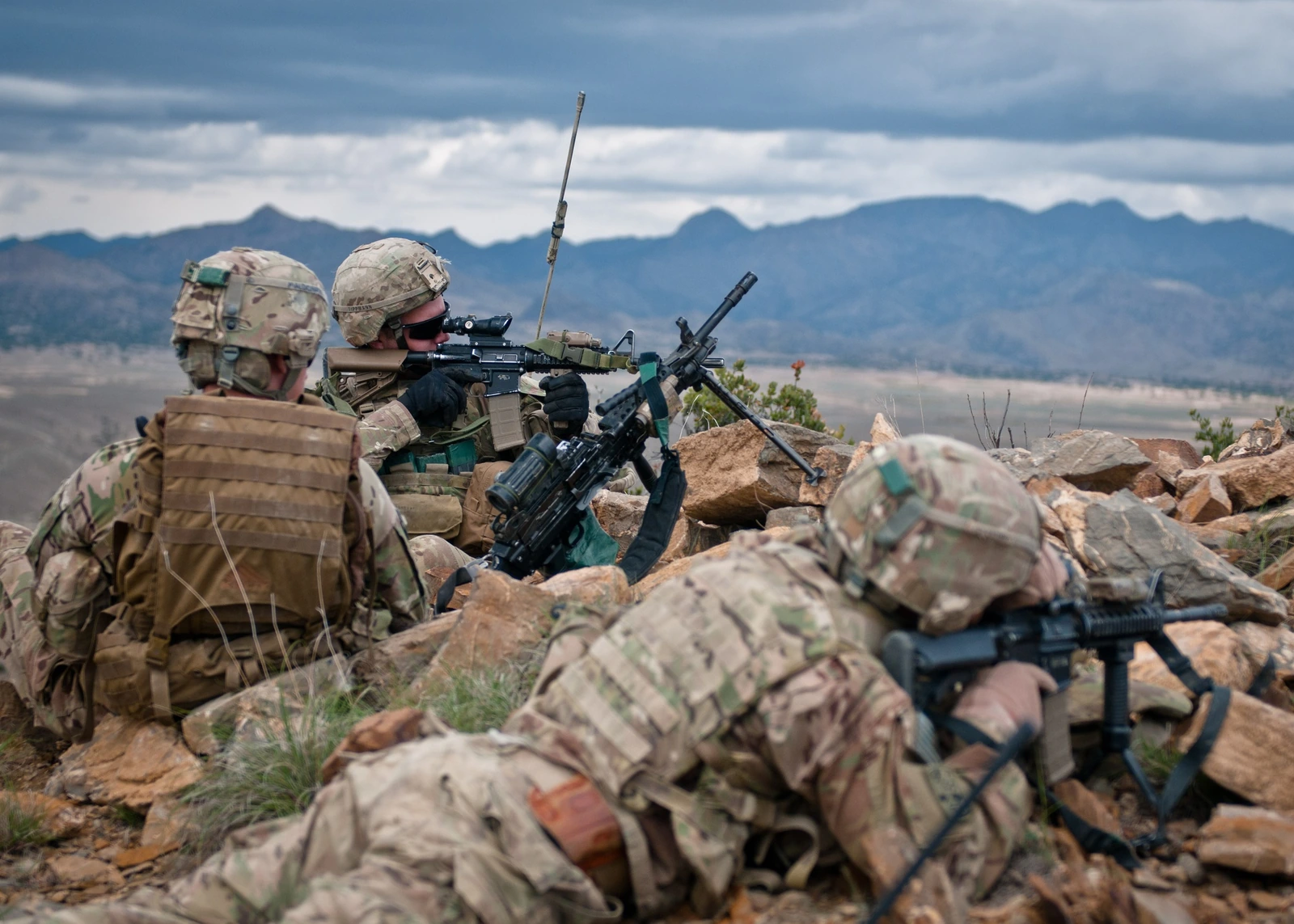
During evasion along a ridge, the shape of the ground determines how much of a person’s body is exposed and how much of the next slope can be observed. The highest point often provides distant views while a bulge in the hillside conceals the nearer ground below. The military crest lies below the topographic crest. From this area, the slope can be observed as fully as possible down to its base, with higher ground remaining behind the observer.
Topographic Crest and Military Crest
The topographic crest is the highest point of a hill or the highest line along a ridge. The military crest is defined by the view over the slope in front of it. It lies on the upper slope, below the topographic crest. Its precise location follows the shape of the ground: a projecting shoulder, a rounded ridge and a narrow rock edge produce different viewing conditions.
The term therefore describes an observation area. A person who can see the foot of the slope from there also has an unobstructed line of sight to that ground. The hillside behind the person can make the silhouette less distinct; movement, exposed pale skin or conspicuous equipment can still stand out against it. Evasion therefore requires attention to how the observation area can be reached and left, as well as to the view it provides.
Why High Ground Can Conceal the Slope Below
A convex slope is gentler near the top and becomes steeper farther down. Its outward-curving surface comes between the eyes of someone at the crest and the lower slope. More distant ground remains visible while a strip immediately below is hidden. A track or a person in that strip may be concealed even though the valley floor beyond is already in view.
Moving the observation point downhill can bring the line of sight past this bulge and extend the view to the foot of the slope. It also opens the view from the lower slope towards the observer. Higher ground behind the observer reduces the contrast against the sky. Terrain or dense vegetation in front of the body can instead interrupt the direct line of sight.
A concave slope is steeper near the top and gentler towards the bottom. From its upper edge, this inward-curving surface can be observed over much of its extent, unless vegetation or other landforms interrupt the view. A person on the lower slope may therefore be visible while remaining well below the crest line. A local fold in the ground, a boulder or dense vegetation must lie between the person and the observer to interrupt this line of sight.
Silhouette Depends on the Viewing Direction
On an open crest line, the head, shoulders and equipment appear against the sky. The continuous human outline can be conspicuous even when clothing colours cannot be distinguished. Below that line, earth, rock or vegetation may form the background. The potential observer’s direction matters: from lower ground, a shoulder of the hillside can already form the visible skyline although it lies well below the summit.
Body position changes this outline. A prone body may remain below an edge while a raised head or pack projects above it. The whole moving outline therefore needs to be considered, including equipment carried high on the body. A single tree or boulder at the edge provides screening within a limited area; stepping out to its side can expose the complete body outline again.
Observe from a Concealed Approach
Before reaching an edge, a halt is made within existing concealment. The reachable observation point, its background and the route back into concealment are examined first. A low approach uses small folds in the ground and existing vegetation. The upper body remains below the edge while the eyes are brought forward only far enough to obtain the required view. Where the edge itself is open, a point offset to one side with rock or vegetation may offer a better position.
Observation covers the next section of movement, its approaches and the higher ground on the far side. Ground that has actually been observed is distinguished from hidden areas. When a track disappears behind a bulge, its continuation remains unknown at first. Movement or a sound from that area calls for another assessment before the evader moves into it.
A change of position can reveal ground that was previously hidden. The observer first returns into existing concealment and moves sideways from there. This provides a second viewing angle without walking along the open edge. Whether the additional view justifies the movement and exposure depends on the specific gap that must be resolved before continuing.
Choose Movement Space Below the Edge
Onward movement is considered through a sequence of terrain screens: a fold in the ground, a rock projection, a vegetated shoulder and the next concealed stopping point. Between them lie the sections where the person would enter an open line of sight. Following the military crest may provide a good view while leaving the evader exposed to an opposing slope for a considerable distance. Where vegetation is absent, a lower fold in the ground may provide more useful movement space.
This distinction is particularly significant in open desert or rocky terrain. When ground actually forms the background behind the body from the observer’s direction, the outline against the sky disappears. The moving figure may still stand out clearly on a uniform, light-coloured hillside. Small rock groups and depressions must then be assessed as individual visual barriers. A gully may screen the body from the side while opening out in the direction of travel; its course and a reachable exit determine how it can be used.
Narrow gullies and canyons also concentrate surface runoff. With heavy rain threatening, a concealed passage can become a watercourse that is difficult to leave. A longer concealed stay requires further conditions: a location away from regular traffic, screening from several directions and a way to leave. These requirements for an evasion hide are assessed separately from the view needed for a short period of observation.
Opposing Slopes, Side Views and Observation from Above
A ridge interrupts the view from the valley into the ground behind it. Higher ground across the valley may nevertheless provide a view over that ridge into the same area. An elevation to one side may also allow a view along a gully whose walls screen the body from an observer across it. Every change of direction therefore alters the surfaces between the body and a potential observer.
Observation from the air produces a steeper line of sight towards the ground. The side of a hollow may then lie below the line connecting observer and person. When choosing a stopping place, overhead screening is therefore examined as well. Overhanging rock or continuous vegetation may screen this viewing direction, while an open-topped depression exposes the body. The point used to observe the next slope and the place used for a longer rest may consequently be in different locations.
The appearance of U.S. Department of War (DoW) visual information does not imply or constitute DoW endorsement.