

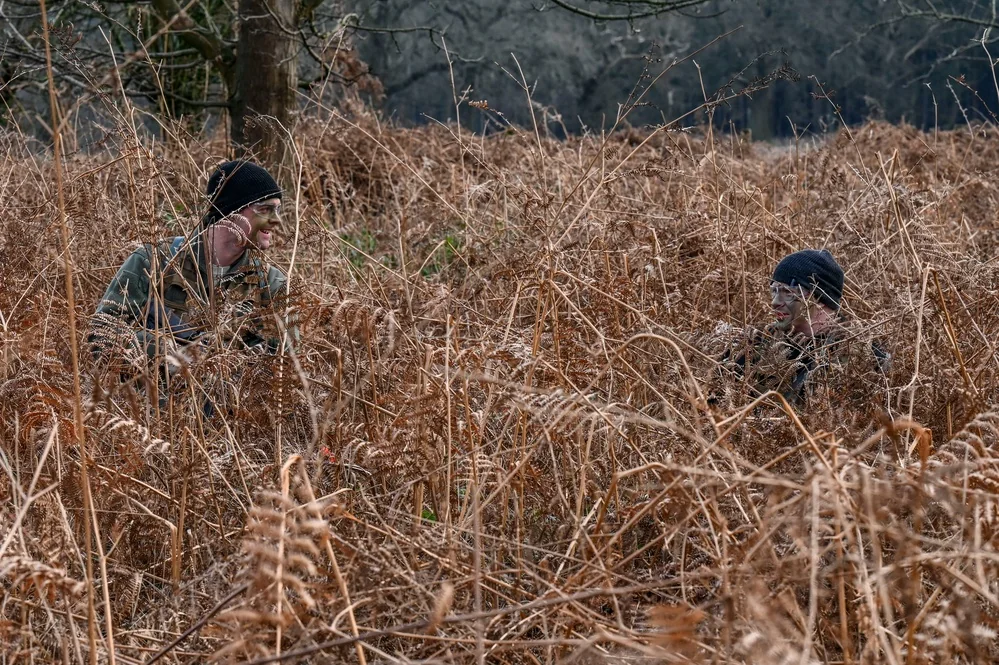
An evasion hide provides a concealed place for isolated military personnel while hostile forces search for them or restrict their freedom of movement. It allows them to assess the situation, check available resources and conserve strength for further evasion or recovery. Concealment, observation, routes out and the tasks that need to be carried out at the site must work together.
A site sheltered from the weather may be unsuitable for this purpose if a path passes directly beside it, approaching people cannot be detected or there is only one difficult way out. Conversely, dense vegetation alone is not enough if ground conditions make a longer stay physically untenable. Selection depends on the threat and the purpose of the halt.
From initial concealment to a concealed halt
After separation from friendly forces, an accessible concealed point provides an opportunity to assess the immediate situation. This includes observing hostile activity, checking personal condition and available resources, and attempting to establish the planned communications. This first opportunity to assess the situation is not yet a decision to remain at that location for longer.
US evasion terminology distinguishes between a hide site and a hole-up area for a subsequent stay. A hide site provides a concealed halt to review the situation and equipment, improve camouflage, rest and plan the next movement. A hole-up area places greater emphasis on restoring the person's ability to function. It is needed when physical condition requires a stop for water, food, equipment maintenance and rest. The person's condition, supply needs and the threat determine the kind of halt required and how long it lasts.
Site selection: concealment, observation and a way out
Paths, roads, access to water and prominent terrain features can bring people towards the site. Choosing a location away from such movement reduces these opportunities for encounters. At the same time, approaches must remain observable enough to detect changes in the situation.
A hide must not trap the evader. Possible routes out therefore form part of site selection from the outset. A terrain feature that conceals the body well may also block further movement. Gullies and canyons introduce the additional danger of rapidly rising water.
Concealment must be assessed from several directions. Dense vegetation in front of the body may leave the sides exposed; a site that is inconspicuous from ground level may be open from above. Conversely, a completely closed screen of vegetation impedes observation from within. The site must allow concealment and awareness of the situation without requiring the evader to leave concealment every time they look out. Observation is carried out from a concealed prone position.
BLISS: five criteria for an evasion hide
The US mnemonic BLISS brings together the visual and spatial requirements. It supports site selection and preparation.
| Criterion | Practical meaning |
|---|---|
| Blend | The person, equipment and any changes to the site must blend into the existing surroundings. |
| Low silhouette | Keep the visible outline low; neither the body nor equipment should project above the existing concealment. |
| Irregular shape | Avoid conspicuous regular shapes and break up recognisable outlines of the body and equipment. |
| Small | Keep the site and the changes needed to use it small, rather than creating an extensive camp area. |
| Secluded location | Choose a location away from the ordinary movement of people. |
BLISS addresses the site's visible outline and location. The threat posed by thermal imaging is assessed separately. Approaches remain under observation during the stay so that people or search forces moving towards the site can be detected.
Use the site with as little alteration as possible
A short stay during evasion makes use of existing terrain and vegetation wherever possible. Extensive cutting, rearranging or construction changes the very surroundings into which the hide should blend. The first step is therefore to use existing concealment for the body and equipment. Additional camouflage addresses the outlines that are actually visible, rather than covering the whole site with a conspicuous pile of fresh material.
A well-concealed position loses its value if repeated movement creates a clear path leading to it. Entry and exit are therefore adapted to existing terrain and vegetation. Unnecessary movement within the site must also be avoided. This concerns both the visible movement itself and the changes it causes to the ground and vegetation.
Camouflage changes during a stay. Cut vegetation wilts, and initially useful shade shifts with the sun. The site must therefore continue to be assessed as these conditions change. Shiny objects are kept covered, rattling equipment is secured, and watch alarms and hourly chimes are switched off.
What happens in the hide
A hide site provides an opportunity to reassess conditions after the initial evasive movement: what resources remain, what limitations exist and what is needed for the next phase? Stocks of water, food, equipment and communications resources influence the next decision. Rest preserves the ability to make the next movement. It is combined with continued observation and security.
A hole-up area must support additional tasks because a longer stop to meet basic needs and rest requires more than concealment alone. Water and, where needed, food must be accessible; equipment may need maintenance. Resting, obtaining food and preparing it are kept spatially separate, rather than concentrating every activity at the actual resting place. Every additional movement, however, increases the risk of revealing the hide. Site selection therefore needs to account for how the person will obtain supplies during the stay.
Keep communications and recovery in view
Existing evasion planning, such as a prepared Evasion Plan of Action, and the intended recovery procedures govern the stay. A site that provides good concealment may not also be suitable for communications or signalling. These possibilities therefore belong in site selection and the continuing plan for the stay.
Before transmitting, the threat of hostile direction finding must be considered alongside the need to establish contact. Visual concealment does not prevent a radio transmission from providing clues to the location. Conversely, a blanket refusal to communicate can impede recovery. The planned communications procedures and the actual situation govern the decision.
Stay or continue evading
The stay continues while the site still provides protection, observation and the rest or sustenance required. It loses that function if search forces control the approach, tracks lead directly to it, water or weather protection becomes inadequate, or a prepared recovery requires movement elsewhere.
Before leaving, the person reassesses the next concealed point, the route to it and their ability to complete the movement. A new direction of approach, an impassable section or a sharp decline in physical capacity may end the planned movement before the destination and require another route or a new concealed halt.
The appearance of U.S. Department of War (DoW) visual information does not imply or constitute DoW endorsement.