

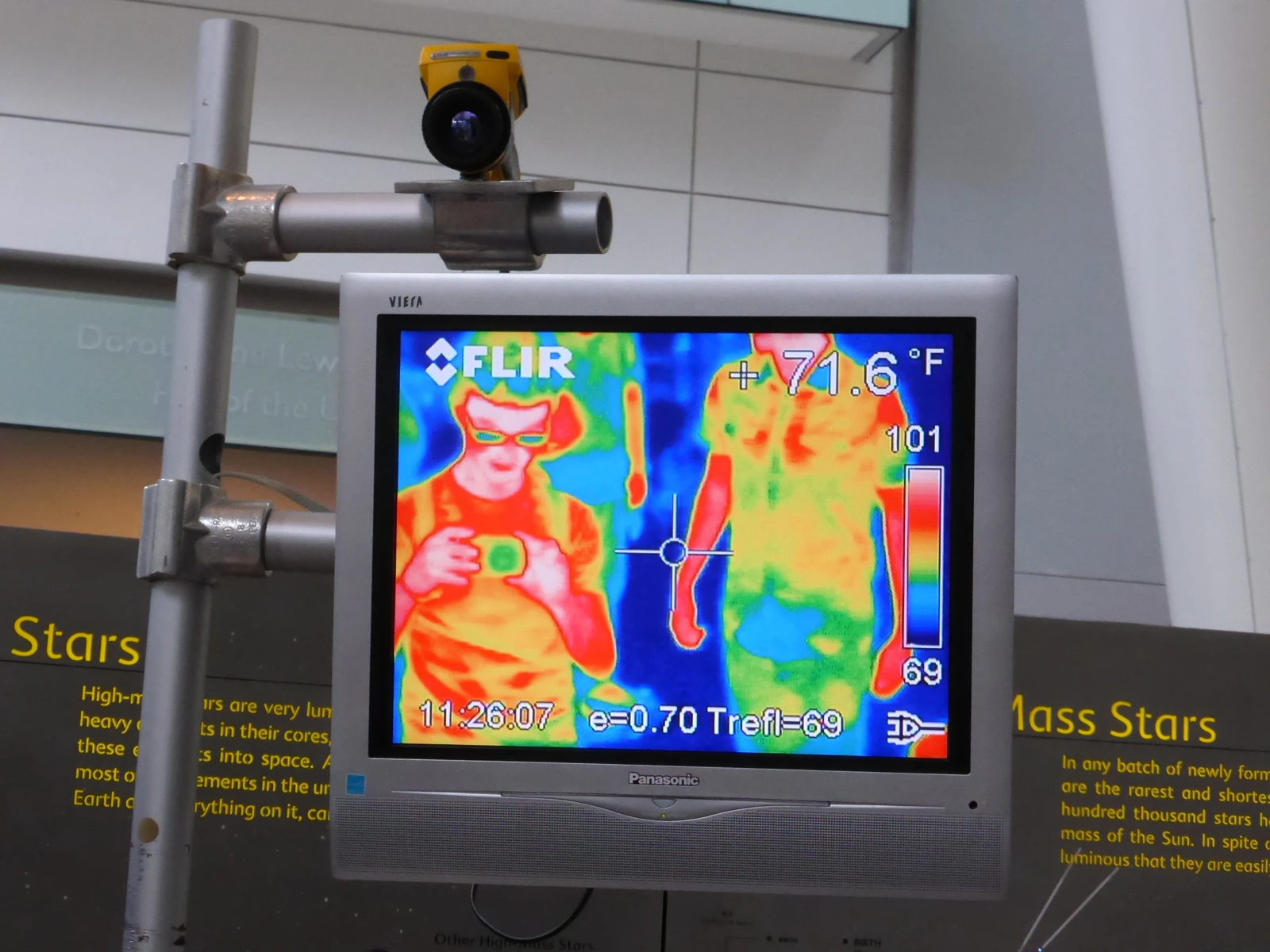
Thermal imagers receive infrared radiation from exposed skin, clothing, a screen or the ground in front of the person. A tree trunk can interrupt the direct image of the body. An opening beside it may still expose an arm. A covering that obscures the human outline can also remain visible as a conspicuous area in the thermal image.
Three tasks therefore interact for an isolated person: interrupting lines of sight, limiting exposed body parts and movement, and considering the background behind the visible parts. A halt site also involves views from the sides and from above, along with changes occurring during the stay.
Visible light, near infrared and thermal imaging
Infrared is an umbrella term for different forms of observation. For surfaces at ordinary environmental temperatures, a near-infrared image relies predominantly on reflected light. Thermal imagers use longer wavelengths, where the surfaces’ own emission becomes important.
| Observation | Image information | Significance during evasion |
|---|---|---|
| Visible light | Reflected sunlight, moonlight or artificial light reveals colour, brightness, shape and movement. | A dark object against a light background can stand out as a continuous silhouette. |
| Near infrared, NIR | Reflected radiation immediately beyond visible red, used by suitable night-vision and camera systems. | Leaves and equipment materials can have different relative brightness here than they do to the naked eye. A matching visible shade of green does not describe this reflection. |
| Thermal infrared | The surfaces’ own emission and reflected thermal radiation. Common camera bands are approximately 3–5 µm in mid-wave and 8–14 µm in long-wave infrared. | Body parts or a covering can stand out against the background without visible light. The material and camera band determine which surface is imaged. |
Low-light or NIR observation and thermal imaging may be used together. An outer layer matched in colour initially serves a purpose in reflected light. Its transmission in the relevant wavelength band, surface temperature and reflection also matter for thermal imaging.
Use the actual sight barrier
Solid earth, rock and a sufficiently wide tree trunk block the direct view of body parts behind them for a typical thermal imager as well. The camera images the surface of the obstacle facing it. Shoulders, feet or equipment projecting beyond its edges remain in view; the useful screening ends at the edge visible from that viewing direction.
A narrow trunk may hide the torso from an observer at ground level, while an elevated view exposes body parts around or above it. At a halt site, the assessment therefore concerns where earth, wood, rock or continuous vegetation actually lies between the body and a possible observation direction.
With artificial coverings, the material’s behaviour in the relevant spectral band matters. Some thin plastic sheets block visible light while transmitting long-wave infrared. With an opaque covering, heat absorption can instead change its outer surface. The camera then images that surface.
Openings and movement in vegetation
Vegetation screens through leaves, branches and trunks with openings between them. Several offset layers can interrupt more of the body’s outline than a single thin layer of foliage. From another direction, however, the openings align differently. At a resting point, vegetation above the person and views through the sides therefore matter as much as a dense appearance from the front.
A hand visible through a gap need not provide a complete human silhouette. When it moves, the contrast pattern in the image changes, providing a temporal cue alongside shape. Shifting branches can also expose parts of the body that were previously obscured. Observation and small tasks at the halt site are therefore carried out within the existing screening; hands, head and equipment should not repeatedly enter the same open line of sight.
Screening and background change continuously during movement. A short passage through an open gap can expose much more of the body than the longer stretch through vegetation before it. The decision concerns the transition as well as the distance to the next concealed point.
Which surface stands out in the image
For a surface opaque in the camera’s band, the sensor receives a mixture of the surface’s own emission and radiation reflected from its surroundings. Emissivity describes its own emission at a given temperature in the wavelength band considered, relative to an ideal blackbody. Smooth metallic surfaces can be highly reflective, so their thermal image also depends substantially on the radiation environment reflected in them.
A reflective emergency blanket may, for example, reflect the cold sky and appear conspicuously cold against soil or vegetation. The human outline beneath it may disappear while a large conspicuous area remains detectable. Such an area can attract attention before further observation identifies it as a person, equipment or another object.
Exposed metallised film can also reflect sunlight. If it is needed for protection against heat loss, its shiny surface is kept behind the existing outer screening.
Contact points and a warming cover
A covering exchanges heat with its surroundings and with the body beneath it. Where the covering is cooler than the part of the body touching it, direct contact transfers heat into the material. Beneath a close-fitting layer, warming of the enclosed air and radiative exchange also contribute. The camera may subsequently image the changed outer surface while the body itself remains hidden from direct view.
Shoulders, knees or a bent elbow can press a loose covering against the body from inside. These contact areas require attention when adopting or changing position. Where the available arrangement permits it, separating the body from the outer screen reduces direct contact heating. An air gap does not eliminate radiative exchange or warming of the air; the outer surface remains part of the heat balance.
Insulating clothing also changes the temperature pattern on its outer surface. Exposed skin, thinly covered areas and more heavily insulated parts can therefore produce different contrasts alongside one another. Additional layers against cooling also affect mobility and heat loss.
The background changes during the stay
Sunlit rock, soil, foliage and wet surfaces absorb and release energy differently. Sunset therefore does not produce a uniformly cold background. An exposed body surface may stand out less beside a rock that remains warm and more against cooling vegetation. The background immediately behind the visible part matters, rather than air temperature alone. Even with a temporarily small temperature difference, outline, reflection, size and movement may remain conspicuous.
Fog and rain affect the radiation path through absorption and scattering; rain also changes surface temperature and wetness. The wavelength band, droplet distribution and viewing path determine how much image information remains. Light fog may already reduce visible sight while a thermal image still provides useful contrasts.
After a change of posture, checks establish whether the head, hands or equipment have entered new viewing gaps and whether elbows or knees are touching the outer covering.