

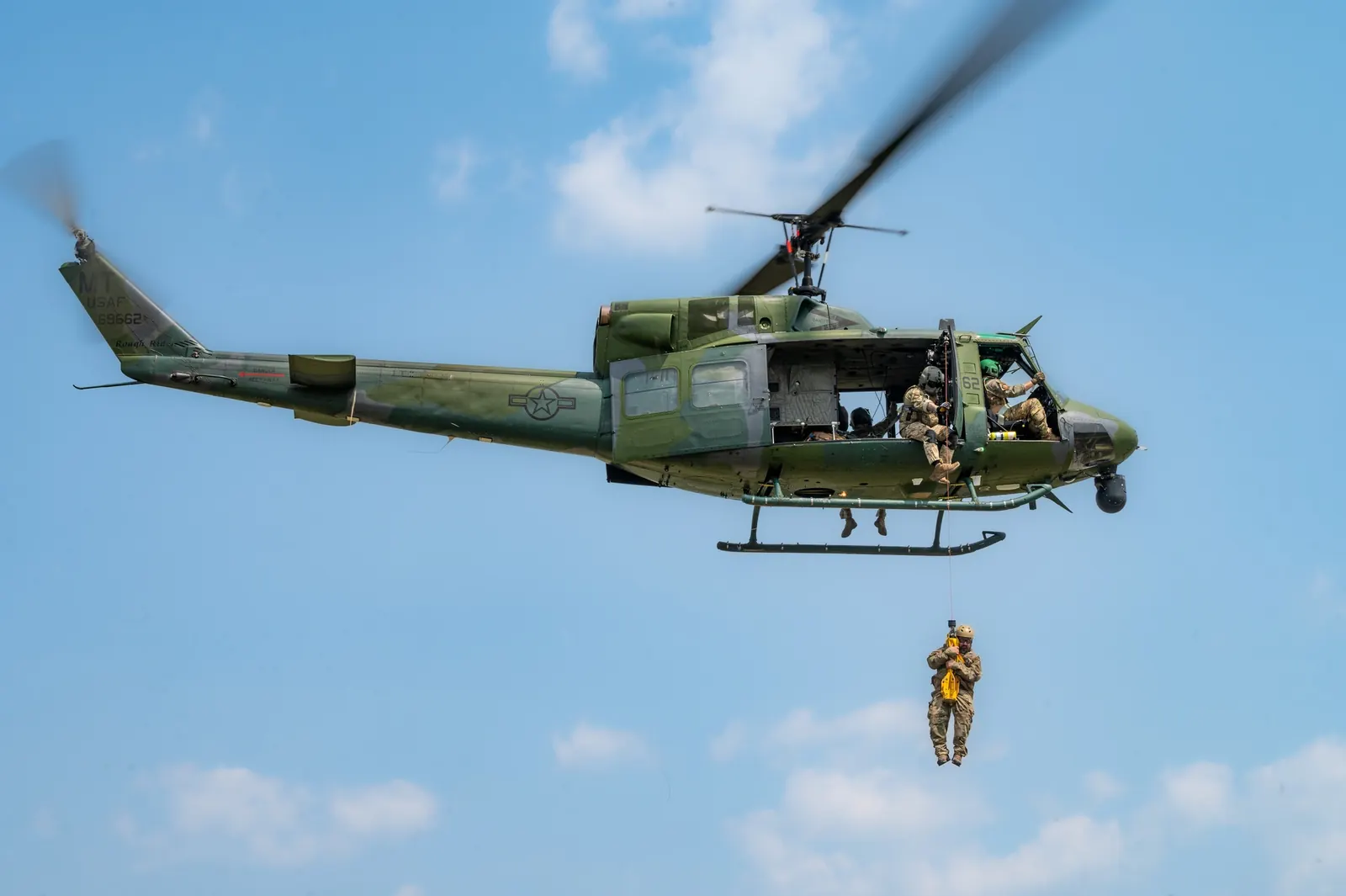
Escape is getting free from enemy captivity through one's own action. In the SERE context, extraction means the physical pickup and removal of isolated personnel by recovery forces that are actually available. A prolonged period of evasion may lie between them: the person has left the place of confinement but must avoid recapture, survive with the means that remain and regain contact with friendly forces. Preparation in captivity, movement after escape and participation in a possible pickup therefore form a connected sequence.
Preserving the ability to escape under captor control
In captivity, the captor determines where a person may move, whom they may contact and which possessions they may retain. Food, rest, clothing and care affect how mobile they will remain. Preparation therefore uses the opportunities still available: eat the food provided, use permitted opportunities for movement, monitor the condition of feet and clothing, and carry out everyday tasks in a manageable routine. Injuries, increasing weakness or missing footwear change how far a person could travel outside the place of confinement. Planning has to begin with that actual condition.
The person also checks which resources remain available. What still protects against cold or rain? Can available water be carried? Which possessions are actually accessible and portable? A survival kit issued before capture counts only if it is still present and usable. Captors may confiscate or withhold personal equipment and medical supplies. Preparation therefore depends on the equipment retained. Additional supplies, freedom of movement and unnoticed storage cannot be assumed under captor control.
Location knowledge may have to be assembled from individual observations. During transport, the sequence of recognisable changes in direction, approximate journey times, road or water sounds and distinctive visible terrain features can provide clues. Observable environmental conditions and changes add information at the place of confinement. The person retains these observations without turning an assumption into a certainty. A sound may suggest a road; it does not establish the road's location or the forces using it. That distinction matters both for subsequent movement and for recovery: an approximate location description must remain identifiable as approximate.
When considering a possible escape opportunity, the person also needs to assess what could follow. How mobile are they, what concealment is within reach, what threats can they identify and where could they stay next? Leaving immediate captor control may still leave them on exposed ground, without water or a usable direction. Preparation therefore includes the first tasks outside: leave the immediate danger, observe from concealment, narrow down the location and continue evasion with the resources that remain. Exhaustion can quickly change the plan; exertion, carried load and distance must be within the person's physical capacity.
Fellow captives, communication and the consequences of escape
In communal captivity, individuals have different observations and abilities. An available means of contact may allow them to establish the condition of fellow captives, compare location information and organise essential care. Separation and surveillance restrict this exchange. Information about a possible escape also affects other people: if participants or helpful fellow captives become identifiable, the captor may restrict their options as well. The amount disclosed therefore needs to suit the contact actually available and the requirement to protect information.
Under the US conduct framework, prisoners of war prepare to exploit escape opportunities under the guidance and supervision of the senior military person able to act. Leadership, care for the sick and wounded, and protection of fellow prisoners continue during captivity. Joint planning therefore also considers the people who will remain behind. If someone with important care or organisational responsibilities leaves, the remaining prisoners must carry out the work that person previously did. Assistance with escape and assistance with survival in captivity may compete for the same limited capabilities.
Those consequences require a concrete assessment. Who can move independently, who depends on others, and which tasks will remain unresolved after someone leaves? The group's condition may alter an intention that was previously workable. Armed guards, pursuit and recapture remain immediate hazards in the decision.
National escape responsibilities and the type of captivity
The American Code of Conduct requires US service members to continue resisting exploitation, make efforts to escape and help others escape. It rejects parole and special favours from the enemy. Parole ties release or reduced restraint to a promise, such as not bearing arms in future. A promise not to attempt escape may also become the price of privileges. The captor thereby interferes with future options and may create divisions within the captive group.
Under British service law, escape responsibility concerns people subject to that law who have been captured by an enemy. It turns on known steps towards rejoining British forces that they could reasonably be expected to take. Failing to take such steps without lawful excuse is an offence. It is also an offence, without lawful excuse, intentionally to prevent or discourage another person who is likewise subject to British service law and has been captured by an enemy from taking reasonable steps to rejoin those forces. Known opportunities, actual capabilities and the circumstances of captivity are therefore part of the responsibility.
The type of detention changes the decision. For US military personnel held by a government outside war, the American framework advises against attempts to escape from an unfriendly government's custody, with an exception for life-threatening circumstances. A breakout may lead to additional criminal prosecution there and complicate release. For prisoners of war, by contrast, prisoner-of-war law limits punishment for the unsuccessful escape attempt itself to disciplinary measures. Separate conditions apply to acts associated with escape; violence against life or limb falls outside the restriction for nonviolent acts committed solely to facilitate escape. Government detention, prisoner-of-war captivity and hostage-taking therefore each require an assessment of legal status, threats and the consequences of action.
Physical escape and legally successful escape also have different thresholds. For prisoners of war, the latter include joining their own or allied armed forces, leaving territory controlled by the detaining power or its allies, or joining a ship flying their own or an allied flag in the detaining power's territorial waters, with that ship outside the detaining power's control. If subsequently recaptured, they may not be punished for that already successful escape. Using weapons against escaping prisoners of war must remain an extreme measure preceded by warnings appropriate to the circumstances. Armed guards nevertheless remain an immediate threat to life; the person cannot base movement on an assumed interval between warning and firing.
After escape: evasion with the means that remain
Outside immediate captor control, the person regains more freedom to move. The first task is to avoid recapture. A concealed area permits observation and assessment once the immediate threat allows it. The person establishes their actual condition after captivity, the possessions still held and their location knowledge. Concrete abilities matter: walking, carrying a load, using essential items and covering the next stretch. After prolonged captivity, assumed capacity may differ greatly from actual capacity.
The next movement needs an achievable purpose. With a known location and reliable knowledge of friendly areas, the person can assess whether their equipment and physical capacity will allow them to reach those areas. If location knowledge is lacking, observable terrain features and memories of transport first help to narrow it down. Long distances travelled in a merely assumed direction consume strength and may lead closer to enemy routes or positions. Remaining concealed and observing may therefore take priority, while an immediate threat at the current location can force a move.
Movement proceeds between usable concealed areas and remains linked to observation. Before another stretch, the person reassesses accessible terrain, signs of human activity and their own exertion. Roads and other transport routes may help orientation while also concentrating enemy movement. Protection from detection must be planned alongside the need for water, rest and shelter from weather. This also explains the alternation between movement and concealment: an exhausted person can neither keep walking indefinitely nor maintain complete observation throughout essential rest. Remaining physical capacity needs to cover the next necessary tasks.
If the radio, phone, map and other originally issued equipment are missing, observable surroundings and personal abilities remain the basis for action. The person can avoid hazardous areas, gather location information, reach a more suitable concealed position and pursue a reachable return option when it is reliably known. A vehicle seen by chance or an unfamiliar uniform does not yet constitute confirmed pickup. Contact with unknown people may disclose location and identity; apparent willingness to help must be assessed against the situation and available knowledge of that person or group. The evasion article explains movement and concealment decisions in greater detail.
Identification records and evasion plans before deployment
Preparation for recovery begins before deployment. An Isolated Personnel Report, ISOPREP, supports identification and authentication. An Evasion Plan of Action, EPA, communicates intended evasion to recovery forces. With these records held in the recovery system, forces can match later evidence or a contact to a missing person. This is particularly useful when the person has only limited ability to report.
After captivity, the situation may differ substantially from the original plan. The captor may have moved the person; issued equipment or information may have fallen into other hands. A previously planned pickup point does not establish where they are now. If contact becomes possible, they need to report their current position, changes since the original isolation and possible losses. Recovery forces can then compare the prepared information with the actual situation.
Contact, location and useful situation reports
Radio contact requires an available, usable device with a power supply, suitable antenna, and the settings and procedures specified for the operation. A compatible receiver must be within reach on the other end. Terrain and other obstacles can block a line-of-sight radio path. A more exposed position may improve the link while also making the person more visible. Available communications are therefore assessed together with concealment and the threat. Specified contact times and procedures help limit energy use and unnecessary transmissions; an audible reply still has to be attributed to the correct party.
A useful location report describes the current position and how it was determined. Available coordinates are passed with their actual reference and time; when coordinates are missing, clearly recognisable terrain features and a local description may narrow the search area. Uncertain transport memories or a merely assumed location are reported as uncertain. False precision may send the force to the wrong place. After further movement, the earlier report must also be distinguished from the present position.
Other information directly affects pickup. Observed enemy activity reveals threats along the approach or near the person's position. Slope, trees, wires, buildings and other obstacles affect how forces can approach and how much space they have. The number and condition of people determine transport and assistance requirements: one mobile person needs different support from a group with an injured person unable to walk. Forces also need to know which signalling devices are available so that they can request a signal the person can actually give. This information is passed over the established contact and updated when conditions change.
Visual signals when no radio is available
A visual signal may draw forces' attention to the position when they actually reach the area and can see it. In sunlight, a signal mirror can be directed at confirmed friendly forces; the reflective surface is covered again afterwards. A suitable cloth or ground marking may provide contrast. An agreed pattern carries a specific message only when both sides know it. Size, contrast and viewing direction determine visibility; that same visibility may reveal the location to enemy observers.
A visual signal shows the person's presence but does not establish a two-way exchange. It offers less scope than a usable communications link to clarify the situation, confirm identity or coordinate changes to the planned pickup. Signals are therefore used under prepared arrangements or instructions actually received. An unanswered signal does not reliably confirm that friendly forces have recognised the person. Until pickup is imminent, they must continue to conceal themselves, observe and remain able to act.
Checking identity and accounting for compromised information
An accurate position answers where someone is. Authentication checks whether the contact is the person being sought. Recovery forces are especially vulnerable during approach and pickup; a false contact may lead them to a dangerous place and disclose information about their actions. The check therefore takes place before pickup even when precise coordinates are available. The person uses the prepared means specified for the operation and follows the actual authentication process.
Captivity may undermine an identity check that was previously usable. Confiscated information or information disclosed under captor control may have become known to other people. When a communications link exists, such losses or possible compromise are reported so that the recovery system can coordinate the comparison and any required changes. The person does not invent a replacement code: a new value known only to one side may prevent the check from succeeding. Further checks at the pickup site may connect the radio contact to the person physically present.
From communication to physical pickup
Before an impending pickup, portable belongings are packed and secured, while required signalling devices remain accessible. The person stays concealed until pickup is actually imminent and approaches the vehicle or team only when instructed. A non-threatening posture, secured weapons and avoiding sudden movement assist identification. Within a short time, the team has to distinguish the people being sought from unknown individuals and possible threats. Uncoordinated movement or independently running towards the vehicle makes that task harder.
When a ground team is used, it establishes physical contact, checks identity and brings the person to the transport platform. Inability to walk or an acute injury may require additional assistance at the site and during transport. The team needs knowledge of the condition and suitable capabilities for that assistance. The recovery vehicle may be a ground, air or maritime platform. Access, threats, terrain obstacles and people's condition determine which form is feasible.
For ground pickup, the person must be able to cover the distance to the team or vehicle, or be brought there by the team. During air or maritime pickup, the crew determines access and the handling of the equipment actually used. Landing, hoisting and other methods require different equipment and participation. The person reports limitations early and follows the instructions given for that means of recovery. Changing the platform or pickup location in turn depends on reachable forces and their capabilities.
German SERE training connects the term extraction with active participation in rescue and recovery. In one German multinational pickup model, contact is followed by identity checks, separation of the people being sought from unknown individuals, protection and transfer to the vehicle. Separation permits targeted checking and protected reception of those being recovered. In the British model, suitable forces may perform recovery in addition to their primary role; their suitability is assessed for the particular situation. What matters to the isolated person is therefore the confirmed task and connection to the pickup team, rather than an expected specialist vehicle or a particular appearance.
Pickup is complete once friendly forces have physically received the person and are directing their onward recovery. A final identity check may still take place. Health information and urgent information about other isolated people or captives remaining behind are passed to the receiving force. Care, debriefing about the isolation and return to the person's organisation then form part of reintegration. The personnel recovery article explains how this connects to the recovery options available.
The appearance of U.S. Department of War (DoW) visual information does not imply or constitute DoW endorsement.