

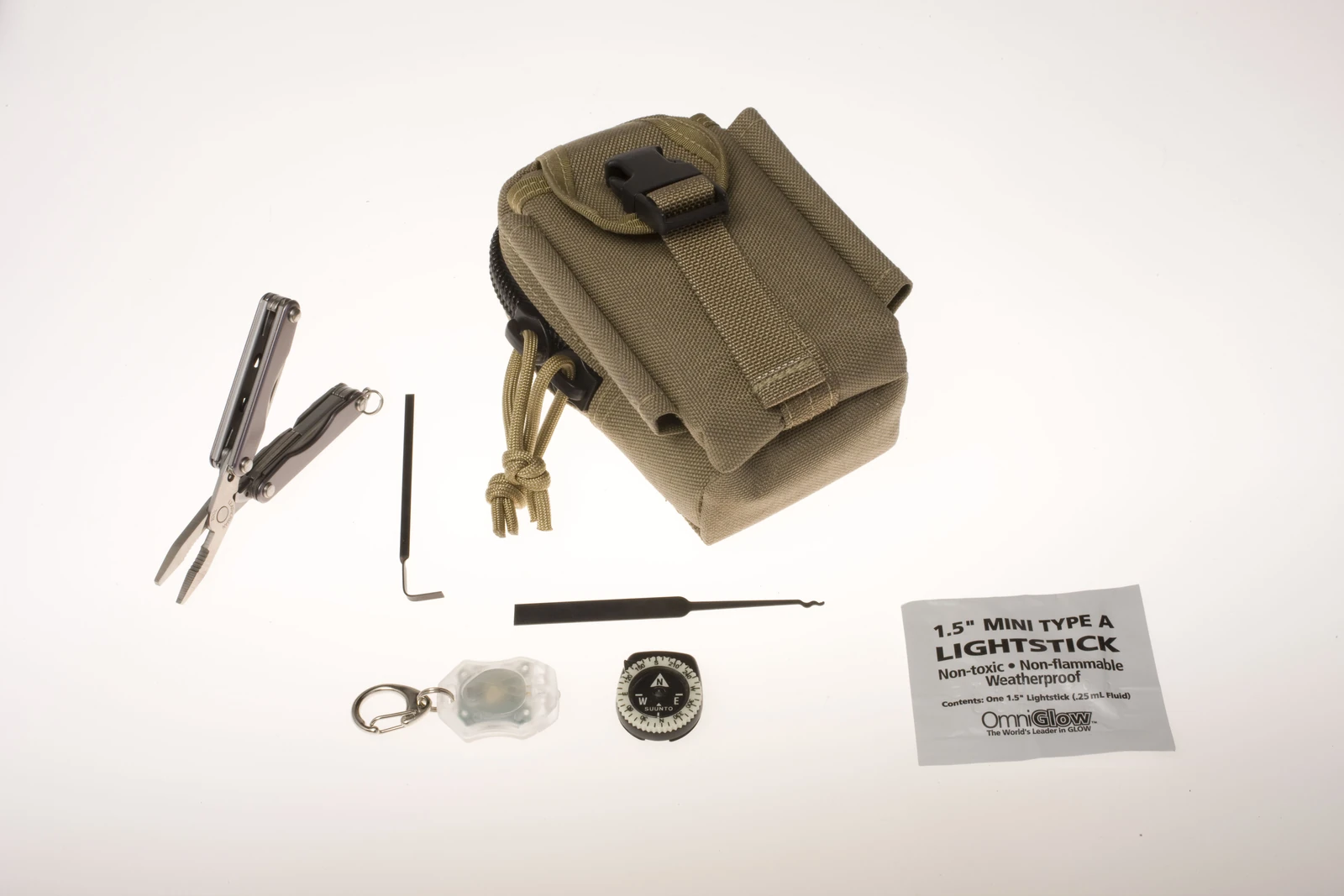
The Escape & Evasion Survival Kit in the CIA Museum was assembled for special operations personnel. The kit contains diamond wire for cutting metal, a ceramic blade, lock picks, a mini-Leatherman, a can opener and fishing equipment.
The case and the equipment in the photograph
The kit measures 20 × 15 × 7 centimetres. Its textile case has a zip with cord pulls and an additional buckle fastening on a webbing strap. Two slender lock tools lie beside and below the case. The pliers on the left belong to the mini-Leatherman, and the black compass below bears the Suunto name. The packet on the right is marked “1.5" Mini Type A Lightstick” by OmniGlow, indicating a lightstick approximately 3.8 centimetres long.
Wire and blade: different cutting tools
The diamond wire cuts metal by abrasion. Hard abrasive particles on its surface remove material as the wire moves across the workpiece.
Ceramic is hard but brittle: sideways twisting, prying or impact can chip the edge or break the blade.
The small Suunto compass
The compass at the bottom of the photograph has visible cardinal-direction markings and a scale around its perimeter. Because the steel tools can deflect its magnetic indication, the compass is read away from them.
The miniature lightstick
The packet on the right contains an OmniGlow lightstick. Lightsticks of this type produce light through a chemical reaction. Activation mixes two previously separate solutions; neither a battery nor an open flame is needed. Once started, the reaction cannot be switched off. Covering the light hides it but does not stop the chemicals being consumed.
Ambient temperature affects the process. In the cold, a lightstick of this type glows less brightly and reacts more slowly; warmth speeds up the reaction.