Fletcher Christian and his fellow mutineers took control of the Bounty on the morning of 28 April 1789. William Bligh, her commander, was brought on deck with his hands tied. Armed men guarded the approaches to the other officers, preventing him from assembling a party to recover the ship. Within a few hours he and eighteen other men were crowded into an open boat. The Bounty sailed away without them.
The ship had been sent to carry breadfruit plants from Tahiti to the West Indies. For the men put over the side, that expedition was over. They first needed somewhere to obtain water and food, then a means of getting home. Tofua was close enough to reach by boat. Bligh intended to replenish their supplies there and continue to Tongatapu, where he hoped for assistance from its ruler, Poulaho. Timor, far to the west, was not yet their next destination.
Nineteen men in the launch
They had not initially been assured of the larger boat. The mutineers wanted to lower the small cutter, but it leaked too badly. The launch was put into the water instead: an open working boat, 23 feet long, or approximately seven metres. With nineteen occupants, chests, casks and provisions, it lay low in the water. The men sat close together, with no cabin and no dry compartment for their food.
As the party was forced into the boat, several men managed to save useful possessions. John Samuel, the clerk, secured Bligh’s journals, his commission and important ship’s papers. These preserved a record of the expedition and material with which to explain the loss of the Bounty. Samuel also obtained biscuit, wine and rum. William Purcell, the carpenter, was allowed to bring his tool chest. Others collected sails, cordage, twine, lines and canvas, together with a water cask and smaller empty casks.
The assortment gave them the means to do several kinds of work. Sails and oars would move the launch; canvas and rope could be used to alter it; Purcell’s tools allowed repairs. The empty casks could hold water found or collected later. A copper pot would let them cook when they reached land. For defence, the mutineers threw them four cutlasses, but withheld firearms. If a meeting ashore turned hostile, the party would have those few blades and whatever movement an overloaded boat could manage.
Their navigational equipment consisted of a compass, a quadrant and an old book of latitudes and longitudes. The compass supplied a direction. With the quadrant, Bligh could observe the sun’s altitude and establish latitude when the weather allowed. Samuel had been forbidden to save charts or the marine timekeeper. There would be no chart to consult and no accurate time reference for determining longitude. Bligh also had to draw on his previous voyages and his memory of islands and coastlines. Finding the right island would still leave the separate task of finding a harbour.
The first landings on Tofua
They rowed towards Tofua, but its coast offered no easy place to beach the launch and fill their casks. Cliffs and surf obstructed the landing. On the first night they used two oars to hold the boat under the island’s shelter. Eventually they found a stony cove from which searching parties could climb the cliffs, using the growing vines in places. The men returned with coconuts, a few plantains and water from holes in the rock. For nineteen people, the quantities were small, and even these journeys demanded considerable effort.
Bligh went searching too. On one return he became so dizzy that the botanist David Nelson and others had to help him down. The stay therefore brought little immediate recovery from the mutiny. The men worked back and forth between the launch and the higher ground simply to improve their meagre supplies. When islanders came to the cove, trade initially offered a less arduous way of obtaining food. Buttons and beads bought breadfruit, coconuts and some water.
Bligh would not offer nails. Metal might be needed for work on the launch, and they had little prospect of replacing repair materials during the passage. On his instructions, the party told the islanders that their ship had capsized and sunk. The story concealed the mutiny while also revealing that no ship’s company was nearby to support them. What had begun as useful contact became more threatening as the crowd grew and some men tried to haul the launch ashore.
Bligh threatened one of the chiefs with a cutlass, stopping the attempt for the moment. Through the afternoon, however, he saw more men holding stones and preparations to stay on the beach. The British party was becoming surrounded in the cove. He decided to leave around sunset. Moving their belongings through the surf was already difficult; the men could not all step aboard together and pull clear of the shore in one quick movement.
On the evening of 2 May, the British party came under attack as it withdrew. Quartermaster John Norton went back up the beach to release the stern line and was knocked down and killed. Islanders on the beach held the line, trying to drag the launch back. Bligh cut it with his knife. His party hauled out to the small boat anchor, but pursuers now came after them in canoes, throwing stones. The anchor had fouled and held the launch fast. Only when one of its flukes, an anchor arm, broke could the men get free and row out.
Reaching open water did not immediately end the pursuit. The loaded launch was slower than the canoes, and the men could scarcely bring their cutlasses to bear against the attackers. Bligh ordered clothes thrown overboard. Collecting the garments delayed the pursuers, and approaching darkness helped the launch gain enough separation to escape. Norton remained on Tofua. There were now eighteen men in the boat, and after the attack Bligh abandoned the plan to equip it in the Tongan islands.
He proposed sailing for the Dutch settlement on Timor and explained the distance to the men. Their remaining food would have to sustain a long passage. Before they headed west, he obtained their agreement to very small rations. After Tofua they had about 150 pounds of ship’s biscuit, 28 gallons of water, 20 pounds of salt pork, three bottles of wine and five quarts of rum. A few coconuts and crushed breadfruit supplemented the stores. Part of what they had brought from the ship had already been consumed or lost during the attack.
Heavy seas and continuous work
Heavy seas met them on the morning after departure. The sail lost the wind as the boat dropped into the troughs, then came under heavy pressure on the crests. Water broke over the stern. While the men bailed with all their strength, Bligh ordered weight discarded: surplus clothes, cordage and spare sails went overboard. Each man could keep two suits. The launch became lighter, and there was a little more room to work between its occupants. They also lost possessions that might have been useful during a longer voyage.
The biscuit was particularly vulnerable. It had initially been kept in bags, where seawater reached it and some began to spoil. The party rearranged Purcell’s chests, moving the tools into the bottom of the boat and putting the bread inside. This protected the store better against further water, but could not undo the damage already done. Spoiled biscuit was retained and eaten. They had no replacement stock, and the little fresh food obtained on Tofua was soon used up.
Working with the material saved from the ship, they gradually improved the launch. Additional shrouds supported the masts. A canvas weather cloth was fitted to keep water out, and seating boards raised the quarters by about nine inches. That small extra barrier could intercept some of the sea coming aboard. Even so, one or two men frequently had to bail without interruption. The boat remained usable only while steering, handling the sail and emptying it continued together.
In the larger seas, they had to run before the waves. A heading that brought Timor closer could put the hull badly across the breakers and let more water into it. Bligh therefore accepted a northwesterly course for periods of the passage. When the sea moderated, he steered farther south again, seeking to avoid being driven towards New Guinea. His intended landfall was among the Australian reefs south of Torres Strait, where he hoped to find shelter and supplies. The weather continued to determine how directly they could sail towards it.
The party divided into two watches. One half sat up and worked while the other tried to sleep on the floor or the chests. There was too little space to straighten their legs. Rain and seawater kept their clothes wet; nights were cold, and the men woke with cramps and pain. A good run under sail might save them from rowing, but it provided no sheltered sleeping place. As the boat moved west, its occupants continued to lose strength.
Finding their position and dividing the bread
Whenever cloud and the boat’s motion permitted, Bligh observed the sun. The resulting latitude let him check whether they had moved too far north or south. Longitude depended on carrying forward the courses steered and the distances they were estimated to have sailed. This process, dead reckoning, accumulated the errors of the separate estimates. A sun observation corrected their north–south position without removing uncertainty over how far west they had actually travelled.
To improve the speed estimate, the men later marked a log line and practised counting seconds. William Peckover, the gunner, had brought a watch from the ship; in early June it stopped. Cloud could prevent an observation, while on some dark nights even the compass was unreadable. They then kept their direction by the wind and sea. Bligh recorded islands, landmarks and reefs whenever he could write in the launch. He also explained the positions of New Guinea, Australia and Timor to the party, so that if he became incapacitated they would at least understand the route still ahead.
Two sailing canoes approached as they passed through the Fijian islands. After Tofua, Bligh would not risk another landing and had the men row away from the shore. Whether the canoes were hostile remained uncertain; contact might also have brought provisions. His decision meant continuing past visible land on the food already aboard. The men had neither better weapons nor more strength than during the attack, and losing the boat would have meant losing their stores and navigational equipment with it.
Dividing the biscuit consequently became a fixed part of work in the boat. Two coconut shells were made into a balance, with pistol balls providing the standard weight. A portion weighed approximately 18 to 19 grams. At first Bligh generally issued three portions a day. They were small enough to stretch the supply, but far too small to offset the work, wet conditions and lack of sleep. Weighing made the division visible and consistent: each man could see that his share was measured by the same standard.
On 24 May, Bligh checked the remaining stock. At three issues a day it would last another 29 days. He could not be certain when they would reach Timor or whether they could obtain provisions there; they might have to continue to Java. He therefore removed the evening portion, extending the calculated supply to 43 days. The men now had two bread issues instead of three. The evening allowance was restored on 6 June, after the Australian stops and with a prospect of making a quick crossing.
Rain could change the water supply much more quickly. The men spread their sails and collected the runoff. In early May, their stock rose to 34 gallons; a later heavy fall added another twenty. On other nights the sea and water breaking into the launch kept them too busy to collect anything. Weather that supplied drinking water also soaked the men afresh and interrupted their sleep. There was no equivalent replenishment of biscuit at sea.
The fishing line usually caught nothing. Occasionally the men could take noddies and boobies by hand when the birds came to the boat. They divided the entrails as well as the flesh, including small fish and squid from the birds’ stomachs, and gave the blood to the weakest men. With eighteen recipients, the pieces were tiny and unequal. A man who could not see them named the recipient of each piece. This allowed the extra food to be shared without the person dividing it deliberately awarding the largest portions. The few birds did not end their dependence on the biscuit.
A passage through the Barrier Reef
By late May, they were seeing more driftwood and seabirds. Bligh expected the Australian coast and began looking for a way through the Barrier Reef. Beyond its outer breakers he hoped for smooth water, where they could sleep, gather food and work on the launch without simultaneously fighting the sea coming aboard. The approach first placed them in danger, however. During the night the helmsman heard surf when the breakers were already close under their lee. Bligh still managed to turn clear.
They approached again in daylight and followed the line of breaking water, searching for an opening. When the wind shifted unfavourably towards east, the launch could no longer readily sail away from the reef. The men were too weak to row out. They now needed a passage before wind and sea carried them onto it. On 28 May they found one. A strong stream took the boat through, and beyond the breakers they reached the smooth water Bligh had sought.
A small nearby island proved little more than a heap of stones. A larger one had a suitable sandy beach, and they landed that evening. The following morning, 29 May, Bligh named it Restoration Island. He divided the party between boat and shore, checked for inhabitants and sent men to gather food. Oysters clung to the rocks. Since they were difficult to detach, the collectors opened them where they grew instead of spending time breaking whole shells away.
In a moist hollow, the men found water and dug a well which refilled as they emptied it. A small magnifying glass, normally used by Bligh to read his instruments, helped them make a fire. Saved sulphur and a tinderbox made subsequent lighting easier. The copper pot could now be used: oysters, a little biscuit and pork became a stew, with a full serving for each man. Palm hearts added to the meal. In the shade they could finally lie down while the launch rested quietly beside the beach.
The stop also allowed an essential repair. A fitting that held the rudder at the stern had come out and been lost. The men replaced it with a large metal staple. Bligh had already prepared loops at the quarters so that oars could be used for emergency steering, but in the heavy seas that alternative would have been difficult. At a sheltered beach they could restore the mounting of the proper rudder before beginning another open-water passage.
They filled their water containers to nearly sixty gallons and continued gathering food. Bligh kept back the biscuit whenever oysters or other fresh food could take its place. Each meal ashore was intended to save biscuit for the next sea passage. Supplies were still limited. Water could be carried away, many of the oysters were eaten immediately, and after a short rest the party had to move on. Restoration Island gave them a workable stopping place on the journey to Timor.
The stops along the Australian coast
Over the next few days, they continued within the reefs and landed on other islands. Searching produced shellfish, water and periods of rest, but no large reserve of food. Oysters adhered firmly to the rocks, and other shellfish were scarce. Turtle tracks and old shells encouraged the men, yet they caught no turtles. Some ate unfamiliar fruits or raw beans and afterwards feared that they had harmed themselves. Nelson was repeatedly asked, as the botanist, whether things were edible, but could not identify or recommend every plant they found.
Nelson himself returned from one search so exhausted that two men had to support him. He had continued working in the sun, became intensely thirsty, experienced trouble with his sight and could no longer walk. The others laid him in the shade and gave him small amounts of biscuit and wine. More men suffered nausea or painful straining at stool. Food and sleep ashore had not ended their illnesses. The searching parties still had to obtain each addition to the stores through physical effort, with less strength available for it.
On Sunday Island, oyster distribution led to an open confrontation. Purcell challenged Bligh, who took a cutlass and told the carpenter to take another. John Fryer, the Bounty’s master and thus her navigating officer, intervened. Bligh and Fryer later gave different accounts of what had started the quarrel. Bligh accused Purcell of insubordination. Fryer maintained that the searching parties had agreed beforehand to keep their own finds, and that the dispute began when Bligh nevertheless demanded Purcell’s oysters.
Both accounts describe an argument over food in which the commander picked up a weapon. Which man had broken an agreement remained disputed among the participants. Purcell was also the carpenter whose tools they had brought; Fryer was one of the officers who had served alongside Bligh before the mutiny. Leaving the ship together had not removed their tensions. After the confrontation, they still had to work in the same boat and divide the next small meals among themselves.
On another small island, Bligh wanted the fire kept in thick vegetation so that it would not be visible from the mainland. An additional fire ignited dry grass, making the island burn conspicuously. Bligh and Fryer again disagreed. Bligh held him responsible; Fryer denied knowing the relevant orders and described limiting the spread by pulling up dry grass. No attack followed, but some of the rest they had expected was lost. The night’s search for food was also disappointing. The bird party returned with only twelve small noddies, and the men watching for turtles brought back none.
After six days along the Australian coast, the launch left the protection of the reefs on the evening of 3 June. The stops had restored the rudder, supplied water and allowed several meals. Reaching Timor now required another open-water crossing. The surgeon, Thomas Ledward, and sailmaker Lawrence Lebogue weakened particularly badly on the way. The men had swollen legs, hollow faces and increasing mental dullness. On 8 June they finally caught a small fish, dividing flesh and offal among everyone. There was little more fresh food available during this last sea passage.
Finding Kupang
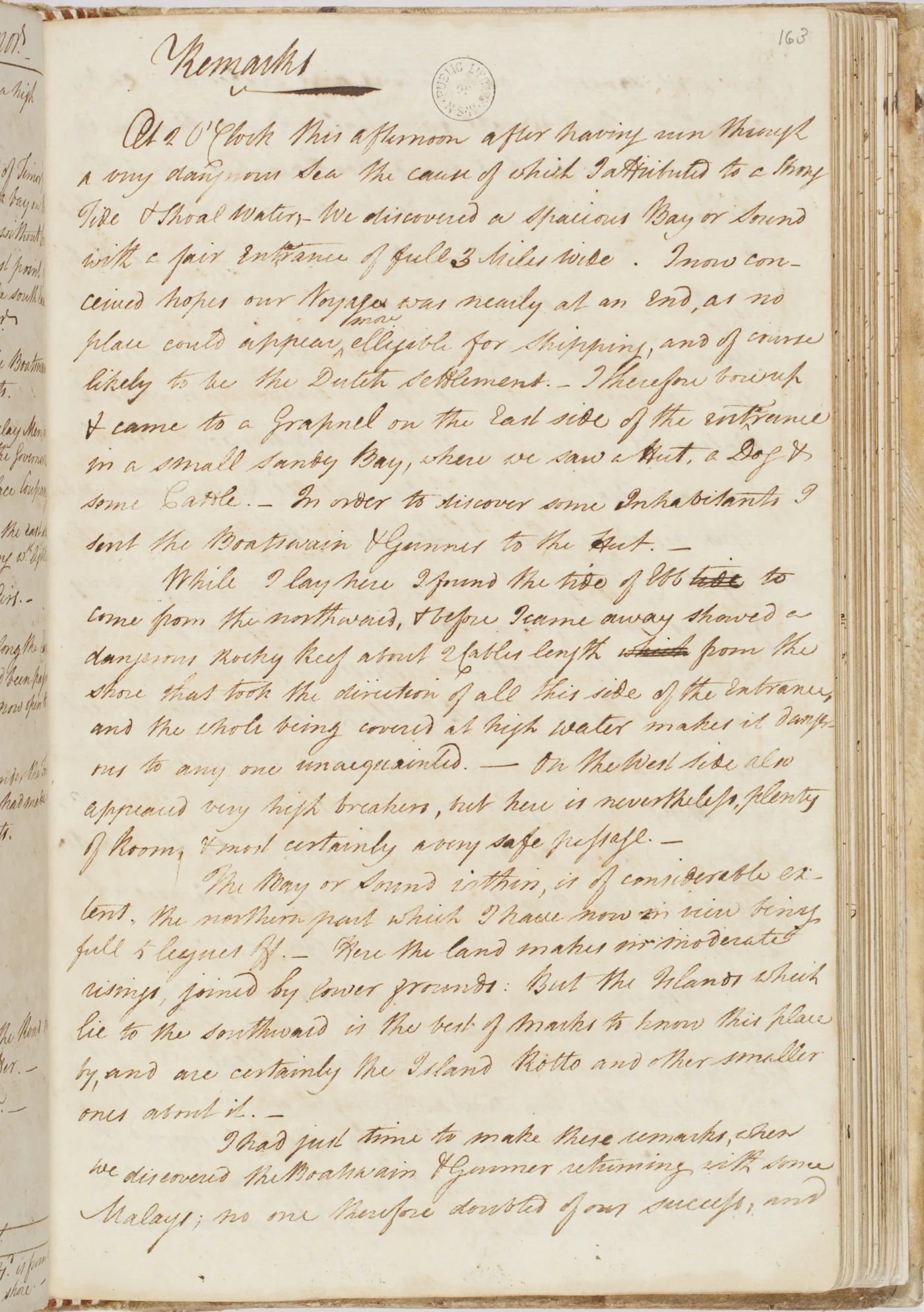
They sighted Timor in the early morning of 12 June. For the passage since Tofua, Bligh recorded 41 days and 3,618 nautical miles by his log, approximately 6,700 kilometres. Those figures end at the sighting of the island. The harbour they needed was still ahead, and Bligh did not know its precise position. He believed the Dutch settlement was towards the southwest and followed the south coast in search of it.
Heavy surf prevented landings in many places. During the night of 12–13 June, Bligh hove to so that they would not sail past the settlement in darkness. In a bay they eventually saw a hut, a dog and cattle. William Cole, the boatswain, and Peckover went ashore and returned with local inhabitants. One agreed to guide them to Kupang. For the first time on this final approach, the party had someone aboard who knew the local waters.
The pilot took them along the eastern side of the channel, with Semau on their left. As the wind failed, the men had to row again. Bligh issued larger portions of biscuit and wine and allowed a short rest before continuing. Before daylight on 14 June, the launch lay near the town and its fort. During the voyage, they had made a small flag from flags originally used aboard the ship to indicate sounding depths. Bligh hoisted it as a distress signal and waited for permission to land.
An English sailor brought him to Captain Spikerman. At the captain’s house, the men received tea, bread and butter; clothing and treatment for their sores followed. Some could scarcely walk from the boat. The launch still carried enough provisions for eleven more days at the small allowances. A food reserve remained for the previously planned fallback passage to Java. All eighteen who had left Tofua had arrived at Kupang. There had been 47 elapsed days since they were cast off on 28 April. Counting both the first and last date gives 48 calendar days; the often-associated distance of 3,618 nautical miles was the figure Bligh had recorded two days earlier, on sighting Timor.
Care and the journey home
The gravely ill governor, Willem Adriaan van Este, and his deputy, Timotheus Wanjon, arranged accommodation and further care. Bligh housed the men together rather than dividing them between the hospital and ships. Weakness, swollen legs, inflamed wounds and abdominal and bowel complaints continued. Bligh also became ill. The party could now eat, rest and receive help, but the men were not yet healthy enough for a quick journey home.
For the onward passage to Batavia on Java, Bligh purchased the schooner Resource. Before they could leave Timor, they lost David Nelson. The botanist died there of a fever on 20 July. Further deaths followed at Batavia, where Thomas Hall died on 10 October. Both the Resource and the launch were sold there. Bligh had found no suitable means of having the open boat carried to Europe.
Bligh left Batavia on 16 October 1789 while part of his company remained to await onward passage. William Elphinstone and Peter Linkletter died shortly after his departure. Robert Lamb died during the voyage to Europe. Bligh himself landed at Portsmouth on 14 March 1790. He still had no news of Thomas Ledward when he published his full voyage account in 1792. At that point he could report the return of twelve of the nineteen men forced into the launch from the Bounty. Norton had been killed on Tofua; eighteen had reached Timor, but five of those men were known to have died on the subsequent journey, while Ledward’s fate remained unresolved for Bligh.