In May 1940, Airey Neave commanded a troop in the British 1st Searchlight Regiment of the Royal Artillery. His unit withdrew from the Arras area to a position south of Calais. On 24 May he was wounded while defending a forward position and taken to a French hospital. Shells and bombs struck the hospital over the next two days. When the British defence collapsed on 26 May, the wounded could no longer be evacuated. At about half past five that afternoon, Neave was captured on a stretcher on the shore.
The wound delayed his transfer to Germany until August. He was first confined at Spangenberg, near Kassel, in a castle used as an officers’ camp. The accommodation was overcrowded and medical supplies scarce. Red Cross parcels had not yet arrived; these would later become an important part of the prisoners’ food supply. Neave remained there until March 1941, when the Germans moved him to Thorn in occupied Poland.
An escape attempt, then Colditz
At Thorn, officers lived in underground rooms with little daylight and poor sanitation. They were locked in from eight each evening until seven the following morning. Guards carried rubber truncheons, and the officers had to attend three roll calls a day.
The harsher conditions at Thorn had been imposed as a reprisal for the alleged treatment of German prisoners in Canada. Many of the restrictions were lifted after a few weeks. Neave, however, left before another transfer could be arranged. On 16 April he escaped with a fellow prisoner, intending to reach Soviet territory. Germany had not yet invaded the Soviet Union. The two men were caught near Warsaw and handed over to the Gestapo. Neave was held in the prison at Płock, where he witnessed the abuse of other inmates, before being sent back to Thorn.
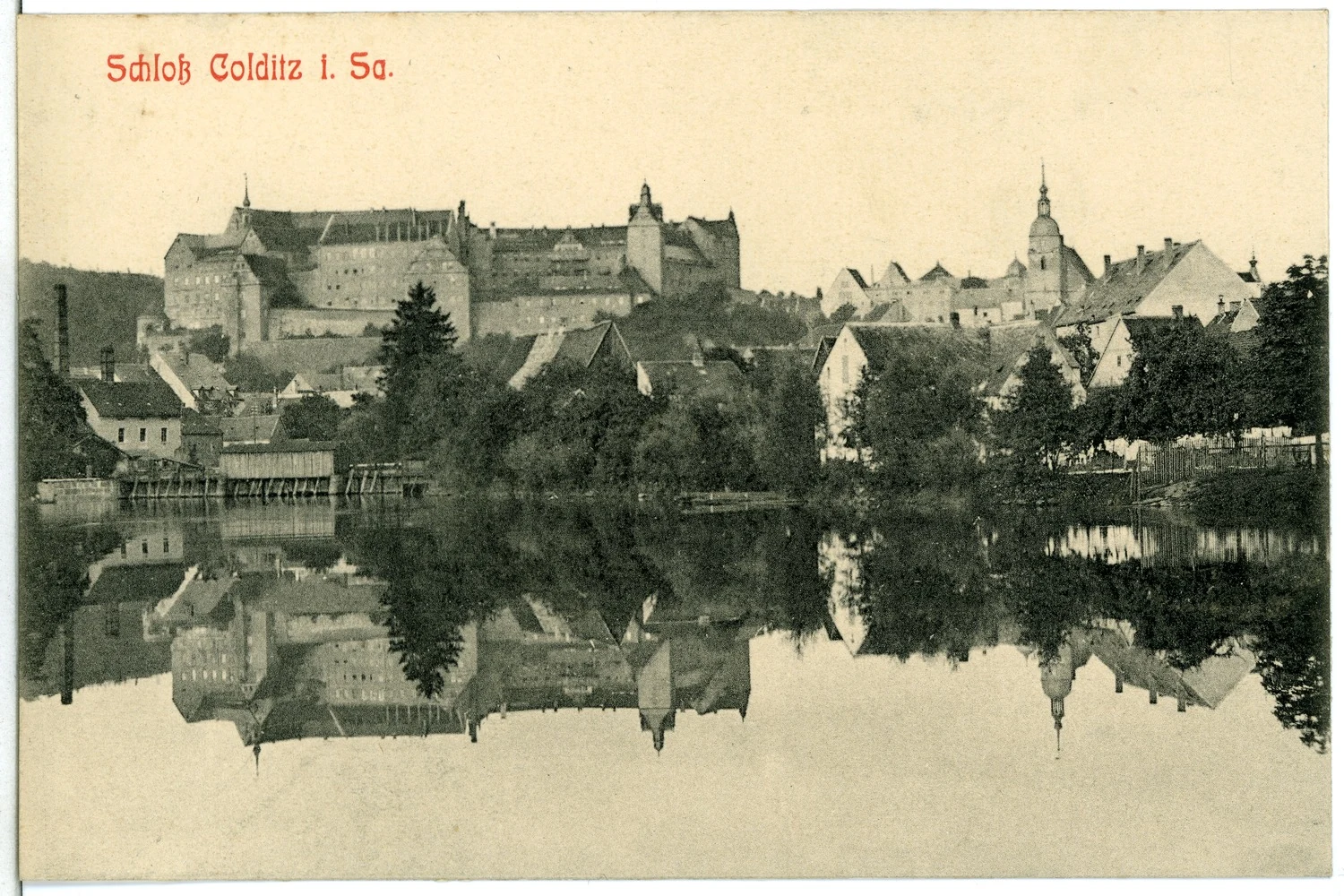
On 15 May 1941, the twenty-five-year-old Neave arrived at Colditz. Oflag IV C, the officers’ prisoner-of-war camp in the castle, held men who had already escaped from other camps, among others considered likely to try again. High walls, guarded courtyards and checkpoints inside the buildings made another attempt difficult. The quarters were overcrowded and opportunities for exercise limited. Bringing such prisoners together also enabled them to combine their skills. British, Dutch, French and other officers pooled their language skills, practical knowledge and experience gained during earlier attempts.
Another prisoner was the twenty-four-year-old Dutch officer Toni Luteyn, whose name is also written Tony Luteijn. After his country’s surrender he had refused to sign the declaration of honour demanded by the Germans. Under its terms, Dutch officers had to promise that they would take no further part in the war against Germany. His refusal had taken him through the camps at Soest and Juliusburg to Colditz. He spoke good German and possessed a Dutch passport. Several Dutch officers had already made their way from the castle to Switzerland, providing experience of a route beyond the prison walls for the later British–Dutch escape.
Neave had already tried to leave Colditz disguised as a German soldier in August 1941. His uniform was assembled from altered garments, dyed material and imitation insignia, with the expectation that it would be seen in dim light. He got from the prisoners’ courtyard into the German part of the castle, but was noticed separating from other soldiers, pursued under the floodlights and caught. There was another difficulty as well: the numbered metal pass he had used had been reported missing. A second attempt needed to deal with the checkpoint itself as well as the quality of the clothes. Leaving the prisoners’ area was precisely the moment when a supposed German might be asked to explain his presence and produce a pass.
The hidden route beneath the stage
Pat Reid, the British escape organiser at Colditz, found another way in the Saalhaus, the castle’s theatre block. The prisoners used a wooden stage there. Reid realised that it extended over a section of the building closed to them. Removing the wooden steps to the stage allowed him to crawl underneath and examine the floor. Beneath straw and rubble lay a lath-and-plaster ceiling, with the inaccessible room on its other side.
With the Canadian officer Howard Wardle, Reid cut through that ceiling. He lowered himself into the empty room on a rope made from bedsheets and opened its locked door. A corridor ran beyond it. During another reconnaissance he opened a second door and reached the attic above the German guardhouse. A spiral staircase descended from the attic into the guards’ quarters. The sequence of stage, empty room, corridor and attic offered a route that would avoid presenting a disguised prisoner at the exit from the prisoners’ courtyard.
The opening had to remain concealed until the escape. The prisoners installed a wooden frame and a fitted plywood panel in the hole. Painted white, the panel could look like the rest of the plaster ceiling to someone standing in the room below. Concealing the opening and exploring the passage took many days. The way into the guardhouse also had to be opened; Neave used wire for that fastening. Boxes of uniforms, civilian clothing and food were stored in the unused attic, ready for the men when they arrived. They would not need to carry their escape supplies openly through the camp on the chosen evening.
Reid arranged the departures for just after a change of guard. The sentry newly posted at the guardhouse entrance would not know which officers had entered during the previous watch. Two men in the right uniforms coming down the staircase would appear to be officers leaving the guardhouse. The concealed route brought them out on the German side of the internal checkpoint. Their uniforms would first be tested where they could already appear to belong to the garrison.
Four officers were to use the route on two successive evenings. Neave and Luteyn would go first, followed by the British officer John Hyde-Thompson and the Dutch officer H. G. Donkers. Each pair combined Dutch language skills and documents with the preparations made by the British group. Reid could take them as far as the guardhouse attic. Once outside, the two pairs would have to manage their own journeys.
Uniforms, civilian clothes and documents
Neave spent six weeks preparing his new officer’s uniform. A Dutch army greatcoat provided the basis. He painted its buttons grey with scenery paint and covered the collar in dark green material. Epaulettes, rank markings and other insignia were cut from linoleum and painted gold or silver. A service cap was covered with green material; its peak was reshaped and varnished black. Although the parts had come from prison clothing and theatrical supplies, they had to look like a coherent German uniform in the guardhouse’s electric light.
For the journey beyond the castle, the men set aside civilian clothes. Dutch workers could move among the many foreign labourers in Germany, and an accent was not unusual in that role. Their papers still needed to account for where they came from and where they were going. Luteyn’s genuine Dutch passport gave Neave a model for a forged passport of his own. The German camp administration had already taken the photograph he would use in it.
The other document was an employment pass in the name of “de Never”. It described Neave as a Dutchman travelling from Leipzig to Ulm to work on an electrical installation in a factory. A German sentry had supplied information about such passes. A Dutch escape organiser in the camp had also established that they were issued by a Leipzig police office. Neave could therefore base his forgery on a real kind of administrative document and give the journey a purpose that fitted it.
He entered the camp interrogation room at night and used its typewriter. A jelly duplicator served to reproduce the papers, while a piece of linoleum carved by Neave provided the stamp. He added the stamp impression and signature himself. The false passport was intended to support his claimed nationality; the employment pass explained his travel within Germany. Its validity only as far as Ulm would become critical later. A document could persuade officials that its holder was a foreign worker while still failing to authorise the journey he wanted to make.
The first train journey and the check at Ulm
After evening roll call on 5 January, Reid took Neave and Luteyn beneath the stage, through the concealed opening and along the passage to the guardhouse attic. Their departure began at nine that night. While the two men put on their uniforms, Reid retraced his steps and closed the entrance. They descended the spiral staircase, walked out of the guardhouse and passed two sentries. Prisoners watching from the camp last saw them heading towards the bridge over the castle moat. Beyond the camp, they changed into civilian clothes.
During the night of 5–6 January, Neave and Luteyn walked to Leisnig, where they caught the 5.45 a.m. train to Leipzig. There they learned that the suitable onward service would not leave until 8.52 that evening. They had a full day to spend in the city, trying to rest without attracting attention. Twice they went to the cinema. Sitting among an ordinary audience gave them somewhere to recover without appearing to be two travellers waiting for hours at a railway station.
While the pair waited in Leipzig, the prisoners at Colditz concealed their absence during roll calls so that the counts would not reveal the escape. A concealed dummy was used as part of the deception. On the evening of 6 January, Reid took Hyde-Thompson and Donkers through the same route. The first pair gained a head start, and the second was able to use the prepared exit before the guards began their search.
Large stations, especially their waiting rooms at night, gave railway police opportunities to check civilian papers. On trains, by contrast, Neave and Luteyn had observed that it was chiefly military travellers who were asked for passes. Civilian clothing helped them on the longer railway journeys, although it could not remove the possibility of a check. Finding refreshments also called for restraint. Coffee and beer were available to buy, but eating chocolate openly or smoking conspicuously could draw attention to goods that prisoners obtained through parcels.
From Leipzig they travelled to Regensburg, changed trains and continued to Ulm. On the morning of 7 January it was established at Colditz that two British and two Dutch officers were missing. While the guards searched the castle, Neave and Luteyn tried to buy tickets at Ulm at about half past ten, intending to reach Engen, near Singen in the frontier district. Officials examined their Dutch papers. They accepted the claimed nationality but told the men that the passes were not valid for travel beyond Ulm. The employment journey constructed in the camp had reached its stated destination. The actual escape still had to continue to Switzerland.
A policeman escorted the pair to an office of the Reichsarbeitsdienst, the Reich Labour Service, where they were supposed to report. He allowed them to go upstairs alone and waited below; their good German had helped persuade him to do so. Neave and Luteyn walked through the upper part of the building to another door and left. The policeman had accepted their role as workers without allowing their onward journey. Using the unguarded exit enabled them to avoid the required report and continue on their own.
They could no longer take an express train straight towards the frontier. Instead, they walked and used local trains until they reached a point about three kilometres outside Singen in the early hours of 8 January. Behind them, the second pair encountered the same problem. Hyde-Thompson and Donkers also appeared at Ulm with similar documents, asking to travel towards the frontier. The police were now alert to this combination. Both men were arrested, and on 10 January they were back at Colditz. The shared plan had taken all four through the guardhouse, but only the first pair got beyond Ulm and continued to Switzerland.
Shelter near Singen, then the crossing to Ramsen
Arriving near Singen at about four in the morning, Neave and Luteyn had hoped to reach the frontier while darkness still covered their movement. Workers on bicycles stopped and questioned them. The fugitives heard the workers say that they would inform the police. Pressing on would leave them in the area as daylight arrived, close to people who had just taken an interest in them. They looked for somewhere to hide and found a small hut in which they could sleep.
The weather was poor and the temperature very low. They stayed in the hut throughout the day. When they set out again at about six that evening, they took large spades and two long white coats they had found there. Carrying the spades would support a labourer’s role in the inhabited frontier district. The coats were kept for the snowy ground ahead. After losing the opportunity to cross during the previous night, they had to make another approach in darkness.
A Hitler Youth patrol stopped them. This time Neave and Luteyn presented themselves as Westphalian workers and persuaded the young patrol members to let them continue. During the check they learned that two prisoners of war were being sought in the area. The encounter with the cyclists had not been their only difficulty: a youth patrol was also looking for escapers near the border.
They passed through Singen and walked west from the station. A signpost indicated that Gottmadingen was four kilometres away. The men first turned north, skirted a large wood beside the Singen–Gottmadingen road, then came south again. They crossed a railway line north of the road and approached a short stretch where the road and the Swiss frontier met. Swiss territory projected into Germany here. An approach from the German side would not necessarily bring them to a long, straight boundary or any obvious division in the landscape.
Open ground surrounded by woods lay ahead. About seventy metres to their left, a sentry stood at a road barrier where cars were being stopped. The spades had served their purpose. The men threw them away and put on the white coats before crossing the road and the snow-covered clearing. Over the exposed distance of roughly two hundred yards they alternated between walking and crawling. The pale clothing reduced their contrast against the snow, but they still had to cover the ground near the German sentry before reaching the wood.
They crossed the frontier during the night of 8–9 January. The first crossing, however, did not give them a reliable guide to the next part of their route. There were no visible Swiss guards or lights. Switzerland also imposed a blackout after ten at night, so illuminated houses and streets could not show them where they were. They accidentally walked back into Germany. Only when they saw another German sentry on their left, to the east, did they recognise the error.
They then followed a compass bearing towards Ramsen and came into Swiss custody there. After train journeys, marches, checks and a day in the cold hut, they arrived hungry and exhausted. They had left the German frontier district behind and could give their real names. On 9 January the police at Schaffhausen recorded their statements.
Three months in Switzerland and the journeys home
The Swiss authorities had to establish who the men were and decide how they should be treated. Luteyn wore civilian clothes and could produce his Dutch passport. In Neave’s case, the police recorded some British military clothing and a German prisoner identification disc. On 10 January the military administration ordered that he be treated as an officer and brought to Bern. The flight through Germany had become a stay under Swiss supervision, with prescribed places of residence and journeys that required permission.
At Colditz, the concealed exit had meanwhile been found. On 13 January the German guards searched the Saalhaus. A corporal lifted a board in the steps to the stage, and a smaller soldier crawled underneath and discovered the opening in the ceiling. The door at the top of the guardhouse stairs was then secured with additional bolts. Hyde-Thompson and Donkers were already prisoners again. Neave and Luteyn were beyond the camp’s reach, but they could not simply board a train home from Switzerland. Further frontiers separated the neutral country from their destinations.
Neave remained in Switzerland for more than three months. On 16 January he was authorised to spend two or three weeks receiving medical treatment at Gerzensee. In February he received permission to attend lectures at the law faculty of the University of Fribourg; the university was to certify his attendance before he left. A visit to Gstaad was specifically approved in March. He could recover, study and make visits, but these movements had to be arranged with the administration.
On 13 April the Swiss military administration approved Neave’s request to move to Vevey. He would not remain much longer: he left Switzerland on 15 April. His onward route took him through France and Spain to Gibraltar, and from there to Britain in the spring of 1942. For this stage he received help from an organised escape network that lodged fugitives and moved them across borders. Neave had made most of the German journey with Luteyn through their own efforts. Getting from landlocked neutral Switzerland to British territory required other connections.
Luteyn left later, departing Switzerland on 8 May with nine other Dutchmen. He travelled through Suriname to Australia and rejoined the Netherlands East Indies forces there. When Neave reached Britain, he was the first British officer to have escaped successfully from Colditz. He subsequently worked for MI9, helping other prisoners escape and return. The two men had shared the route out of the castle and across the Swiss frontier; their subsequent journeys brought each back into the service of his own armed forces.