After HMAS Armidale sank on 1 December 1942, her survivors tried to reach help in two damaged ship’s boats. Others remained on an improvised raft and a life raft. Both boat parties were eventually picked up, but attempts to recover the men on the rafts failed. Of the 149 people aboard Armidale, 49 returned.
A missed rendezvous off Timor
Armidale was to take reinforcements to Timor and bring sick and wounded soldiers back to Australia. In late November 1942, Australian and Dutch forces were still fighting on the Japanese-occupied island. Supplies reached them from Darwin through small landing places on the southern coast. For the passage to Betano, the Australian navy assigned two corvettes and the smaller auxiliary vessel Kuru. The operation depended on the ships finding one another after dark and having enough time to complete the transfers off the coast.
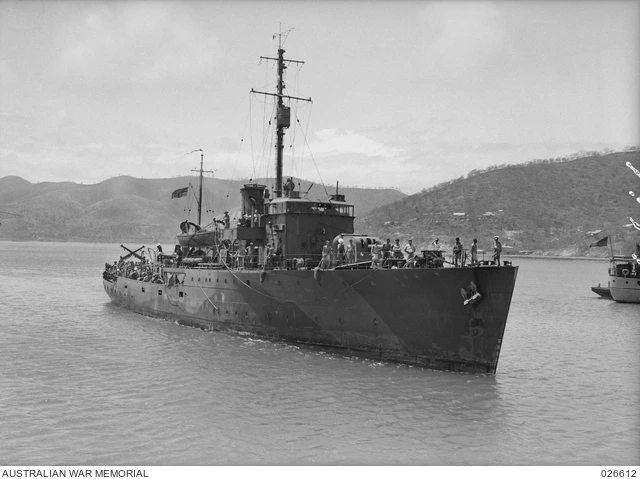
Kuru was to go ahead, land supplies and embark Portuguese refugees. When the corvettes arrived, she would transfer the civilians to Castlemaine, which would then return to Darwin. Kuru’s shallower draught also allowed her to ferry the troops from Armidale to the beach and bring wounded men out to the larger ship. Armidale belonged to the Bathurst class of small corvettes used for minesweeping, escort and transport work. With a maximum speed of about 15 knots, she faced many hours within reach of Japanese aircraft during the crossing.
There were 83 naval personnel and 66 soldiers aboard Armidale: three Australians, two Dutch officers and 61 men of the Netherlands East Indies forces. Together they made up the 149 people aboard. The soldiers had embarked for service on Timor, so almost half the people being carried were not members of the ship’s company. Where they were accommodated also mattered during the sinking. Many of the Netherlands East Indies troops were in the forward mess deck, which suffered particularly heavily from the first torpedo explosion.
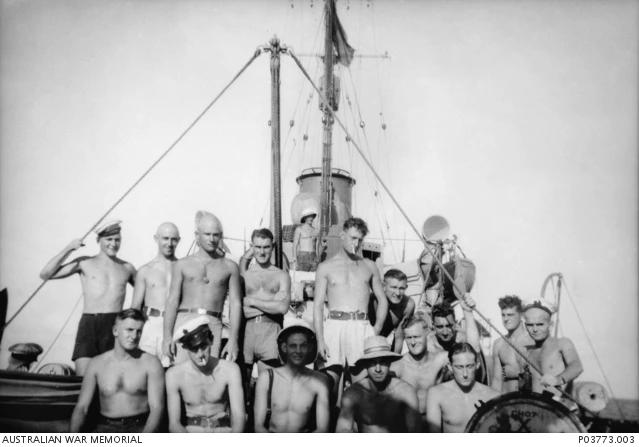
Kuru left Darwin on the evening of 28 November; the corvettes followed the next day. On the morning of 30 November, a Japanese aircraft discovered and attacked them. Philip Sullivan, Castlemaine’s captain and the senior commander at sea, signalled Darwin to express his doubts about the operation’s prospects. Almost a full day remained before the intended rendezvous, leaving time for further attacks. Commodore Cuthbert Pope, directing the operation from Darwin, nevertheless ordered the ships to proceed and promised fighter protection.
More bombers attacked without seriously damaging the corvettes. Their repeated evasive manoeuvres, however, delayed the passage. Australian Beaufighters drove off the Japanese aircraft during one attack, but the distance from Darwin made continuous protection impossible. Kuru was delayed as well, by bad weather and difficulty finding her landing place. When she finally reached Betano, the corvettes had not arrived. She embarked 77 Portuguese refugees and one wounded Australian soldier, then left the coast at about two in the morning on 1 December.
Armidale and Castlemaine arrived roughly an hour later. There was no sign of Kuru or of the expected signal fires on the beach. With dawn approaching, they turned south again to get clear of the coast. The three ships finally met after daylight. The refugees were transferred to Castlemaine, but the reappearance of Japanese aircraft prevented a further exchange of passengers between the corvettes. Castlemaine headed back to Darwin with the refugees and orders to search for two missing airmen on the way. Armidale and Kuru were directed to return to Betano independently and complete the movement of troops.
Armidale sank within minutes
Early in the afternoon of 1 December, Armidale survived another bombing attack. Her captain, David Richards, again requested adequate fighter protection. At about three o’clock, nine bombers, three fighters and a floatplane appeared. This time the bombers initially remained outside the range of the ship’s guns, then divided into groups and approached with torpedoes from different directions. Richards altered course in an attempt to disrupt their runs. Two torpedoes struck the corvette on the port side.
The ship quickly developed a heavy list. Richards ordered her abandoned when the deck was already inclined at about 50 degrees. Lifesaving equipment had to be released as men made their way over the steeply sloping decks and into the water. Wireman Bill Lamshed was thrown overboard near his workshop. From the sea, he saw Armidale still moving ahead with her propellers turning, then breaking apart. Only three or four minutes passed between the first torpedo hit and the sinking.
Eighteen-year-old ordinary seaman Teddy Sheean returned to the after Oerlikon gun following the order to abandon ship and continued firing at the attackers. Several survivors saw him there. Lamshed initially saw only the gun in action and learned afterwards who had been firing it. Sheean went down with Armidale. His action was recognised with a posthumous Victoria Cross in 2020. The ship’s resistance ended with her sinking, but the attack on the survivors continued for another ten to twenty minutes.
Japanese aircraft machine-gunned the men in the water. Those able to dive tried to protect themselves below the surface; others were held up by their lifejackets. Once the aircraft had departed, survivors were scattered across a large area. They had to find one another, recover wounded men and collect whatever floating equipment they could reach. About 102 people had survived the immediate sinking. Many were injured, and further lives would be lost during the following days.
The wounded went into the motorboat
Armidale’s motorboat remained afloat despite its bullet holes and offered the best available place for the wounded. Richards used it to collect men from the sea. A Carley life raft, two elongated floats from the minesweeping gear, drums and timber had also survived. Before the last operation, Leading Seaman Leigh Bool had persuaded his shipmates to secure useful scraps of timber aboard the ship. Some of that wood now floated among the survivors and could be combined with other wreckage to build a larger raft.
Strong swimmers brought the scattered material together. The men lashed timber and other debris across the two minesweeping floats until they had made a shared platform. They could hold on to it and remain together more easily, but much of their bodies stayed in the sea. Even on the raft, they were sometimes waist-deep in water. The little rope available had to hold the overloaded structure together. Lashings repeatedly loosened and had to be tightened or replaced.
That afternoon they also found Armidale’s whaler, a pulling boat roughly eight metres long. It was damaged and waterlogged, lying below the surface. The survivors fastened additional floats to it and attached it to the raft. Some men could then stand inside the flooded boat while their lifejackets supported them. They rotated between these places and the rafts so that at least they could change posture periodically. The whaler was still unfit for a voyage.
They passed the first night expecting to be found by an Allied aircraft the following day. In the morning they distributed small amounts of bully beef and water. Although the sea was warm, prolonged immersion made every injury more painful. Cramps, raw skin and brief, interrupted spells of sleep made maintaining the raft harder. Sharks and occasional sea snakes approached; the men drove them away by splashing vigorously. No death from a shark attack is known for this group.
Sharing the available places became a further difficulty. Australian naval personnel and Netherlands East Indies soldiers lacked a common language. Australian survivors later described arguments over the Carley float and the armed soldiers occupying it. Eventually the groups remained on different floating supports and drifted apart.
Richards set out to reach help
By midday on 2 December, the men had seen no Allied aircraft. The wounded needed care, and Richards decided to take the motorboat towards the area patrolled by Australian reconnaissance aircraft. There the little boat stood a better chance of being discovered than near the sinking position. First lieutenant William Whitting had been paralysed from the hips down by his injuries and could not lead the passage. Richards took him, other wounded men and men still strong enough to row. Twenty-two people set out in the boat. Gunnery officer Lloyd Palmer took charge of those left behind.
At first the engine would not start. In any case, the fuel supply would have lasted for only about 100 miles. The men propelled the boat themselves for 28 hours before the engine was made to run. It then operated for approximately twenty hours. A sail helped them continue afterwards. On 5 December a reconnaissance aircraft found the boat about 150 miles west-north-west of Darwin. Richards had achieved the immediate purpose of the voyage: the navy now knew for certain that Armidale had sunk and that some of her people were still alive.
In Darwin, Pope had cancelled the Timor operation on the evening of 1 December after Japanese cruisers were reported in the area. He knew nothing of the sinking at that point and still assumed the following day that Armidale was on her way back. Only when she failed to arrive and did not report her position did a loss become more likely. Pope began an air search on 3 December. The men on the rafts could see no sign of it. They had no connection with Darwin and no news of Richards’ progress.
Following the motorboat sighting, the corvette Kalgoorlie sailed to the rescue on 5 December. She searched the reported area the next day and came under attack from Japanese bombers herself. Not until the evening did her crew see a red flare. At about 11 p.m., they took twenty men aboard from the motorboat; two had died during the passage. The condition of the rescued men and the danger of further air attack led her captain, Harold Litchfield, to return to Darwin. Kalgoorlie reached port on 7 December. The other survivors remained at sea.
Making the damaged whaler float again
While Richards was making his passage, Palmer and his men attempted to recover the whaler. Its numerous small bullet holes could be plugged comparatively easily. The greater problem was a gash near the stern, about ten to fifteen centimetres wide, extending from the gunwale to the waterline. First they had to raise the flooded hull far enough to reach the damage. They crowded onto the raft, pushing it lower in the water, then dragged the damaged end of the boat onto it and supported the other end.
Two men bailed with steel helmets, initially floating themselves inside the boat. Gradually they bailed water out faster than it came in, and the hull rose. They plugged the smaller holes with scraps of canvas. A piece just big enough to cover the large gash was held in place with brass screws taken from other parts of the boat. The men used their pocket knives as tools. The repair had to stop large quantities of water pouring in whenever the boat rolled.
It worked only partly. With 29 men aboard, the lower edge of the gash sat just above the waterline in a calm sea; any greater movement could admit water again. The two helmets consequently remained in constant use for bailing. Even so, the improvement was considerable. The boat now supported men above the surface, initially allowing them to take turns in comparative dryness. The raft still needed repairs every few hours. A Netherlands East Indies soldier and Leading Cook William Williams died during these days.
On 5 December, Palmer decided to take the whaler towards Australian reconnaissance coverage as well. They had been adrift for nearly four days, supplies of food and water were running short, and from their position there seemed to be no search under way. If Richards had been found, his rescuers could look for the rafts. If the motorboat had been lost, the whaler offered another attempt to reach help. Sub-Lieutenant James Buckland remained responsible for the men on the improvised raft and the Carley float.
Palmer selected the boat’s company himself. He needed men capable of rowing for long periods, but also took two wounded men whose condition was particularly affected by immersion, and some men showing severe nervous strain. Another 25 naval personnel and three Australian soldiers went with him, making 29 people in all. Several dozen stayed behind. They no longer had a usable boat alongside them and depended on being recovered by others.
Four days under way with little food and almost no water
When they set out, Palmer had to leave the remaining drinking water with the rafts. It was held in a container of about three and a half gallons, and no second suitable container was available. The boat party had six tins of condensed milk and two twelve-ounce tins of bully beef. The milk was intended to replace part of the missing water supply. On their first evening, the 29 men shared two tins; on Sunday they had one tin of meat. These small rations were scarcely enough to support the physical work of the passage.
Palmer organised four rowing watches. Half an hour of work was followed by an hour and a half without rowing. The interval was not spent in a dry, quiet boat. Some men had to bail; others lay in the wet bottom between the rowers at work. Their skin was raw after days in the sea, and every movement against the thwarts and hull hurt. To propel the boat they had five small dinghy oars and one whaler oar.
The rudder and the boat’s usual equipment were missing. Bill Lamshed used his knife to fashion a new rudder from bottom boards. A small pocket compass supplied by a Netherlands East Indies soldier replaced the lost boat’s compass. To provide additional propulsion, the men joined three pairs of overalls into a sail, using the stave of a boat hook as a mast. In a favourable wind this helped the rowers. They still had to work and keep removing water from the boat at the same time.
Palmer directed a south-easterly course. When some men called for a route south, he maintained his decision. At sea, without a coastline in view, they had no way to check their actual progress against the shore. Palmer was trying to reach the area covered by Australian reconnaissance aircraft. Meanwhile thirst grew worse. Some men hallucinated, and sleep was possible only in brief snatches. On Tuesday, 8 December, they issued the last tin of meat.
That morning rain squalls came into sight, but initially remained beyond the boat’s reach. When a light drizzle finally arrived, the men could gather very little and licked water from their skin. Only a heavy tropical shower provided enough to collect a reserve. They cut a five-gallon petrol tin lengthwise into two troughs and caught more rainwater with the rubber parts of their lifejackets. Empty milk tins served as drinking cups, while a cut-off section of an inflatable lifejacket held the reserve. After drinking, they could row with renewed strength.
Kalgoorlie recovered the second boat party
Later on 8 December, Rex Pullen heard an aircraft. The first machine was too distant and disappeared, but subsequently a Catalina approached. The men waved and shouted until the flying boat passed overhead and circled. It dropped a package containing two blankets and a message: the food had already been dropped to the rafts, but their own position would now be reported and a ship sent. Palmer stopped the rowing so that the boat would not move farther out of the newly established search area.
The men had to wait another night. The next morning Hudson aircraft appeared, dropping food and water. A message announced the corvette and explained that she had been given a course to their position. During the afternoon of 9 December, Kalgoorlie finally reached the whaler. The 29 men still had enough strength to climb the scrambling nets lowered over her side. Once they stood on deck, however, their legs gave way.
Kalgoorlie’s crew cared for them and tried to hoist their boat aboard as well. Its damaged stern broke apart in the process. A wooden thwart support survived and is now held by the Australian War Memorial. On 10 December the corvette arrived in Darwin. The men went into hospital and were reunited there with Richards and the survivors from the motorboat. Both boat passages had now ended successfully. The search for the men on the rafts was still continuing.
The men on the rafts were never recovered
An aircraft had already sighted the remaining groups on 7 December, far north of the whaler’s later position. Pope initially sent the auxiliary vessel Vigilant there, but held her back when a Catalina from Cairns was promised for the recovery. The flying boat found the raft on 8 December. The state of the sea prevented a landing. Its crew dropped supplies and photographed the men on the low platform.
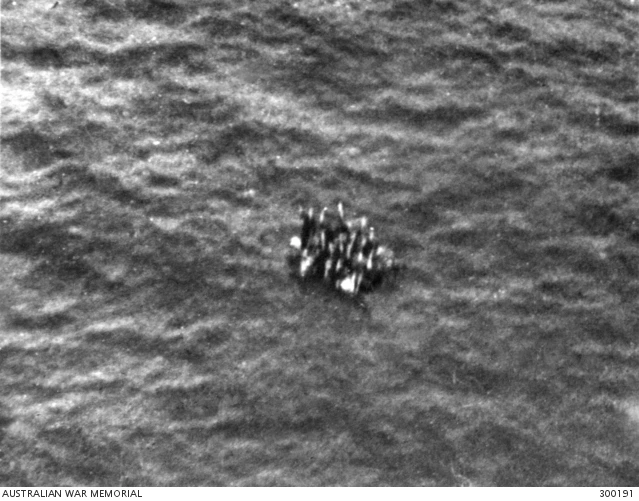
After the attempted water landing failed, Vigilant was again ordered to the raft position. Serious engine trouble later forced her to return. Kalgoorlie took over the search, while the Dutch destroyer Tjerk Hiddes also passed through the area. Aircraft searched daily, but neither the improvised raft nor the Carley float was found again. The search ended on 13 December. What happened to these men after the Catalina departed could not be established.
The sinking and the days that followed left a hundred people dead or missing. Twenty men had been recovered from the motorboat and 29 from the whaler. While the search was still in progress, Pope changed the instructions for future Timor runs. If a night approach failed, the ship was to return to base rather than remain off the island through the day and attempt the operation again the following night. The faster Tjerk Hiddes undertook the next evacuations. In three December voyages she brought approximately 950 people to Darwin.
The Darwin inquiry cleared Richards and found that fighter protection had been inadequate for operations by vessels of this type. Whether the operation should have been mounted with these ships fell outside its terms of reference. The survivors, meanwhile, had to recover from their injuries. Many later suffered disturbed sleep and damaged health, and some had to leave seagoing service. After the war, Palmer went to Timor seeking evidence that men from the rafts had entered Japanese captivity. He found no trace.