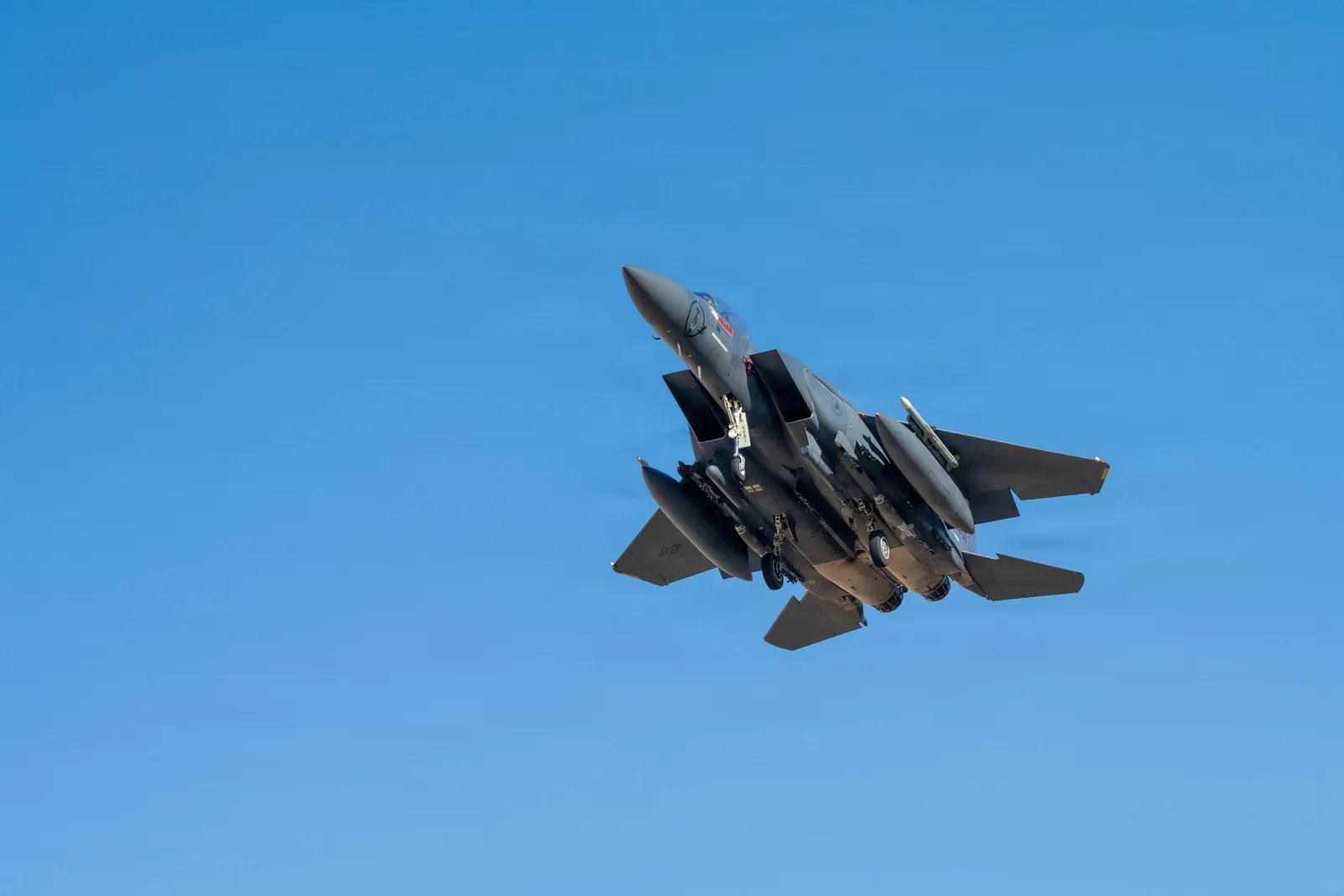
On 3 April 2026, an American F-15E was shot down over Iran. Both members of its crew escaped in their ejection seats, but landed a considerable distance apart. A helicopter recovered the pilot that same day. His badly injured crewmate remained in the mountains. Finding him and bringing him out required a second, much larger operation, which was not completed until Easter Sunday morning.
The aircraft's mission call sign had been DUDE 44. After the shootdown, the two men were distinguished by the suffixes Alpha and Bravo: Alpha was the pilot in the front cockpit, and Bravo the weapon systems officer in the rear seat. On the ground, each had to survive independently while Iranian forces searched for them.
Shot down and separated
The F-15E had been flying over the Zagros Mountains in support of Operation Epic Fury. Unlike the single-seat fighter versions of the F-15, the Strike Eagle carries two crew members and is designed for both air combat and attacks on ground targets.
President Donald Trump later said the aircraft had been struck by a shoulder-fired, heat-seeking surface-to-air missile. Despite earlier attacks on Iranian air-defence sites, mobile systems remained a threat to aircraft and subsequently to the rescue force. Losing the F-15E forced slower helicopters and transport aircraft into the same hostile airspace.
It was still late on 2 April on the US East Coast, but already the morning of 3 April in Iran. The Joint Personnel Recovery Center responsible for the area registered the two men as isolated personnel. After signals from active rescue beacons were confirmed, the recovery operation was ordered. The force then had to establish their locations more precisely and find a way to reach them, while a search for the Americans was already under way on the ground.
According to Trump’s later account, sending more people into Iran was contested even within the American military. Some officers had advised against taking the risk. General Dan Caine, chairman of the Joint Chiefs of Staff, and Defense Secretary Pete Hegseth supported the operation. The first approved rescue force flew towards Alpha, whose location had now been established. The search for Bravo continued.
Bravo had survived the ejection with serious injuries. He fractured his back, arm and shoulder; his parachute was damaged. The colonel could nevertheless move. He left his landing area and climbed into the rocky terrain above it. He had to negotiate steep ground, treat his bleeding wounds and manage with the equipment that remained available after the loss of the aircraft.
A daylight recovery for Alpha
Alpha was the first man whose position was established accurately. The Americans chose to recover him in daylight, despite the Iranian forces looking for him. A force of 21 aircraft and helicopters was committed. HH-60W Jolly Green II helicopters made the pickup. They carried Air Force rescue specialists, including pararescue personnel trained to reach, treat and evacuate casualties in combat.
Before the helicopters could reach the pilot, other aircraft had to attack Iranian forces nearby and keep them away from the pickup site. A-10 Thunderbolt IIs performed the Sandy role. In this operation, that meant maintaining contact with the isolated airman, bringing the rescue force forward and engaging enemy forces that threatened either the pilot or the approaching helicopters. Other combat aircraft and remotely piloted aircraft supported them.
The long flight into Iran also required airborne tankers. The HH-60s took on fuel from C-130s en route. HC-130 Combat King II aircraft are dedicated personnel recovery platforms and can refuel helicopters in flight. This allowed the helicopters to cover the distance to the pilot without first landing inside Iran to take on fuel. They also needed sufficient fuel for the return journey.
One A-10, whose pilot had primary responsibility for communicating with Alpha, was hit during the fighting. Its pilot continued the mission before flying to another country. There, he determined that he could not land the damaged aircraft safely. He ejected over friendly territory and was also recovered.
The helicopters reached Alpha and picked him up. During the withdrawal, the trailing helicopter came under fire and its crew suffered minor injuries. It nevertheless made the return flight. By Friday afternoon, the pilot was safe.
Bravo remains in the mountains
Bravo moved away from his landing area to evade the search on the ground. Iran's Revolutionary Guard, other armed groups and local authorities were involved. A reward also encouraged members of the public to find the Americans. Bravo had to hide from people entering the area.
Climbing increased his distance from the landing area but demanded considerable physical effort despite his injuries. On Saturday he hid in a rock crevice. He carried a personal emergency communications device through which he transmitted his location. The steep terrain made access more difficult for the rescuers.
Hegseth said the proposed Friday-night recovery was postponed by a day. In the cold, windy mountains, Bravo had little water or food. By Saturday, 4 April, communications with Bravo were confirmed. With CIA support, American forces had established his precise location and positively identified him visually. CIA Director John Ratcliffe later described the confirmation that Bravo was alive and concealed in a mountain crevice. Hegseth passed that confirmation to the president. On the recommendation of the CENTCOM commander, the second recovery was approved. Meanwhile, American aircraft attacked enemy search forces to keep them away from Bravo.
A much larger second operation
The Americans committed a substantially larger force to the second recovery because Iranian forces had had more time to search for Bravo. After the operation, President Donald Trump gave a figure of 155 participating aircraft, including bombers, fighters, tankers and rescue aircraft. That figure covered support for the operation as a whole. The aircraft did not all need to be over Bravo at once: some attacked enemy forces, while others provided surveillance, air protection, fuel or transport.
A battle manager known by the call sign Peaches and her team had to integrate aircraft flying at different speeds and altitudes, with different fuel states and duties. Air Force Chief of Staff Ken Wilsbach highlighted her work in September. He put the overall effort coordinated by her team over roughly fifty hours at 176 aircraft. This was a later figure for the whole rescue effort, rather than Trump’s total for the second operation. Tankers extended endurance while maintainers prepared additional fighters.
Deception also supported the search. American activity in several areas was intended to leave Iranian forces uncertain about the actual pickup location. The recovery had to be organised in marginal weather.
Two MC-130J Commando IIs brought personnel, equipment and three disassembled A/MH-6 Little Birds to an improvised landing area on farmland. The small helicopters’ rotors had been removed for transport. After unloading, technicians assembled the three aircraft for flight within minutes. The Little Birds covered the short leg into the mountains; the MC-130Js had moved the force and equipment over the long distance to the forward site.
The recovery took place during the night from Saturday into Sunday. A-10s in the Sandy role and other aircraft protected the force. The rescuers reached Bravo and brought him away from his hiding place. After almost two days of isolation, he was with American troops again.
The transport aircraft cannot take off
A new problem developed at the improvised landing area. Both MC-130Js became stuck in soft, wet sand and could not take off again. The surface had accepted the landing but would not support the loaded aircraft during their takeoff run. Two of the Army Little Birds also remained behind. Bravo and more than ninety members of the recovery force were now stranded at the forward site.
Three lighter replacement aircraft arrived in succession, took Bravo and the recovery force aboard and departed. US forces then destroyed the two MC-130Js and the Little Birds left behind so that the aircraft, equipment and sensitive systems would not fall into Iranian hands.
Trump later said the force had decided against spending hours unloading the remaining equipment before demolition. Switching to the smaller replacement aircraft meant bringing the people out and leaving the remaining equipment behind.
Iran gave a different account of the losses. On 5 April, a spokesman for the Khatam al-Anbiya headquarters said Iranian forces had foiled the rescue and destroyed American transport aircraft and helicopters in southern Isfahan province. That account contradicted the American explanation that its own forces had demolished the stranded aircraft and evacuated the personnel. Published images of wreckage alone did not establish how each aircraft had been destroyed.
Out of Iran
By the morning of 5 April in Iran, Bravo too was back on friendly territory. Easter Sunday had just begun on the US East Coast. The Joint Personnel Recovery Center reported that both members of DUDE 44 had returned. About 50 hours had passed since their isolation was registered.
In September, Bravo appeared publicly under his mission call sign and described his isolation. That month, Wilsbach announced that ten Airmen had received battlefield promotions for their performance during the DUDE 44 recovery.
The appearance of U.S. Department of War (DoW) visual information does not imply or constitute DoW endorsement.