

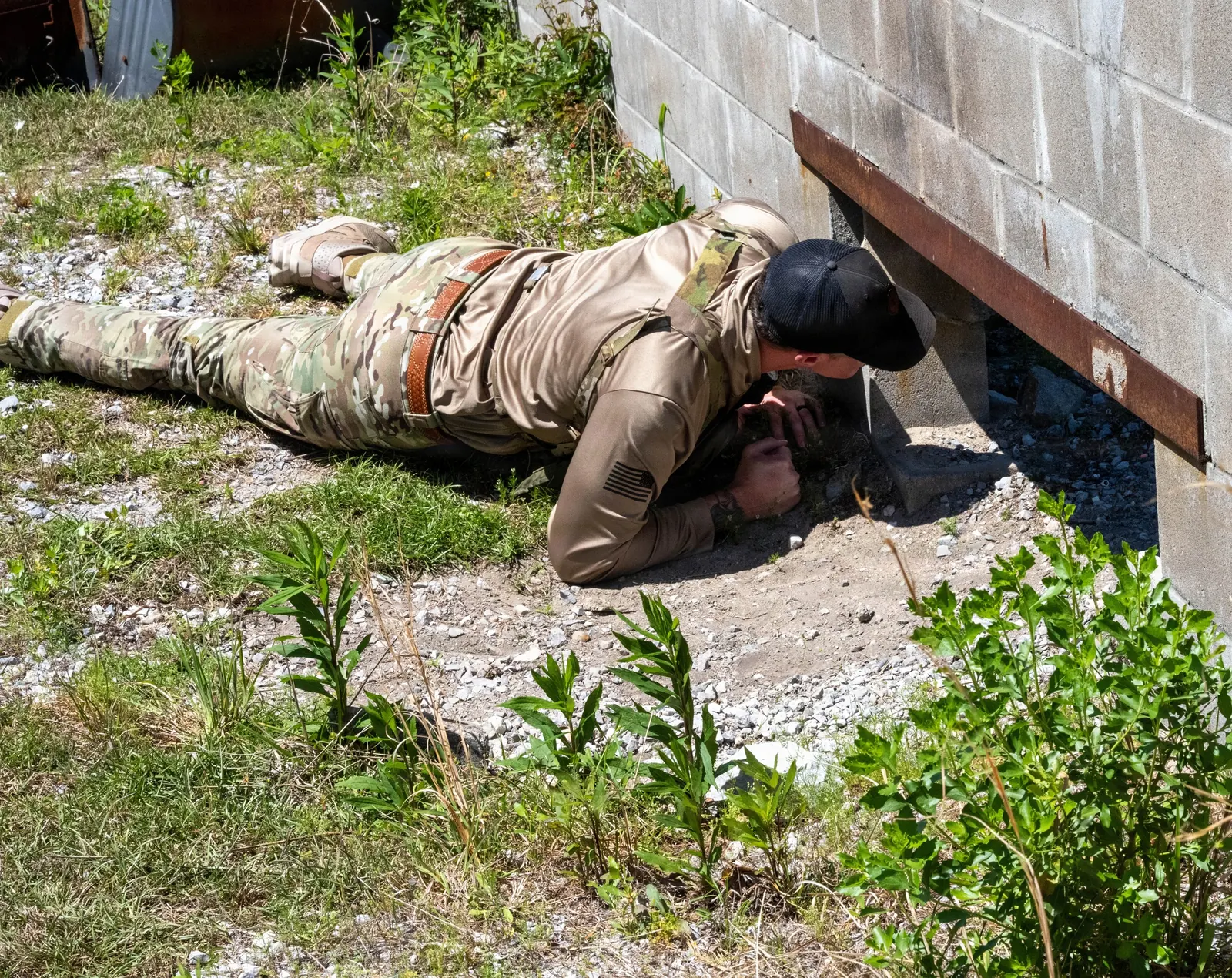
Combat Survival means staying alive and remaining able to return while facing military threats. A person separated from friendly forces must deal with injury, weather, lack of water and exhaustion while avoiding detection and capture. A fire provides warmth but may reveal a location. A water source offers fresh supplies, yet reaching it may be dangerous. A march creates distance from a threat but may consume the last available strength. Each decision requires the person to weigh these consequences.
Isolation can follow a forced landing, separation from a patrol or being cut off from friendly forces. Regular supply and planned contact may be lost. The person must use whatever equipment they have carried, found or recovered to protect and sustain themselves, navigate and, where possible, communicate. They need to establish what remains usable and how long it can meet their needs.
Identify the most urgent task
The first concern is immediate danger: hostile fire or impending capture, a burning vehicle, severe bleeding or an exposed position. Taking a lengthy inventory there prolongs exposure. If able to move, the person first seeks a protected location within reach. Life-threatening external bleeding also requires self-aid at the earliest feasible opportunity. Which action can be taken first depends on the danger they face at that moment.
At a suitable halt, the person can assess the situation more thoroughly. Where are they, and what supports that position estimate? What hostile activity have they actually observed? How do injury, wet clothing or exhaustion limit what they can do next? What water, food, protective material, first-aid supplies and navigation aids are available?
The assessment determines the next concrete step: control bleeding, reduce further heat loss, confirm position, reach a suitable rest location or examine the next stage of the route. If several problems need attention, the most urgent comes first. The person then checks what has changed.
Preserve and reassess personal capability
Direct pressure and suitable available dressings provide initial self-aid for a bleeding wound the person can reach. For life-threatening bleeding from an arm or leg, a purpose-designed tourniquet can interrupt blood flow; its use depends on having the device and knowing how to apply it through practice. Bleeding control is checked again at a protected halt and after movement. Without medical oversight, a tourniquet applied to control bleeding is not loosened because it hurts or because a march has paused. Its application time is recorded.
Injury also changes how much protection from the cold is needed and how far the person can move. Cold ground, wind and wet clothing continue to remove heat from an injured person at rest. Insulation beneath the body and protection from wind and precipitation therefore belong in their care. Additional wounds may become apparent after initial treatment, so examination of the body continues at a suitable halt. Even after first aid, the person must plan around their remaining mobility, supplies and the threats ahead.
The next stage must be within the person's current physical capacity. A leg that supports a short move may fail during a long detour. A hand injury can make fastenings, dressings, a drinking container or signalling equipment difficult to handle. Essential items must remain secured and accessible so that they can still be used despite the injury. When reducing carried weight, the person must retain the items needed for protection and supplies at the next halt.
Lack of sleep, fear and exhaustion can cause forgotten equipment, indecision and repeated navigation mistakes. When these errors occur, it helps to focus on a shorter stage: check position and equipment at a concealed halt, identify the next unmistakable terrain reference and move only as far as that point. Rest preserves strength for difficult stretches ahead. If a new threat develops at the rest location, another move may be necessary despite exhaustion.
Injury, cold and supplies: an isolation scenario
Suppose a person separated from friendly forces is moving in cold rain. One leg can bear only limited weight. They have some water, food and material for weather protection, but no confirmed radio contact. Their approximate position is known; a distant return point has so far been identified only on a map. Starting a long march immediately would leave them exposed to the weather and consume more supplies and strength. It is also uncertain whether the leg can sustain the journey.
The person first examines the nearby terrain for somewhere to avoid the immediate threat. If able to move, they leave an exposed position for suitable concealment close by. There they can check the injury, equipment and actual position. A sufficiently sheltered halt allows them to use available material against wind and rain and as insulation from cold ground. If this cannot be done there, the next short move needs to reach a more suitable resting place.
When looking for a water source on the map, the person needs to judge how far the remaining supply will last. A marked source is an option only if it is accessible and the water can be treated with the equipment available. A long descent may overstrain the injured leg; an exposed approach increases the risk of detection. Depending on the remaining distance and strength, it may be better to use the carried supply for now, seek a more protected approach or choose a different halt.
After resting under shelter, the person reassesses movement. If sufficiently mobile, they plan a short stage to an identifiable terrain reference. If the leg deteriorates or new hostile activity appears, that objective is reconsidered. If contact can be established, they can report position, mobility limits and local hazards. Until the next course of action is confirmed, they must continue to provide their own protection and supplies. Progress towards the return point still depends on whether the leg remains usable and water and protection are adequate at each stage.
Plan protection and concealment together
Clothing, ground insulation and weather protection perform different functions. Clothing traps insulating layers of air around the body; wind and wetness reduce its effectiveness. During strenuous movement, the person needs to respond before becoming too hot, so that sweat does not add to the moisture in their clothing. At a longer halt, the body produces less heat and needs more protection again. Available shelter material needs to keep out enough wind and precipitation to allow rest beneath it.
A concealed place may still be unsuitable for rest. Cold, wet ground removes heat through direct contact. A gully can carry water during rain; a confined hollow can impede further movement. The rest location therefore needs sufficient weather protection, useful concealment, approaches that can be observed and a way to move on. Existing terrain features and carried material may provide these with less effort than extensive construction. When selecting a hide site or hole-up, these requirements must be considered alongside the purpose of the stay.
A fire can provide warmth, heat water or cook food. Light, smoke, smell and gathering and preparing fuel can also reveal the location. The first question is whether available protection from wind, wetness and cold ground is enough to stay warm. If extra warmth is urgently needed or a fire is necessary to prepare water or food, its benefit must be weighed against the risk of detection. Someone who forgoes a fire but continues to lose heat needs another effective way to stay warm.
Water, food and route planning
Water planning covers the carried supply, accessible sources, suitable treatment and protected storage. Carried drinking water allows the person to delay approaching a source. Exertion and heat increase water loss. Reaching another source costs strength and may require crossing terrain where detection is easier. The route must therefore account for the water carried and the sources that can actually be used.
Finding a source is only part of the task. The available treatment method must be suitable for that water and its intended use and applied according to its instructions. Containers, time, fuel or a functioning device may be required. Treated water is then kept in a clean, closed container. At a halt, the person checks whether the remaining supply will cover the next stage and the rest afterwards. If it will not, access to a usable water source must influence where they go next.
Food supplies energy for further work and movement. Obtaining and preparing it takes time and strength and may keep the person in one place longer than the situation allows. Suitable food already carried is rationed according to expected exertion. Before seeking more, the person weighs that need against obtaining water, treating injuries, resting or moving to another location. A long search followed by a cooking fire may prolong the stay and reveal it. A brief opportunity for safer movement can therefore take precedence over replenishing food.
Deciding when to move and checking the route
There needs to be a reason to move: to gain distance from a specific threat, reach a better protected rest location, obtain supplies or reach a possible point of return. Staying at a suitable location preserves strength and reduces the chance of being detected while moving. If the location or its immediate surroundings become dangerous, movement may be necessary despite exhaustion. The person needs to consider the objective, the route and whether they can complete it.
The shortest route may cross an open area. A longer concealed route may be steep, wet or impassable for an injured person. The choice depends on exposure to observation, terrain, extra exertion and the value of reaching the objective. Darkness may make observation harder, but it also obscures the ground and obstacles and complicates navigation. Night observation helps the person examine the terrain before moving on.
A planned journey is divided into stages that can be checked along the way. Before departure, the person establishes the current position, the next recognisable terrain reference and the reason for moving. Along the route, they compare direction, terrain and distance travelled with the plan. If these no longer agree, they resolve the discrepancy at a suitable halt before spending more strength moving in an unknown direction. After a detour around an obstacle, further planning must account for the changed route and extra exertion.
What can reveal a person's presence
An observer may detect the person directly or notice signs they have left. Movement attracts attention; a body outline against a brighter background is easier to recognise than one concealed by a suitable terrain feature. Shiny objects, light, rattling metal or alarm tones may reveal a concealed location. Before moving, the person secures loose equipment, prevents unintended sounds and checks for visible reflections. Concealment must be assessed from directions an observer could look from, as well as from the person's own view of the surroundings.
A halt also leaves signs. Broken vegetation, disturbed ground and repeatedly used approaches can reveal occupation or direction of movement. A place that needs little alteration saves work and leaves fewer additional signs. Reducing signs therefore starts with considering how much a site needs to be disturbed. The approach also needs to remain inconspicuous so that tracks do not lead to the concealed person.
A concealed body outline does not necessarily mean an inconspicuous thermal signature. Thermal observation depends on emitted heat and the properties of intervening material. When selecting and using protective material, the person therefore needs to consider both heat loss and possible observation. Camouflage colours alone do not make an insulating cover an effective screen against thermal imagers.
Using equipment and sharing tasks within the group
Equipment is organised by function. What is available for first aid, weather protection, drinking water, navigation and communication? Is it complete, accessible and usable? Using one item for several purposes can cause a shortage elsewhere: material used to build a shelter may then be unavailable for carrying loads, storing water or signalling. Before using it, the person needs to consider what will be lost.
If several people are isolated together, tasks and the shared route depend on what each member can still do. One person can observe while another checks a dressing or supplies. If someone has limited mobility, the next halt must be within that person's reach too. Brief mutual checks help identify missing material, overlooked injuries and conflicting position estimates. The group coordinates its tasks to avoid unnecessary light, noise, signs or movement.
Protecting information before capture
Military isolation also concerns information about the person, friendly forces and the intended return. An open transmission may disclose position and intent to unintended recipients. A carried plan or conspicuous map markings can reveal a planned route and objective if seized. The person therefore avoids transmitting sensitive details about friendly forces, intended return routes or identification procedures over an open channel. Unnecessary annotations of movement intentions are avoided on carried maps; terrain references needed for navigation remain usable.
Prepared documents serve different functions. An Evasion Plan of Action describes intended behaviour during isolation and helps friendly forces plan their search around the intended route. An Isolated Personnel Report supports identification and authentication. Neither replaces a current position and condition report. Whether the person needs to depart from the plan depends on the actual threat, their mobility and their supplies. If confirmed contact becomes available later, they can report the change.
From personal survival to actual return
The person may reach an area under friendly control under their own power or return through organised recovery. How Personnel Recovery can be carried out depends on the person's condition, the forces available and the terrain. Severely restricted mobility requires a different approach from that used for someone who can walk; an accessible location may still be unsuitable for the intended recovery. Preparation therefore includes maintaining the ability to act and accurate information about condition and surroundings.
If a usable connection exists, reports cover position and its reference, the number of people, injuries and mobility limits, observed hazards and available signalling devices. An uncertain position is treated as uncertain and checked using further information. Independently of checking the position, authentication establishes whether the contact is actually the person to be recovered. A familiar call sign alone is not enough.
Without radio contact, available visual signalling equipment may help establish contact with recovery forces. Before using it, the person considers the intended recipient, who else could see the signal and the procedures prepared for the operation. An openly visible signal can also attract hostile attention. An unidentified aircraft or vehicle is therefore no reason to abandon concealment. Suitable signalling equipment is kept ready and used when contact with recovery forces is recognisable or established through the agreed procedure.
During confirmed recovery, equipment, dressings and protective material are secured. The person helps the recovery force locate them precisely, communicates mobility limits and follows instructions. Sudden movement or approaching a vehicle independently makes safe recovery harder; approach begins when instructed. Recovery is complete when the person is actually under friendly control. Medical and psychological care and reintegration then address the consequences of isolation.
Combat Survival in relation to SERE and captivity
SERE connects Survival, Evasion, Resistance and either Escape or Extraction, depending on the system. In Combat Survival, the person must sustain their body while facing hostile threats. These tasks overlap at a concealed rest halt: the person needs to recover, remain undetected and prepare the next stage of the return. The captivity and recovery subjects included depend on the particular national course.
In captivity, the person has much less control over their supplies and movement and must sustain themselves within those limits. Questioning, exploitation for information or propaganda and responsibility towards fellow captives become additional concerns. Resistance prepares personnel to deal with this exploitation. Information about comrades or friendly plans may endanger others. For members of the US armed forces, the Code of Conduct sets national requirements for information and conduct and requires them to protect fellow prisoners. Other armed forces teach their own conduct requirements.
In its earlier form, the British Aircrew Combat Survival Course expressly connected Combat Survival with Conduct After Capture. Australian aircrew training also teaches Combat Survival and SERE together. In these programmes, Combat Survival extends beyond water, shelter and food to include conduct after capture.
How training brings these tasks together
German SERE B combines theoretical and practical elements. Shelter, fire, water treatment and food preparation help sustain the body. The Evasion Plan of Action records intended behaviour; the Isolated Personnel Report supports identification. Training in conduct during recovery prepares the person to work with the recovery team. Level B thus covers practical capabilities needed between separation and recovery. Level C develops survival and evasion further, together with conduct as a prisoner of war. In this German programme, Resistance to Interrogation is an additional module primarily for special operations forces and aircrew.
In the US Air Force, aircrew preparation begins with the aircraft emergency and landing. Field subjects include survival medicine, day and night navigation, evasion and camouflage, sustenance, shelter, signals and recovery equipment. Separate water programmes cover survival on water and the equipment available there. Where the person lands and what equipment remains determine the first task. Available signalling devices, mobility after landing and usable protective material also directly affect subsequent evasion.
Australian aircrew SERE prepares for forced landing or separation from friendly forces in a combat environment. Practical components cover sea and coast, arid areas and jungle; swimming is part of the course described here. Evasion is combined with resistance to questioning, indoctrination and exploitation, and with escape. A concluding evasion and capture scenario brings these tasks together. The environment changes the means and opportunities for survival; preparation for hostile threats continues beyond these environmental stages of training.
Combat Survival forms part of the British Mountain Leader 2 course. Graduates qualify to instruct other soldiers in Mountain & Cold Weather Warfare in winter and summer and are prepared for employment as Surveillance and Reconnaissance Patrol Leaders. Their preparation for reconnaissance patrols includes survival alongside mountain movement. Here, Combat Survival belongs to an instructor and patrol-leader qualification; the earlier Aircrew Combat Survival Course expressly included conduct after capture.
The appearance of U.S. Department of War (DoW) visual information does not imply or constitute DoW endorsement.