

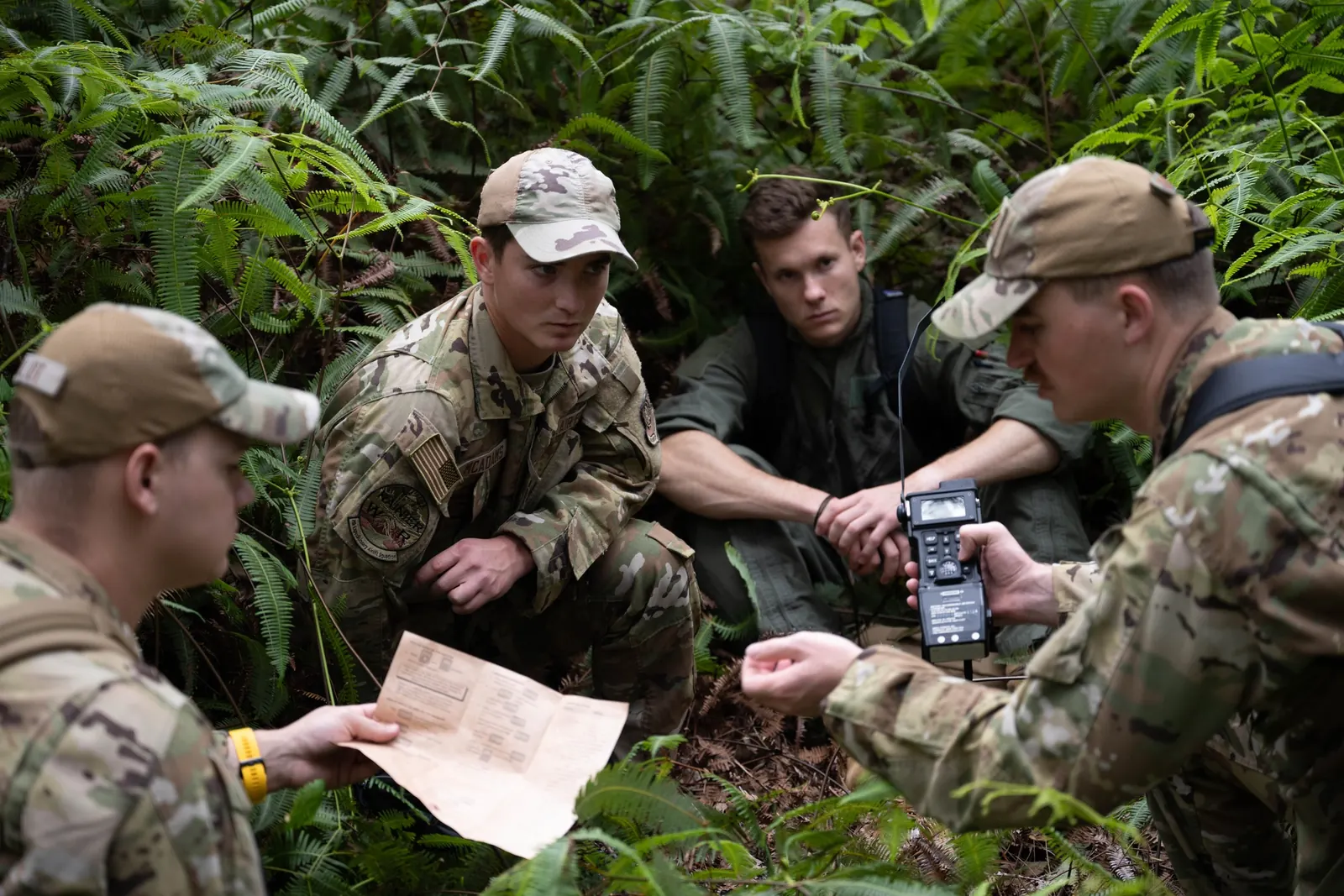
An isolated individual must observe, assess the situation, meet personal needs and prepare every move alone. An aircrew or small group can divide that work: while one member watches the surroundings, others can count the available supplies or assist an injured person. That advantage depends on the people actually present knowing who decides, who performs each task and when the group will move or halt. More people also mean more movement, noise, tracks and demand for supplies.
After unexpected separation, a group may consist of a few members of different units and transported passengers. Their original crew roles remain useful but may no longer fit the situation: the leader is missing, the radio operator cannot use their hands, or the only device has been lost. The group has to establish a workable organisation using the people and equipment that remain.
Build a shared picture from individual observations
After leaving an immediate hazard, first establish who is actually present at a point offering as much cover and concealment as possible. Each person reports their limitations and remaining equipment. For missing members, the last confirmed sighting, its location and the direction of observed movement matter. A presumed route is not a confirmed position; uncoordinated attempts to run back can turn one separation into several independent isolation situations.
Next, bring the observations together. One person saw vehicles, another heard voices and a third knows the route to the separation point. Each report needs a location, direction and approximate time. “Three people moved west along the track” gives more useful information than “The enemy is there”. Where identity or intention is unknown, that uncertainty remains part of the movement decision. Compare apparently conflicting reports against their observation points and times; both may be correct if the people observed have moved in the meantime.
The group uses these observations to decide what it can do next: for example, remain concealed while checking a member’s condition and the supplies, then assess a rally point that might be reached. Everyone needs to know what observation would change that plan. A person who notices new movement or a member becoming unable to continue passes on the change. Without this exchange, the front moves on an old assumption while the rear is already dealing with a new problem.
Clarify leadership and assign work to the people present
Within a military group, establish the existing command relationship and apply the relevant succession arrangements when a leader becomes unable to act. The person responsible gathers information, decides the next action and identifies who will take over if necessary. An ad hoc group also needs an identifiable coordinator and agreed duties. In a mixed group including civilians, practical cooperation has to be agreed explicitly; military rank does not confer unrestricted authority over passengers.
Assign a task to a specific person according to their present ability. The member who knows the terrain and route best can prepare the movement intention. Someone who can operate a radio that is actually available checks its condition. A person with limited walking ability may be able to count supplies or observe an approach if attention, visibility and posture permit. Exhaustion or injury may prevent a previously familiar task; what matters is the person’s ability to perform it now.
A useful assignment identifies the task, required equipment, endpoint and handover. “Watch that approach until I have finished the inventory; then I will relieve you” makes clear who is observing and when the handover will take place. “Someone needs to keep watch” leaves it unclear whether anyone is observing. Two people often have to work in sequence. If both sort equipment at the same time, neither is specifically observing the surroundings during that period. A lone survivor has to plan such changes deliberately into their own work sequence.
Impaired members also change the work of the others. Someone assisting another person to walk or carrying their equipment has fewer free hands and uses additional energy. Adjust loads, distance and breaks together. If a member falls behind, repeatedly drops an item or can no longer complete a simple agreed task, reassess their role. Louder encouragement does not resolve a physical limitation or the gap that it creates.
Make movement and halts a shared sequence
Before moving, agree the objective of the next stage, the direction and how to halt. Use quiet communication that works in the actual light, visibility and hearing conditions. A visible hand movement does nothing for a following member screened by dense vegetation. Spacing therefore has to make use of concealment while preserving contact. A fixed distance in metres cannot replace checking the terrain, visibility and members’ condition.
At a halt, pass the change through the group and establish whether the last member has also arrived. Nobody disappears unnoticed to meet a personal need or search for an item of equipment. When someone has to leave the immediate group, agree the purpose, direction and return as far as the situation permits. This distinguishes a missing member from someone carrying out a known task. If contact is nevertheless lost, use the last confirmed position and existing rally intention; simultaneous searches in different directions enlarge the area over which the group is scattered.
A halt allows the group to observe its surroundings again after moving. Watch approaches, sounds and changes from concealment. Secure loose equipment against rattling; unnecessary walking, loud discussion and visible preparation can expose the entire stay. Then carry out only the necessary work: check condition, drink, organise equipment and decide the next stage. Distribute rest and personal needs so that the observation possible with the people present is maintained.
A person alone has to interrupt observation temporarily for these tasks and choose a location whose approaches they can perceive as well as possible. A group can have another member cover that period. The advantage disappears when everyone sleeps together or the observer is too exhausted to carry out the task. Changes of duty must therefore account for actual condition.
Rally points after separation
A rally point gives separated aircrew members, passengers or unit members a common location reference. They can assemble there, establish who and what remains, and reorganise. A prepared Evasion Plan of Action can include shared intentions, rally points and different intentions for injured and uninjured personnel. Transported passengers’ plans can also be coordinated with those of the aircrew.
After separation, the individual needs to know whether the point is unambiguous, whether it is reachable with their available means and what was actually agreed if reunion fails. A name that each person assigns to a different terrain feature leads the group apart. New enemy activity or impaired mobility may prevent an approach. Compare a reachable alternative against the prepared intention and present situation. The rally point serves group reassembly; pickup by recovery forces additionally requires actual contact or agreed recognition and available forces.
Make a reasoned decision to stay together or separate
Staying together preserves mutual assistance, shared knowledge and access to the available equipment. An injured member can receive help, observation can continue during other work and every item need not be duplicated. At the same time, the group moves within the capabilities of its impaired members. Several people and their equipment must remain concealed; one noisy item or careless movement can reveal the group.
The decision therefore considers health and mobility, observed enemy activity, terrain, supplies and recovery that is actually feasible. Remaining at the present location may be preferable to moving without a reachable objective. If the location becomes immediately dangerous, assess what short relocation is still possible with the members present. The desire for a faster pace alone is insufficient grounds to split.
Before deliberately moving separately, examine what each resulting subgroup would lose and have to do independently. Who has water, protection from the weather, skills, a workable objective and, where applicable, the only communication device? Who would depend on assistance that would no longer be with them? Splitting can interrupt support the members need: two subgroups intended to function independently have only one radio between them, or only one person who can operate it. Where the separate parts would be unable to function, first consider a shorter stage, a halt or a different distribution of loads.
Manage supplies and equipment together
The inventory includes usable food, water, containers, protective material, care equipment and communication devices. Also establish where each item is and whether it can be used. A full container of uncertain contents is not counted as reliably available drinking water. If a device cannot be used because it has no usable battery, the group checks whether it can still send a planned report with the remaining means. Update the inventory after consumption, loss or separation.
For shared supplies, decide who holds and distributes them. Distribution must account for actual needs, upcoming work and members’ condition; an equal portion is not suitable provision in every situation. Issues and the remaining quantity stay clear to the group. Otherwise, the next stage relies on water already consumed. Concealing stocks also prevents sound planning because the others work with a false total.
Distribute shared equipment according to the task. When necessary, its carrier shows others the operation needed for a handover, as time and condition permit. Two prepared communication methods using the same device remain dependent on that one device. Where contact can actually be established, include the present number of people, impairments and available signalling equipment in the prescribed reports.
Organising the group in captivity
In captivity, the captor controls space, movement, contacts and access to resources. They may confiscate equipment, withhold food or medical provision and hold members separately. Organise within the room for action that actually exists: who is reachable, who can meet their own needs and which shared tasks are possible? An arrangement requiring unrestricted access to a camp area does not fit separate cells.
In communal detention, first establish the people present, their evident limitations and the accessible means. One spokesperson gathers shared needs; specific members undertake distribution, cleanliness and assistance for people who need it. Reassign these roles after transfer or separation. A member who needs help to eat must not be overlooked during the next move because the person previously providing that help is now held elsewhere.
Where contact with others is impossible, the individual has to maintain a personal sequence for eating, available hygiene, rest and possible physical activity. With limited contact, task sharing depends on which arrangements the members can still communicate. Sudden movements, loud arguments or an open dispute over leadership may prompt the captor to intervene and reduce the remaining freedom of action.
Organise provision and hygiene with limited means
Establish the amount of food and water actually received and organise distribution so that sick or physically impaired members are also reached. A person who cannot hold a vessel or open a package needs direct help from someone available. Make the handover of that task clear. A general “We look after each other” does not prevent someone being missed during distribution.
Hygiene protects the whole group’s ability to function. Organisms from faeces, vomit or contaminated items can reach the mouth through hands, shared surfaces, food and water. Diarrhoea and vomiting cause fluid loss and can weaken several people at once, leaving previous tasks unperformed. Keep clean supplies and vessels apart from waste and soiled items as far as space and material permit.
A member distributing food avoids direct contact between dirty hands and the shared stock or the inside of a drinking vessel. After using the toilet or providing care that soils the hands, and before handling food, clean hands with soap and water if those means exist. If they are absent, keep soiled handles, lids and vessel rims away from clean contents and drinking openings. Visibly contaminated containers are not moved between drinking water, food and waste. With few members, one person may have to finish dirty care, clean their hands and then distribute food; concurrent roles cannot be assumed.
Make the specific need clear to the captor: missing water for hygiene, a contaminated sleeping area, inadequate vessels or a member unable to use the food received without assistance. The person speaking needs to know these facts.
Protect fellow captives and observe national duties
Shared health concerns can be raised with the captor without revealing other members’ military knowledge. Saying that someone needs help to drink serves their care. Adding the operational information or specialist knowledge they possess may make them a target for specific questioning. Personal privileges obtained by giving information about others also change their circumstances. The group needs to distinguish a necessary welfare report from identifying others as sources of information.
For US prisoners of war, military leadership remains with the senior military prisoner capable of acting; the next senior takes over if that person cannot act. Responsibilities include shared hygiene, care of the sick and wounded, and food utilisation. Harmful information about comrades and special privileges at their expense are prohibited. In the US framework, escape opportunities must also account for leadership and the welfare of prisoners left behind. During operations other than war, US Air Force guidance also requires military personnel detained by an unfriendly government or held hostage to organise in a military manner to the fullest extent possible; civilians in the group should be encouraged to participate.
Prisoner-of-war status depends on the conflict and the protected category of person. For representation before the detaining power, the international framework provides for election or recognition of the senior officer according to the camp’s composition. This representative function and national internal military command have different foundations. A civilian captive does not automatically acquire prisoner-of-war status or a soldier’s national service duties merely because a soldier is present.
Australia distinguishes foreign-government detention, hostage survival and military exploitation in its conduct-after-capture framework. Hostage-taking uses the captive as a means of pressure on third parties; state detention may also involve domestic criminal proceedings. During operations other than war, US military personnel held by an unfriendly government are advised against attempting escape outside life-threatening circumstances because it may lead to further prosecution for violating domestic law.
The appearance of U.S. Department of War (DoW) visual information does not imply or constitute DoW endorsement.