

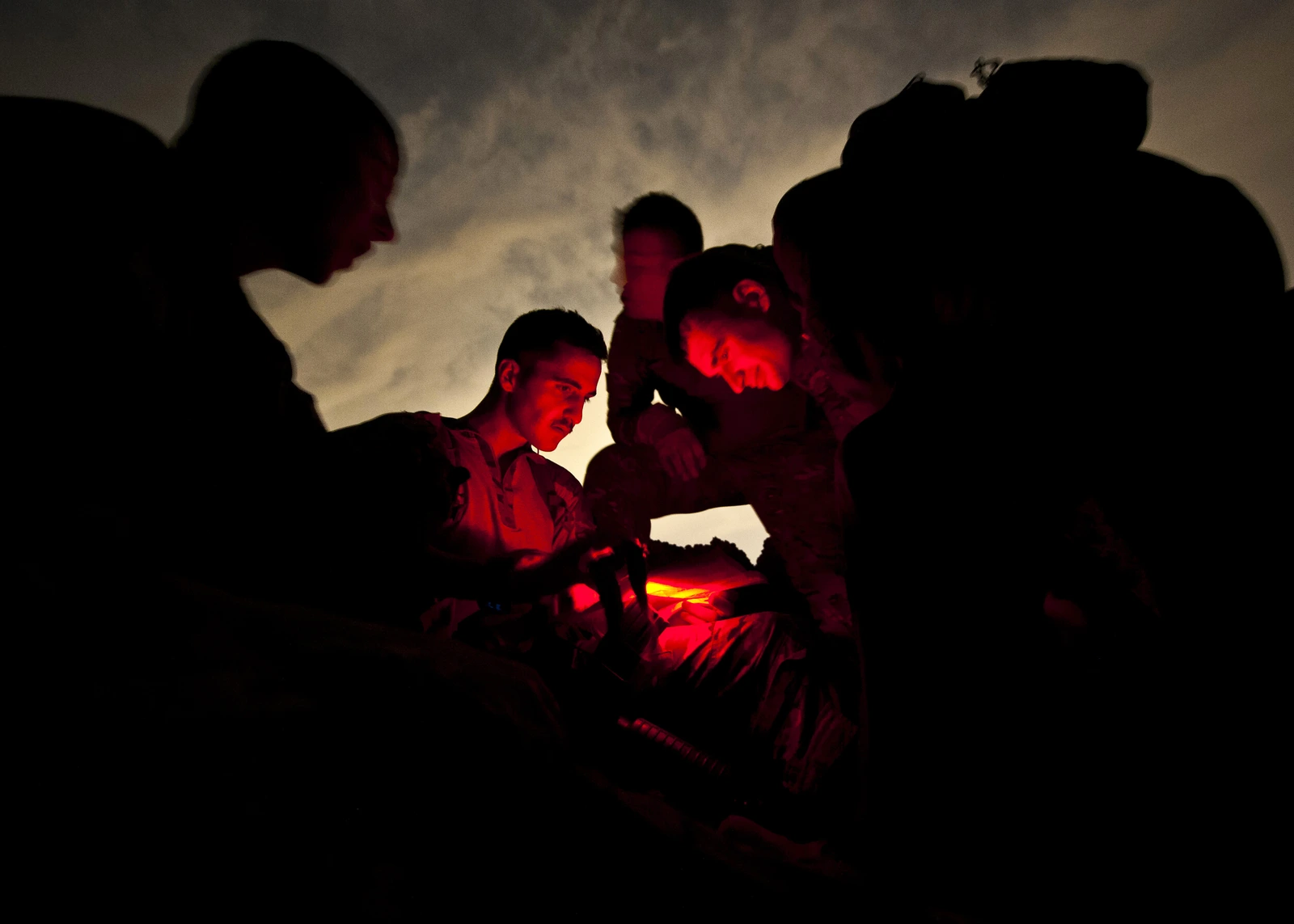
During night evasion, faint outlines and movement are often noticed just outside the direction of gaze. Staring directly at the suspected object can make it disappear again. Night observation therefore combines dark adaptation with off-centre viewing and an orderly scan: halt in concealment, examine the next stretch of ground and check unusual changes before moving on.
Dark adaptation and usable ambient light
The retina works differently in dim light than in daylight. Cones provide sharp detail and colour discrimination when illumination is sufficient; the centre of the fovea contains cones only. The more light-sensitive rods lie outside this centre. Under very low illumination, they mainly provide information about brightness differences, position and movement. Fine detail and colour are lost.
After leaving a bright environment, sensitivity to light increases gradually. Substantial dark adaptation takes on the order of half an hour. Outlines become visible before that; preceding illumination and the light at the observation point determine how much adaptation is achieved. A bright screen between observation periods can impair the sensitivity just gained.
At twilight, in bright moonlight or in an illuminated area, rods and cones work together. Direct viewing can still reveal detail there. Looking slightly away becomes particularly useful for very faint outlines. Dense vegetation can therefore produce different visual conditions from an open area on the same night: what matters is brightness and contrast in the ground being examined.
Applying off-centre viewing
Off-centre viewing means looking slightly beside the object, approximately ten degrees to its left, right, above or below. Its image then falls outside the rod-free visual centre. A weak outline can become more apparent even though it is not being looked at directly. This is a small offset, rather than a glance from the extreme corner of the eye. The head can remain still during these small changes; the eyes shift between nearby points around the object.
Even a faint image viewed off-centre can fade into a uniform area if the gaze remains fixed. The gaze therefore rests on each point for only a few seconds; two to three seconds is a useful guide for shifting the eyes. The next viewing point lies a little above or on the other side of the same outline. This keeps it in the more light-sensitive part of the visual field without repeatedly pulling it back into the centre.
Searching the ground in sections
A rapid sweep across the whole area can miss small changes. The scan consists of slow, orderly eye movements with brief stops. The most prominent outlines are noted first. Adjacent sections are then examined from left to right or right to left, with a small overlap into the preceding area. A weak indication is checked with off-centre viewing before the search resumes where it was interrupted.
The immediate ground, middle distance and farther background are examined separately. This prevents an opening in vegetation from being noticed against a brighter sky while the dark ground below it is overlooked. Dense vegetation calls for smaller search areas than an open slope. The scan also covers the edges of obstructions, where previously concealed movement may become visible. Larger changes in viewing direction are made within existing concealment; checking a single outline requires only the small eye movements.
Outlines, movement and missing detail
In very dim light, outline, apparent size and position against the background provide more information than colour. A dark object may stand out against a brighter gap and disappear against the next tree trunk. Its position is therefore followed relative to several fixed terrain features. An outline moving from one opening to the next gives a better indication of actual movement than staring at an isolated dark patch.
Poor detail resolution limits interpretation. A moving shape may already justify postponing the planned movement, although clothing or equipment cannot yet be distinguished. For a more precise interpretation, observe repeated movement patterns, the continuous outline and its relationship to the ground. If vegetation partly hides it, the next visible gap is watched as well, rather than moving closer to investigate.
Apparent movement of an isolated light
A single stationary light can appear to wander in darkness when stared at for a prolonged period. This effect, called autokinesis, is particularly misleading when few other outlines can be seen nearby.
To check it, the fixed gaze is broken and the surroundings are scanned again. The light's position is then compared with visible fixed features, such as a tree edge or the side of a building. Lateral displacement shows relative to those reference points. A light moving approximately towards the observer, however, can remain in the same direction of view. If no fixed references are available, the isolated light's direction of movement remains unresolved; its apparent wandering alone does not identify a walking person or a moving vehicle.
Limiting glare and separating close work
Bright lamps, headlights or an undimmed display can leave faint terrain outlines temporarily invisible after looking away. The gaze is turned away from the source; an existing barrier can screen the direct glare. After exposure, observation resumes from the halt to establish which outlines and ground features remain visible. Ground assessed before the exposure may now be harder to see well enough to cross.
If an existing light is needed for a brief task, its brightness is reduced as far as the task permits and exposure kept short. Dim red light helps retain a degree of adaptation, but changes colour perception. Coloured equipment markings may become indistinguishable under it. Brief, dim white light is more useful for a task requiring those distinctions. The light and illuminated object remain within concealment because a red source can also be visible from outside.
For necessary close work while stationary, one eye can remain closed or shielded from the light. That eye is more likely to retain a usable dark view once the light is switched off. Using only one eye reduces depth perception and the field of view. The task is therefore completed at the halt; both eyes are opened and the immediate ground is examined again before moving.
Using the observation to decide the next movement
From the concealed halt, observation covers the next movement segment, the screening features that can be reached and possible activity in adjoining areas. Trunks may stand out against the sky while a gully or edge disappears in the dark foreground. Further movement is therefore tied to the ground that can actually be distinguished and the next concealed observation point.
Cloud, fog and the transition from open ground into dense vegetation can sharply reduce contrast during movement. If the previously visible continuation is lost, the area is searched again from concealment. If only a shorter segment leading to reachable concealment remains visible, movement is limited to that visible stretch. A different screened viewpoint or waiting for better light may reveal ground that cannot yet be seen clearly.
The appearance of U.S. Department of War (DoW) visual information does not imply or constitute DoW endorsement.