

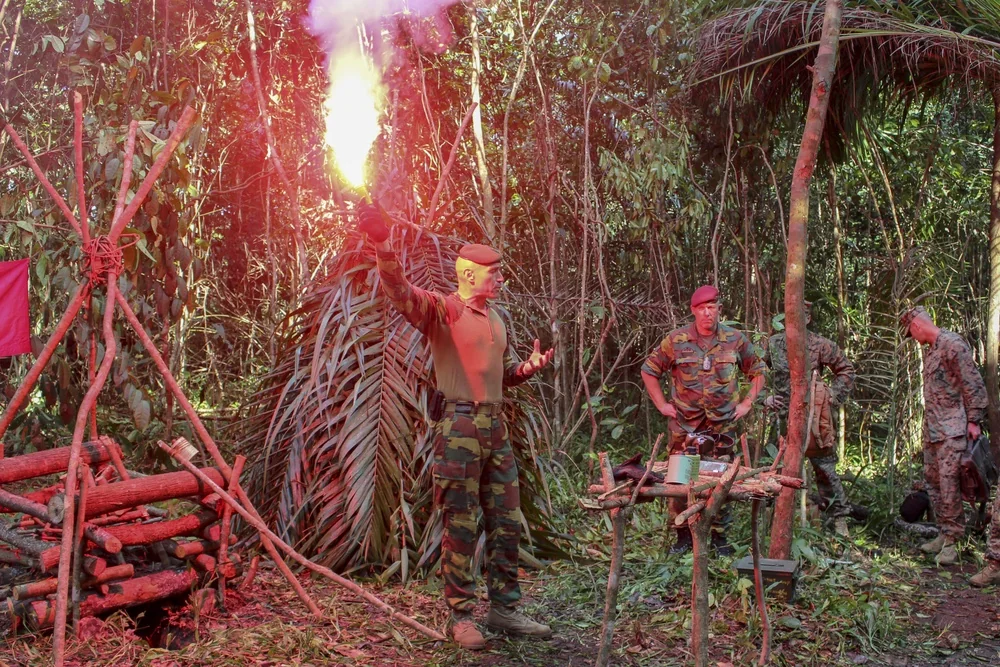
Belgian SERE training prepares service personnel to remain capable after separation from friendly forces, evade capture and contribute to their own recovery. A downed pilot must manage with personal survival equipment; an isolated paracommando must combine protection and sustainment with movement through threatened terrain. Capture changes the task again: conduct under another party's control and protecting military information become central. Belgian training descriptions use SERE for Survival, Evasion, Resistance and Extraction.
Land survival and evasion in the paracommando pathway
In the Belgian Commando A training model, the SERE component is explicitly designated Level B. It covers fire, water, shelter and food, escape and evasion, conduct after capture and personnel recovery procedures. The task is to apply these skills as isolated personnel. Movement and sustainment therefore remain connected: continuing a journey requires sufficient physical reserves, while stopping to rest or obtain supplies also requires consideration of the risk of detection. The training model includes an escape exercise and movement at night or through difficult terrain.
Belgium's pathway for delivering SERE instruction within units uses Unit SERE Instructors. During their training, participants apply survival techniques, procedures to avoid capture and extraction procedures in the field. Wooded training areas with access to water and separate isolation zones support these tasks. Their subsequent instructional remit extends to SERE Level B, but excludes both theoretical and practical resistance instruction. Understanding different captivity situations during this training is therefore separate from authority to conduct resistance training themselves.
Environmental training changes the survival decision. The Belgian Special Operations Regiment, for example, trains for whiteout: snow and extremely limited visibility remove the soldier's visible terrain references. Without visible terrain references, the soldier may no longer be able to judge how to move safely while cold and wind continue to chill the body. Participants therefore practise building snow holes and snow caves. A snow hole takes less time to build; a snow cave requires more time and offers greater comfort. In an urgent situation, the question is how quickly protection can be obtained; the more comfortable shelter may be finished too late. Additional Belgian SERE/PR instructor components for cold weather, desert and jungle environments connect survival, evading capture and self-recovery or assisted recovery with the particular environment.
Aircrew: the situation and the equipment actually available
The Belgian Combat Survival Centre at Beauvechain combines basic survival training with subsequent training for the particular aircraft. While the land component uses the soldier's combat and field equipment, aircrew must be able to operate their aircraft's emergency equipment. A fighter pilot's personal emergency equipment and the resources of a crew with several members create different tasks. A solo pilot must reach and operate the equipment independently. A multi-person crew also needs coordination: who remains capable, which resources are available after the emergency and which people must be accounted for during recovery concern the whole group. Several crew members provide mutual support only if they actually remain together or find one another again after the emergency.
Sea survival: from entering the water to a possible pickup
The Belgian Sea Survival Initial Course combines theory, swimming-pool practice and the open sea. Trainee pilots and future crew members enter deep water, move while wearing a waterproof suit and practise boarding a life raft. At sea, they practise these tasks together: they enter the water, reach the raft, communicate their position and are picked up by the naval vessel supporting the training.
Despite water, cold and restricted movement, the person must use the equipment and get aboard. Seasickness can also make operating equipment and completing the task more difficult. Using the survival kit and preventing hypothermia therefore form part of the water component. In an actual emergency, pickup still depends on a suitable vehicle being able to reach the person. Until that becomes possible, the survivor must keep going with the raft and survival equipment available.
Capture: recognize the situation and protect information
The Belgian captivity component covers conduct after capture; practical SERE training also includes simulated enemy capture. This removes the person's freedom to choose location and movement. When a member of the Belgian armed forces falls into the power of the enemy in an international armed conflict, the prisoner-of-war framework applies. It governs treatment under another party's control and the obligation to provide information during questioning.
A service member with prisoner-of-war status must give surname and first names, rank, date of birth and military identification number or equivalent information during questioning. The identity card must be shown on demand. This creates no obligation to disclose information about the mission, friendly forces or their intentions. For the individual, the boundary is between personal identity details and military information. The detaining power may not use torture or other coercion to obtain information.
Contributing to location, contact and recovery
Belgian crew members support the search for them by operating their personal locating equipment. An aircraft emergency beacon can direct a search towards the aircraft. An individual crew member activates a personal beacon. An appropriately equipped search aircraft can use the received transmission to determine the bearing to that beacon; bearings from different positions narrow down the location. Both sides of the connection matter: the person needs a functioning, accessible device, and suitable receiving equipment must be operating in the search area.
For cooperation with partner forces, location, intended action and identity belong to different parts of preparation. The Evasion Plan of Action describes intended evasion and possible destinations so recovery forces can understand the person's movement. The Isolated Personnel Report contains information for identification and authentication. In Belgium's allocation of responsibilities, the PR officer coordinates these unit documents with the relevant PR organizations. This gives the individual a task before deployment: learn the contact points, communications equipment and recognition procedures applicable to the mission.
When a usable connection exists, isolated personnel must communicate their location through the designated means and follow the contact instructions of the forces involved. Even precise coordinates do not replace identity verification. During multinational recovery, the person is authenticated before pickup; agreed recognition and authentication information must therefore remain protected from unauthorized access. An adversary who knows that information can imitate credible contact or draw recovery forces into a dangerous location. At an actual ground linkup, the recovery team establishes physical contact, verifies identity and escorts the person to the recovery vehicle. The individual's contribution is to follow the communicated movement and boarding instructions, rather than advance towards the vehicle independently.
Dense terrain may lack a suitable helicopter landing site; a ground team must be able to reach the location at all. Belgium includes available search-and-rescue capabilities in PR planning and seeks to resolve an event at the lowest appropriate level. Which air, ground or maritime resources can actually be employed depends on whether they can reach the person under the existing threat.
After recovery
Actual recovery is followed by reintegration, with medical follow-up, immediate debriefing and psychological support. It addresses the recovered person's condition and the effects of isolation. Debriefing also reconstructs what happened during separation, possible captivity and recovery.
The appearance of U.S. Department of War (DoW) visual information does not imply or constitute DoW endorsement.