

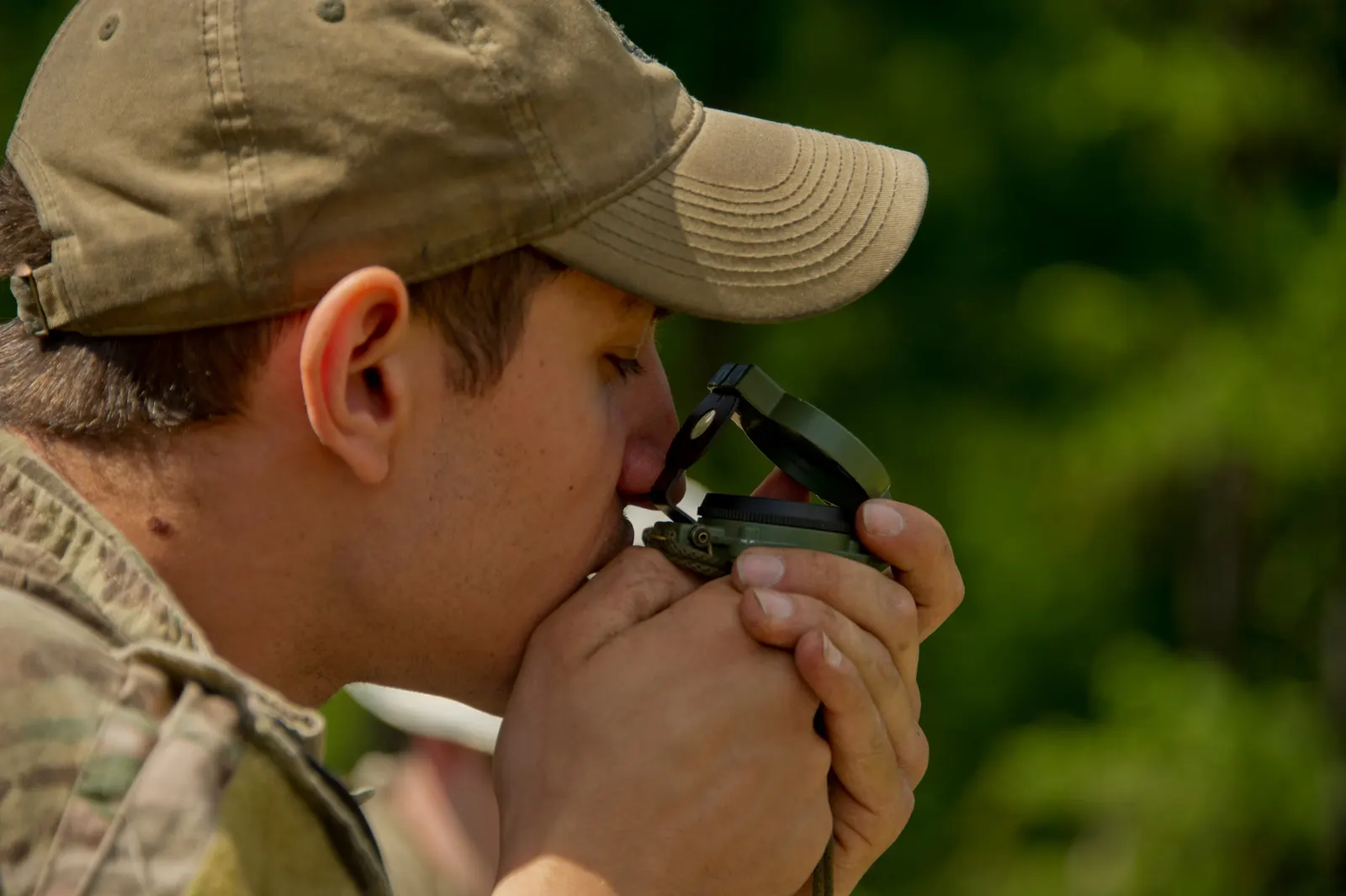
Military survival training prepares personnel to cope with isolation from friendly forces, avoid capture and assist in their own recovery. An isolated soldier has to make do with whatever equipment and supplies remain. Aircrew may first have to survive a parachute landing, escape from an aircraft or get into a life raft. Training therefore teaches personnel to protect and sustain themselves and move under threat from an adversary. They also practise their part in a possible recovery.
Someone trying to avoid capture must also consider the risk of discovery when choosing where to rest or collect water. A fire provides warmth, but its light and smoke can reveal the location. Other people may also use a water source. A hiding place that offers no shelter from wind and rain allows little restful sleep; someone who becomes cold there will be weaker when it is time to move on. Field training therefore teaches participants to obtain supplies and rest while still considering the risk of discovery.
Role and risk determine the preparation
The mission and the person’s role determine the risk. Aircrew may be shot down or forced to land far from friendly forces. Special operations personnel may operate deep inside adversary-controlled territory. Ground troops may become isolated after an attack, the loss of a vehicle or separation from their unit. Training requirements reflect both the likelihood of isolation and the consequences of capture: what information the person holds, their responsibilities and how an adversary might exploit them.
Within the NATO framework, SERE preparation is divided into Levels A, B and C. Level A provides the academic foundations for low-risk personnel and may include limited practical survival training in a controlled environment. Level B combines that foundation with practical survival and evasion training and classroom resistance training for personnel at medium risk. Level C includes extensive practical survival, evasion and resistance training for high-risk personnel. Armed forces deliver these requirements through their own programmes, supplemented by emergency procedures for particular roles and environmental courses, such as training for aircrew flying in northern regions or over the sea.
Working with the equipment that remains
On becoming isolated, personnel first check what remains: protective equipment, water containers, supplies, fire-lighting materials and communications or signalling devices. What has been damaged, lost or used up? The answers determine what the person can do next. Someone who still has a bivouac bag has more options for weather protection than someone who has lost the entire survival kit. Any remaining optical signalling devices are kept ready for a suitable opportunity to signal friendly forces.
Participants practise with the equipment they are issued. They learn to operate the devices, protect them from water and dirt, and stow them so that nothing rattles or gets lost on the move. The protection batteries need depends on the requirements of the particular device. Participants must also be able to prepare signalling devices and use them according to their operating instructions. Before a pickup, they secure loose items so that nothing snags or blows away. Without a water container, a navigation device or a radio, obtaining water, finding the way or contacting rescue forces becomes harder.
Armed forces issue survival equipment according to their national requirements, the mission, isolation risk and environment. They also consider the planned recovery procedures: the person must be able to carry them out with the communications and signalling equipment provided. Anyone using an unfamiliar device needs to understand its functions. A navigation device, a distress beacon and a radio serve different purposes.
Shelter and supplies under threat of detection
Field training combines protection from the weather and cold or wet ground with obtaining water and managing limited food supplies. When choosing a rest site, participants also assess how easily they could be seen, whether they can observe the approaches and how they could leave. A hollow may provide concealment but collect water. A shelter with only one poorly placed exit may leave its occupant unable to withdraw unseen when people approach. The site must allow both rest and observation of the surroundings.
Keeping a fire going requires fuel to be collected and prepared and the fire to be tended. This takes time and energy, keeps the person in one place and can reveal their location through light and smoke. They must weigh the need for warmth or cooking against the risk of detection. An immediate threat from heat loss carries more weight than the wish for a hot meal. Protective equipment and a better site may reduce the need for a fire. In training, participants make this decision in the terrain and weather conditions they face.
The water supply must last for the planned route, including the extra time and effort that difficult terrain may demand. Finding and preparing water or food requires stops and takes time. Containers and water-treatment supplies will also be needed on later stages and must be kept usable. An opportunity to replenish supplies is therefore not always worth taking: the time and effort required, and how long the person must stay in one place, also matter.
Observation guides concealed movement
In evasion training, participants use their observations to decide where and when to move. Before leaving a concealed halt, they observe the next stretch of ground, possible approaches and signs of human activity. Vehicles, voices, smoke, occupied buildings or visible movement may require a change of route. A route that looks short on a map may cross open ground, an obstacle that is difficult to negotiate or a regularly used track.
The person uses terrain cover, avoids presenting a conspicuous silhouette and secures equipment that could make noise. At a halt, they observe from concealment without exposing themselves for a better view. Concealment changes as shadows move; open ground may lie just beyond a strip of vegetation, and the next movement may expose someone who was previously hidden. Participants therefore practise moving a manageable distance, reassessing the situation and adjusting their route to what they observe.
A protected halt allows time to rest, organise equipment and observe the surroundings. It also means spending longer in one place. Before moving on, the person has to judge how far their remaining strength and supplies will take them under the current threat. Moving faster may consume more water and energy; a long detour may exhaust limited supplies. The isolated person must make this decision even without contact with friendly forces.
A German evasion exercise
One German SERE-B programme for ground troops begins with instruction and practical stations covering fire, ground-to-ground and ground-to-air signals, cold protection, heat retention and emergency shelter. An evasion exercise follows: teams of two or three soldiers must reach pickup points while an opposing force restricts their movement. They apply the skills together: a shelter enables them to rest, supplies must last for the next stage, and they need the signals they have practised when recovery begins.
In this programme, participants have limited clothing, a bivouac bag and little food, but no sleeping bag. During shelter work and movement at night, they adjust their clothing to avoid heavy sweating. Sweat-soaked clothing would otherwise increase heat loss during the next rest period. Fuel is prepared before a longer halt. Teams assign fire-watch and observation duties at their bivouac sites; anyone on duty has to forgo uninterrupted rest.
Deep snow increases the time and effort needed even for relatively short distances. The team must plan its movement, allocate supplies and divide the tasks at each halt. Spending too much time and energy on an elaborate camp leaves fewer reserves for the next stage. Inadequate shelter makes rest difficult and leaves participants weakened before they move again. On reaching the pickup point, they still have to carry out the contact and recovery procedures they have practised.
An American course with a captivity phase
One SERE-C programme for Army Special Operations Forces has three parts. It begins with the American Code of Conduct, SERE instruction and practical fieldcraft. During the field phase, participants obtain water and food, build shelters, use fires and practise evasion against an opposing force. They must sustain themselves while continuing to move and avoid detection.
A controlled resistance laboratory follows, placing participants in a captivity scenario. They practise individual and collective resistance to interrogation and exploitation within the American conduct framework. Unlike in the field phase, they now have little control over where they are held, how they use their time or whom they contact. They must maintain their physical capacity, protect information and meet their responsibilities towards fellow captives under these restrictions. The course ends with a debriefing of the training phases.
US Air Force training for personnel at risk also covers post-ejection procedures, parachute landing falls, survival medicine and recovery equipment. Its water survival courses distinguish between ejection and non-ejection aircrew. The emergency procedures for each aircraft determine what equipment the crew can use after leaving it and which skills they will need.
Captivity preparation and information protection
Resistance training prepares personnel for an adversary’s attempts to exploit them in captivity. An adversary may use a captive’s answers to build a picture of the situation, obtain information about other people or use their statements for its own purposes. Training therefore covers national conduct rules, protection of service information and behaviour within a group of captives. Information about fellow captives may endanger them, so the duty to protect information extends beyond the person’s own mission.
In the American ARSOF programme, the Code of Conduct provides the national framework. It requires US prisoners neither to disclose information that could harm fellow prisoners nor to take part in actions that could endanger them. Damaging information about another prisoner can give an adversary more ways to put pressure on that person. Withholding it therefore protects others as well. German SERE-C training may be followed by an additional Resistance to Interrogation module for personnel in particularly exposed roles. This extends training beyond evasion to captivity and questioning: participants practise following their conduct rules and protecting fellow captives despite restricted movement and pressure from an adversary.
The isolated person’s role in recovery
Preparation for personnel recovery begins before isolation. An Evasion Plan of Action records planned evasion actions, helping recovery forces anticipate where the person may move. An Isolated Personnel Report supports identification and authentication. Training distinguishes these tasks: a position report tells the recovery force where someone is; personal authentication information helps establish whether they are the person being sought. That information must be protected so that an adversary cannot use it to impersonate them.
If contact is established, the isolated person must report the situation using whatever means remain. This includes the position, number and condition of personnel, obstacles and observed adversary activity in the pickup area, and available signalling devices. An optical signal can help friendly forces locate the person, provided they can see it and its use has been agreed beforehand or coordinated over the available link. Participants learn when to signal during recovery and how doing so may expose them to detection.
When pickup is imminent, participants secure equipment and loose items and prepare the intended signals. In a hostile environment, they remain concealed until they need to leave cover for the pickup. On contact, they keep their behaviour visibly non-threatening and their weapons secured. They avoid sudden or ambiguous movements that could provoke a mistaken reaction and approach a recovery vehicle only when instructed. Training prepares them for their tasks during recovery by land, water or air. Recovery is complete when they are back under friendly control.
Aircraft escape and survival at sea
For aircrew, isolation often begins with a technical emergency. They must be able to reach and operate the survival equipment fitted to their aircraft type so that they can use it after escape. German aircrew trainees practise with parachutes, life jackets and life rafts. They first rehearse escape from an overturned aircraft cabin in a water training facility, then apply their skills at sea. This allows them to learn the equipment and emergency procedures before dealing with conditions on the open water.
At sea, crew members must use the life raft and signalling devices, secure their equipment and manage their supplies. Wind, current and the capabilities of the people and survival craft determine where and how far they can travel. They cannot approach a chosen point as they would on a march over land. If they later reach the coast, they must assess the terrain, find concealment and choose their onward route over land. Water survival and evasion training prepare them for these different phases of a possible isolation event.
Training for cold, dry regions and dense vegetation
Cold reduces the time available for unprotected work and makes protection against heat loss essential during rest. Snow can be used to build an insulated shelter: its walls block the wind and reduce heat loss. An insulating layer beneath the body provides additional protection from the cold ground. Deep snow also slows movement, making short distances time-consuming. Short winter days leave little daylight for assessing terrain and footing. US Air Force Arctic training for aircrew flying in northern regions therefore concentrates on insulated shelters, fire, water, food and signalling. Crew members learn to survive while isolated and attract attention when a suitable recovery opportunity arises.
In dry regions, the person must choose a route that their water supply and the expected effort allow them to complete. Heat, soft sand or difficult terrain may sharply reduce how far the same supply will take them. Dense tropical vegetation presents a different problem: visibility is short, so obstacles and footing can only be assessed at close range. Detours and passage through thick vegetation take extra energy. Darkness makes assessment harder still. Dense growth provides concealment but also slows progress and makes obstacles harder to spot in time.
Australian and French aircrew training
The Australian Aircrew SERE course prepares crews who may be forced down or separated from friendly forces in combat, including cabin crew. Participants train at sea, on the coast and in arid and jungle environments. The course includes swimming, evasion, resistance to interrogation and exploitation, and escape. The course ends with an evasion and capture scenario. Participants practise avoiding capture and protecting information when their freedom of movement is restricted.
In France, the Centre de formation à la survie et au sauvetage trains aircrew from the Air and Space Force, Navy and Army in survival, evasion, resistance and extraction. Its Alpha, Bravo and Charlie levels reflect the risk of isolation and exploitation; aircrew receive the highest level of training. Environmental courses cover cold, desert and equatorial conditions. Crews learn to survive with their emergency equipment after leaving the aircraft in these environments. The SERE elements also prepare them for concealment, captivity and recovery.
The appearance of U.S. Department of War (DoW) visual information does not imply or constitute DoW endorsement.