

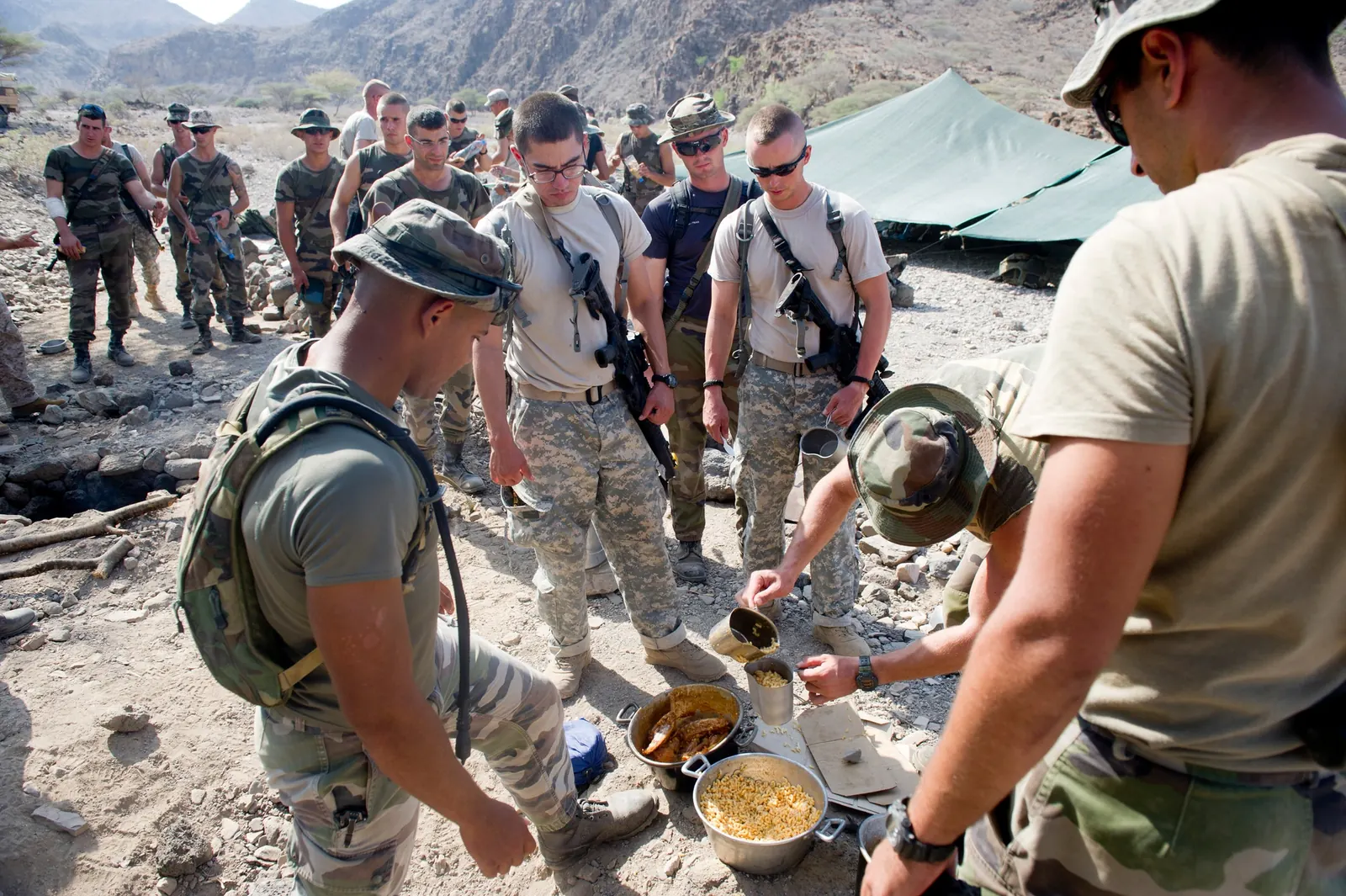
France prepares military personnel at risk through SERE for four connected tasks: survive, avoid capture, resist exploitation and return from isolation. The French terms are Survie, Évitement de capture or Évasion, Résistance and Extraction. Alpha, Bravo and Charlie distinguish the scope of training according to the risk of being isolated and exploited by an adversary. For an aircraft crew member, this situation may begin with an ejection or crash behind enemy lines: the individual must remain capable of acting with the equipment recovered, while the adversary searches the likely landing area.
The Centre de formation à la survie et au sauvetage, or CFSS, prepares aircrew from the Armée de l’Air et de l’Espace, the Marine nationale and the Armée de Terre for these situations. This includes pilots and other crew members. Survival equipment, conduct in captivity and recovery depend on each other: someone who has to leave the landing site still needs a workable route towards possible contact or pickup. Someone who can establish communications must protect their location while being able to identify themselves to the appropriate forces.
Alpha, Bravo and Charlie: risk and tasks
The risk includes both the likelihood of isolation and the consequences of capture. A crew member operating over enemy territory may emerge from an emergency landing injured, poorly supplied and of interest to the adversary as a source of information or propaganda. The French framework associates low risk with Alpha, medium risk with Bravo and high risk with Charlie. French Air and Space Force aircrew receive the highest level. For other duties, the expected operational risk determines the required scope.
| Level | Risk profile | Training content |
|---|---|---|
| A / Alpha | Low risk of isolation and exploitation | Theoretical foundations in protection, personal location, water and food, personal equipment, captivity, information protection and assistance with recovery. |
| B / Bravo | Medium risk of isolation and exploitation | Theory and practical application: initial reactions, survival, movement to avoid capture, navigation, communications, location marking and participation in identification and authentication. |
| C / Charlie | High risk of isolation and exploitation | Advanced practical survival and evasion tasks with operational equipment and opposition, practical captivity and resistance elements, and preparation for the intended extraction. |
Alpha already addresses captivity and recovery: which information needs protection, how can a location be marked, and what conduct assists pickup? Bravo brings personal equipment and procedures into practical use. The individual operates navigation and communications equipment and responds to identity checks by friendly forces. Bravo also covers the psychological and legal foundations of captivity. Charlie develops resistance to exploitation through practice and connects the field tasks under adversarial pressure. These three labels therefore specify the required scope of training. They do not represent a fixed sequence of three courses that everyone must complete.
In the field: remain capable and avoid capture
After an ejection or crash, the individual must first assess the immediate situation: which injuries and environmental hazards threaten them, can they move, which equipment survived the landing, and where are they? French practical training covers these initial reactions and the use of personal resources appropriate to the threat and environment. For aircrew, this includes checking the remaining survival equipment and determining which navigation and communications devices can still be used. An injured leg, a lost water container or a damaged radio changes the next decision immediately.
The individual must combine protection, location, water and food with capture avoidance. A long journey to a better hiding place can consume the remaining water and ability to move. An accessible supply location may also be watched by enemy forces. A fire can provide warmth but produces visible light and smoke, as well as a detectable smell. In a Charlie field situation, the participant therefore uses their actual resources to decide whether to continue, remain protected for the moment or change their movement. Whatever they decide must be feasible with their remaining strength and equipment, and allow them to continue sustaining themselves and avoiding capture.
Évitement de capture means directing observation, movement and concealment against the enemy search. After an evident aircraft emergency, the probable landing area is an obvious place to search. The individual must therefore assess their location, the adversary’s opportunities for observation and the open areas to be crossed before moving. Cover for a pause, a route for the next leg and a possible contact location serve different purposes. Someone who follows only a navigation objective without checking their situation or remaining strength en route may arrive unable to continue evasion or take part in pickup.
French Charlie training connects theory with a practical situation, operational equipment and an opposing force. Protection and sustainment have to continue during capture avoidance; navigation must also support later recovery. The opposing force may compel the participant to abandon a convenient route or refrain from using a conspicuous signal. They must still assess the situation themselves: a navigation device displays a position, but neither the actual security of the route nor the person’s remaining capacity.
Preparation also includes survival psychology. The abrupt change from the cockpit to a confusing situation on the ground can trigger panic, rushed action or freezing. Exhaustion also intensifies the stress of captivity. The individual therefore focuses on one manageable task at a time, such as assessing injuries and equipment, establishing protection, determining location or planning the next move. This helps them act even when their sense of time is disrupted and the familiar routines and technical aids of the cockpit are no longer available.
Captivity, information protection and Résistance
A captured French combatant retains the duty to escape captivity, resist pressure and seek to resume combat. Training therefore prepares personnel for conduct after capture as well as capture avoidance. Alpha teaches foundations in the phases of captivity, information protection and survival in captivity. Bravo addresses the psychological and legal context. Charlie includes practical resistance to state and non-state detaining entities.
The distinction between being a prisoner of war, other detention and hostage-taking changes the framework for conduct. When questioned as a prisoner of war, the required identifying information is limited to surname, first names, rank, date of birth and a personal or equivalent identification number. Mission details, intended movements and recovery information are outside those particulars. Protection against intimidation and public exposure is also part of prisoner-of-war law. The individual needs to know these boundaries even when a detaining entity violates them. Other detention may serve control or questioning. Hostage-taking, however, uses continued detention or threats to life and safety to force a third party to act or refrain from acting. Release or the hostage’s safety is made conditional on that demand. A public statement demanded from the hostage can put pressure on friendly forces, relatives or the government. The individual therefore needs to recognise which requested details disclose military information and which statements are intended to influence third parties.
Information protection is a task alongside physical survival. Details about fellow personnel, the mission, a planned escape movement or authentication information can endanger remaining friendly forces and a recovery operation. A coerced public statement can also be used for adversarial influence. French preparation directs Résistance towards resisting exploitation regardless of whether the rules for prisoners of war apply to the particular captivity situation. Under physical strain, uncertainty and pressure, the individual must still recognise their remaining options and what the information demanded would mean to the adversary. An escape then returns them to survival and evasion tasks: freedom from immediate custody provides neither sustainment nor safe pickup.
Extraction: personal equipment, contact and actual pickup
French training separates three functions of personal equipment: movement, location marking and communications. Maps, compasses and satellite navigation support location and movement. Strobe lights, infrared lights, signal mirrors, smoke or other suitable markers can indicate a location to searching forces. Radio, telephone or data transmission allow an exchange. At Charlie level, the equipment model also includes survival radios or corresponding beacons and protected communications. What matters is which items the isolated individual actually carries and can still use after the incident.
A light signal does not communicate medical condition; a precise coordinate does not prove identity. Infrared markers require compatible observation equipment at the receiving end. A mirror needs a usable line of sight and light. A signal visible to the recovery force may also attract the adversary’s attention in an unfavourable situation. The individual therefore has to connect location marking with the intended contact procedure. A radio is useful only if it works and a link with appropriate forces is established. Without that link, the person must continue protection, sustainment and evasion through their own actions.
When communications are possible, actual location and physical condition are critical information. Both influence where and how pickup might be carried out: someone who can walk can reach a different place from someone unable to move independently. A reported location has to remain consistent with subsequent movement. Someone who has to leave reports the change when a link exists, so that friendly forces search at the correct location. Mission-specific standard operating procedures and special instructions, SOP and SPINS, prepare this coordination.
Authentication then checks whether the person contacted is actually the friendly individual being sought. Information and procedures prepared before the mission are used for this purpose. The ISOPREP, or Isolated Personnel Report, provides a basis for identification and authentication; the individual needs to know the information and conduct intended for their check. Authentication protects against adversarial deception that could lead forces to the wrong person or into an ambush. The training task is to respond to the agreed procedure and then coordinate location marking and pickup conduct with the recovery force.
RESCo, Recherche et sauvetage de combat, connects search and pickup under enemy threat. The forces employed must establish the final location, authenticate the person, consider threats to that person and to their own force, and carry out pickup. The CFSS also prepares ground recovery personnel for this role; aircrew and the forces collecting them need to be able to use the same contact procedures. For the isolated individual, this means assisting the search with available equipment, following the intended contact and pickup procedure, and aligning movement with actual coordination. For special forces personnel, the French Charlie framework also addresses UAR, Unconventional Assisted Recovery. In the French interpretation, this recovery is led by special forces and may include assets from other components. The individual prepares for the procedure intended for their mission.
Recovery can be carried out only with forces that are actually available and suitable for the situation. Threats to aircraft, accessibility, terrain and the person’s condition can change the location, assets and timing of pickup. Isolation ends only when friendly or allied protection is physically established. Handover, assessment of injuries and strain, and debriefing follow. An account of movement, lost equipment, captivity and possible information compromise helps with care for the recovered person and assessment of the consequences for others involved.
Amerrissage sous voile: parachute water landing
For fighter and transport aircrew, having to abandon the aircraft over the sea creates a distinct situation. Amerrissage sous voile means landing in water under a parachute. The crew member must be able to apply the emergency procedures intended for their equipment during descent. Water entry and subsequent survival follow immediately; starting to sort unfamiliar equipment only then consumes time in an environment where the individual cannot move as they would on land.
The CFSS practises this task using, among other means, an EPPAN, an Embarcation à Plateforme pour les activités de Parachutisme Ascensionnel Nautique. The participant is attached to the boat through a harness and safety connection. The boat and winch then lift the participant under the canopy. From a controlled height, the participant puts the prepared survival and water-landing procedures into practice. This arrangement connects the phase under the parachute with actual entry into the water. It prepares personnel for this aircrew emergency; leaving a submerged cabin is a different task with a different starting situation and equipment.
Environmental programmes and survival after an aircraft accident
French aircrew preparation also includes programmes for cold, desert and equatorial conditions. Aircrew learn which equipment they can use in the particular accident environment and what tasks the conditions require of them. In cold and snowy terrain, body heat, protection and a means of indicating location must be maintained. In arid conditions, heat, water supply and exertion limit how far the individual can move. In equatorial forest, the person and their equipment must cope with wet vegetation, restricted visibility and local hazards. An environmental element may focus on survival after an accident; tactical evasion and captivity enter through the relevant SERE task.
The environmental programmes combine preparation for local conditions with acquiring the required skills and applying them in the field. For the isolated individual, what matters is which equipment can be reached after the accident and which resources can be recognised and used. A survival pack assembled for the area being overflown is therefore part of aircrew preparation. The environment also affects recovery: dense vegetation can obstruct location marking, while an open place can increase visibility and consequently change exposure to the adversary.
In the Armée de Terre, the Centre d’entraînement en forêt équatoriale, or CEFE, prepares personnel for movement and sustainment in jungle conditions. This includes preparing equipment for the forest, water obstacles, a tactical bivouac and independent resource finding. These skills help prepare the next movement without continuing supply from the individual’s own unit.
The appearance of U.S. Department of War (DoW) visual information does not imply or constitute DoW endorsement.