

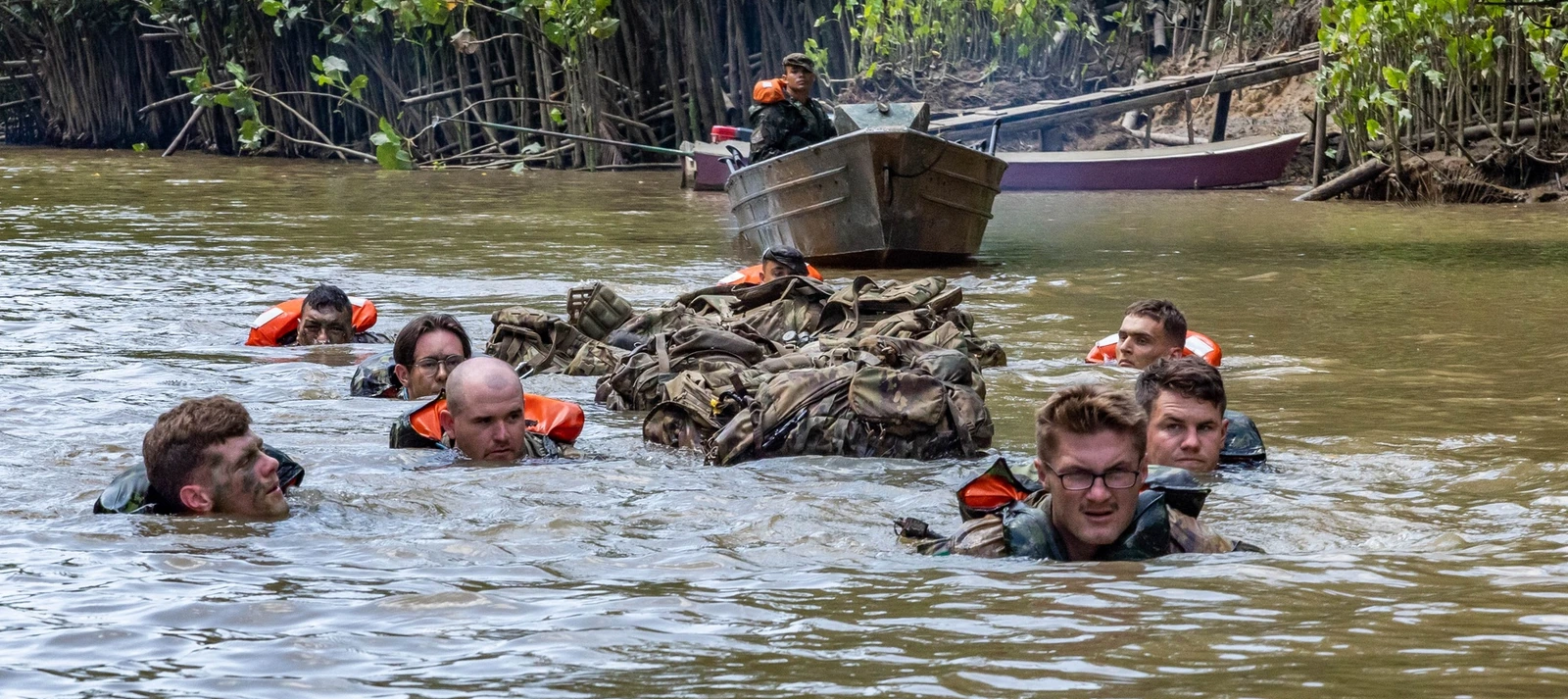
Brazilian military survival training connects several tasks. After an emergency, aircrew must stay alive with the equipment they still have; in hostile territory, they must avoid capture and prepare for recovery. The Força Aérea Brasileira (FAB) links preparation of the isolated crew member, the evasor, with recovery-force procedures. CABAS focuses particularly on survival in Amazonia. The Navy has distinct training paths for aviation personnel and combat divers, while the Army places jungle survival within a broader programme for operations in the selva.
From the downed pilot to the pickup point
In one FAB training path, fuga e evasão begins at the Academia da Força Aérea. Subsequent fighter-pilot training links instruction in Busca e Salvamento em Combate, recovery under hostile threat, with a continuous task on the ground. The student moves through terrain represented as hostile, reaches a designated pickup point at a specified time and carries out the required radio contacts with the recovery helicopter. Place, time and communication procedures form one task. Reaching the correct terrain feature is insufficient if the crew cannot identify the person there or establish contact as agreed.
Helicopter training covers both sides of that connection. Mission planning and a composite recovery task prepare the student for the airborne role; a separate training element places the student in the role of a downed pilot carrying out evasion. The aeronaval CAAVO model, the officer course for naval aviation, also uses an evasion plan leading to a predefined extraction point, the SAR DOT. Participants use camouflage and conceal their tracks, communicate through signs, gestures and communication equipment, and apply the designated passwords and authentication procedures on contact. The participant must reach the pickup point while making detection harder and remaining identifiable to the designated forces.
The Curso de Busca e Salvamento (CBS) prepares military personnel to serve in a rescue team of an air unit or the Esquadrão Aeroterrestre de Salvamento.
What the individual prepares before deployment
The aeronaval training model links recovery to a prepared operations and communications plan. The crew member knows the designated procedures, valid special instructions and codes, checks their ISOPREP data for later identity confirmation and can operate the communication, location and signalling equipment actually carried. Personal documents and other unnecessary information are removed before deployment in accordance with the established rules. If capture occurs, this should leave the opponent with as little information as possible about the mission, contacts and prepared recovery.
After an emergency, the person's condition and remaining resources determine what can be done. Tasks include treating injuries to oneself and others, securing the survival kit and concealing conspicuous items such as the parachute. The waiting area must provide cover. If threat or terrain prevents pickup there, further evasion combines avoiding capture with finding a more suitable recovery area. A landing requires level ground, clearance from wires and other obstacles, and an absence of loose debris: rotor wash can lift it and endanger the person or aircraft. Cover nearby allows the person to remain concealed until contact.
CABAS: individual survival and group stays in Amazonia
The Curso de Adaptação Básica em Ambiente de Selva addresses isolated individuals and groups in peacetime and military operations. The FAB programme provides for a two-week course in Manaus. The field tasks connect immediate action after the accident, care for injured personnel and a continuing stay with the survival kit through rain, heat and dense canopy.
The isolated overnight stay requires the participant to establish their own site. In one CABAS field model, available items include a jungle hammock, survival kit, machete and operational ration. The participant sets up the hammock and site and must produce fire with wet material. Darkness and unfamiliar sounds make work at the site harder. The individual must turn a small set of carried items and local materials into a usable site and remain capable of action until morning.
One CABAS training structure progresses from instruction through a field phase with restricted food and an individual overnight stay to several days of group survival until planned training pickup. The group phase brings together protection, water and food procurement, fire and signalling. The course also covers moving casualties. For an isolated crew, someone who cannot walk changes the entire task: the others must connect sustainment work and movement with the casualty's condition.
A particular task is visibility from the air. CABAS covers mirrors and smoke signals as well as signalling with local materials. Peconha, climbing with a band as an aid, is used for signalling above the canopy. The purpose is a clear line of sight to the searching aircraft; dense foliage can hide a signal beneath it. In a threatened area, smoke and exposed movement also reveal the location. During a CSAR pickup, the person therefore uses the prepared equipment to give a visible signal only when requested by the recovery mission commander.
Location, authentication and pickup
If a working radio is available and contact can be established, the evasor begins the described aeronaval procedure with authentication and a situation report. It includes a protected position report, the number and callsigns of the people, their physical condition, nearby opponent activity and intended action. A position tells the forces where to look; authentication confirms who they are talking to. Prepared codes and personal ISOPREP information link both to data recorded before deployment.
After initial contact, the agreed recovery channel is used. Contact windows limit the time the radio is switched on and conserve the battery; short transmissions limit opportunities for detection by the opponent. Authentication is repeated when a new link is established. If the radio fails or is lost, the prepared lost-communications procedure replaces radio contact. An agreed ground sign can convey survival and direction of movement. The person and forces must know its meaning beforehand; a spontaneously invented sign provides neither the agreed identity confirmation nor a coordinated onward route.
At the pickup site, the person waits concealed. Signals or directions for approaching forces are given only when requested. Once the helicopter has landed or the rescue elements have been inserted, this ground pickup procedure requires the person to take up a plainly visible waiting position. They wait for the team to approach and carry out final authentication, normally kneeling with their back to the helicopter and hands on their head; any weapon is placed on the ground. Only after being addressed and identified do they follow instructions for boarding. This makes the hands visible and avoids bringing a weapon into contact with the recovery team. Injuries belong in the initial situation report so that pickup can match the person's actual condition.
RAFE, LAFE and the evasion corridor
In CAMECO combat-diver training, RAFE, LAFE and Corredor de Evasão form practical evasion elements within Prisioneiros de Guerra, Fuga e Evasão. Naval usage employs Apoio for support; Auxílio is also used in the names of these structures. Their functions differ:
| Structure | Function | Task for the person evading |
|---|---|---|
| RAFE – Rede de Apoio/Auxílio à Fuga e Evasão | A prepared support network receives the friendly escapee and takes them to the LAFE. | Reach an actually prepared support structure and follow the agreed arrangements for onward movement. |
| LAFE – Linha de Apoio/Auxílio à Fuga e Evasão | A support line connects several networks and supports onward movement to friendly lines. | After local reception, follow the agreed onward route into friendly control. |
| Corredor de Evasão | A preplanned strip of terrain coordinates evasion, friendly fires and pickup points. | Reach the planned points within the designated movement area. |
A network and support line require prepared personnel, connections and handovers. The corridor primarily organises the space for movement and coordination with friendly forces. The difference matters to the evasor: a support station can receive them and guide them onwards, whereas they must cross a corridor with the means available. Coordination of friendly fires aims to prevent the person evading from being mistaken for the opponent or hit by friendly fire. These tasks require knowledge of the relevant plan.
Captivity, information protection and subsequent evasion
Captivity places different demands on the person from contact with recovery forces. In the Brazilian naval conduct framework, a prisoner of war in an international armed conflict being questioned must provide their name, rank, date of birth and service number or equivalent identification details. Information about the mission, unit activities or recovery codes falls outside that identity information. This distinction is the practical starting point for protecting information in captivity, complemented by removing unnecessary documents beforehand.
A radio link can also be under enemy control. In the aeronaval procedure, a prearranged duress code therefore conveys that the person has been captured or that the opponent's proximity prevents pickup. This warns the recovery forces even if the contact otherwise sounds normal, so that they are not drawn into a compromised pickup. The code performs this warning function only within the procedure agreed beforehand.
Fuga means escaping from the captors' control or place of detention. Evasão means subsequent movement through enemy-controlled territory towards friendly lines. After a successful escape, the individual therefore returns to tasks on the ground: assess injuries and available resources, make detection harder and reach a support or pickup route that is actually available. The Brazilian combat-diver path connects this situation with the listed evasion modes within a common subject; training to establish the support structures is a different task from using them as an evasor.
CIGS: organising one's own movement in the jungle
At the Centro de Instrução de Guerra na Selva, survival sits within vida na selva, the first phase of the Curso de Operações na Selva. A mnemonic used there is ESAON: Estacione, Sente-se, Alimente-se, Oriente-se, Navegue – stop, sit and rest, eat, orient yourself and then move towards a selected objective. The sequence interrupts aimless movement. It first creates room to think and sustain oneself, then establishes the person's location and objective. Under enemy threat, that halt belongs in a protected place. The subsequent COS elements for special techniques and operations prepare personnel for jungle operations.
The appearance of U.S. Department of War (DoW) visual information does not imply or constitute DoW endorsement.