

Australian SERE training prepares aircrew and selected other personnel to remain able to act after a forced landing, an aircraft shootdown or separation from friendly forces. It covers sustaining themselves with limited resources, evading an adversary, conduct after capture and preparation for recovery. The Combat Survival Training School at Townsville trains aircrew from the Air Force, Army and Navy. Conduct After Capture, or CAC, addresses captivity. Water emergency training starts earlier: with escaping a submerged aircraft and surviving at the surface.
Aircrew SERE: from the aircraft to sustaining yourself
The aircrew course starts from the problem of a crew forced down in a combat environment or separated from friendly forces. Losing the aircraft may also mean losing transport, protection and carried supplies at the same time. The Crew Attendant training pathway specifies a two-week Aircrew Survival Evade Resist Escape Course. Practical activities take place at sea, along the coast and in arid and jungle environments; swimming is included. The course culminates in an evasion and capture scenario.
Concrete field tasks include developing a survival site, constructing shelter, lighting fires and making traps and snares in tropical conditions. Participants work individually and together. For an isolated crew, these address different sustainment problems: making a place usable for rest, providing protection and using available resources to obtain food.
The school also teaches water and food procurement and the preparation of locally available food. This draws on Indigenous Australian knowledge of regional resources. The person must know where to find local resources, how to recognise them and how to prepare them before using them to supplement a limited water supply or emergency ration. At another operating location, a resemblance to familiar North Queensland plants or animals is not enough.
Protection, location, water and food
Australian aircrew survival equipment supports four priorities: Protection, Location, Water and Food. Protection includes shelter from the environment, protection against an adversary and limiting further injury. Location concerns the means by which the person can be found. Water and food sustain physical capability. In Combat Survival, this arrangement connects sustainment to the military problem: a site that provides weather protection may also make its occupant visible to an adversary.
Survival aids may be carried on the person, inside a liferaft or in a separate aircraft kit. What matters to the isolated person is what remains accessible after leaving the aircraft. Losing a kit may remove several functions at once; personally carried items remain independent of that kit. Waterproof packaging protects vulnerable contents, retaining lanyards prevent loss, and packaged sharp edges prevent injury or damage to inflatable equipment. Packaging must also open with cold or gloved hands, when dexterity is reduced.
Sea, coastal, arid, jungle and extreme-cold environments place different demands on this equipment. At sea or along the coast, converting salt water into drinking water may be decisive; water disinfection tablets do not remove salt. In the jungle, insect protection affects conditions for rest, while in extreme cold heat loss and protection during sleep determine whether a resting place is usable. The wider Australian equipment framework therefore includes different additions from those addressed by an individual aircrew course. A person must relate supplies and aids to the environment rather than assume that every survival kit contains the same items.
Sustainment, concealment and preparation for recovery
A fire used to prepare food may also reveal a location through its flames or smoke. During evasion, the person must therefore weigh the need to prepare food against the risk of detection. Australian practical training includes both a signal fire and the use of orange signal smoke. Their purpose is to make a position recognisable.
When an adversary poses a threat, survival aids may also need to be concealed. An essential item must remain accessible without being continuously exposed or laid out. The culmination in evasion and capture then takes the crew into a situation in which its members can no longer determine their location or movements for themselves.
The person's contribution to Personnel Recovery begins with available location and communication aids. A radio may permit an exchange with reachable forces; a beacon or visual signal initially makes a position easier to find. The Australian equipment framework relates the selection of unencrypted or encrypted radios and beacons to the threat. It considers unencrypted aids for peacetime search and rescue and encrypted aids for Combat Search and Rescue under threat. Encryption is intended to protect transmitted information from an adversary reading it; the intended receiver needs the appropriate means of decryption.
Orange smoke helps visually identify a location, but may also show that location to an adversary. Its use therefore requires a specific opportunity for location or pickup by the right side. Electronic aids need sufficient power and a usable transmission path. With an air-dropped rescue pack, release accuracy, wind and terrain determine whether the person can reach it. A pack landing in an open area, in water or beyond the concealed movement space may expose the person again during retrieval.
Conduct After Capture: behaviour under another party's control
Conduct After Capture is the Resistance element in the Australian understanding of SERE. CAC brings together behaviour in captivity, resistance to exploitation and personal survival. The earlier focus, Resistance to Interrogation, addressed avoiding selection for questioning and protecting information during questioning more narrowly. For a captive, the problem extends beyond individual questions: the aircrew course also names indoctrination and exploitation. These may involve influencing the person's beliefs and using the captive to further the detaining side's objectives.
The Australian CAC model distinguishes three captivity contexts. This distinction directs preparation towards different forms of control and different behavioural problems.
| Context | Training task and meaning for the person |
|---|---|
| Foreign Government Detention | Detention by foreign border, police or intelligence officials. The scenario may exist with or without armed conflict. Training addresses survival, coping with stress and behaviour towards government officials. |
| Hostage Survival | Detention by a terrorist or criminal group. The person has to cope with stress and dependence under that group's control and act in ways that support surviving captivity. |
| Military Exploitation | Detention by the armed forces of a hostile state. Preparation addresses survival, behaviour and resistance to exploitation both where prisoners of war are treated in accordance with international humanitarian law and where the detaining side actually violates it. |
Capture changes the person's scope for action. Access to food, location and contact with others may now be controlled by the detaining side. CAC therefore addresses survival strategies and coping mechanisms alongside information protection. Physical and psychological stress may make it harder to maintain rehearsed behaviours and recognise questioning as an attempt at exploitation.
The three-level Australian CAC model
The earlier three-level CAC model begins with computer-based Level A awareness of the Australian conduct framework. Level B covers the three captivity contexts and common survival strategies in a theory workshop and prepares participants for the practical activity. Level C takes personnel with an increased capture risk, including special forces personnel, through practical captivity scenarios. Here the letters describe progression within CAC; they do not also encompass the whole survival and evasion course.
In the practical phase, Resistance Trainers play the detaining forces. Participants have to deal with the behavioural and coping problems of each situation while control and questioning form part of the scenario. A final individual discussion with a Resistance Trainer and a psychologist allows the person to discuss the experience and any health concerns that arose. CAC also forms part of readiness preparation for Air Mobility Group personnel. Aircrew SERE and CAC preparation therefore address different stages of the same exposure: first sustaining oneself and avoiding capture, then behaviour under another party's control.
Underwater escape and survival at the surface
In Helicopter Underwater Escape Training, or HUET, the person practises orientating themselves underwater and reaching the exit. They are strapped into a cabin that may become submerged and change its attitude. In the Army training example at Darwin, a helicopter mock-up is lowered and rotated in a pool. Participants practise releasing the belt, opening the exit and leaving the cabin in repeated runs; some runs are conducted blindfolded.
Removing vision shifts the task towards touch and familiar sequences. Once the cabin has rotated, the usual spatial idea of the path from seat to window may fail. The person needs an escape sequence rehearsed with the specific cabin and equipment. Searching for unfamiliar releases consumes time and breathing reserve underwater. Training therefore takes place in supervised devices; the sequence for the actual aircraft depends on its exits and equipment.
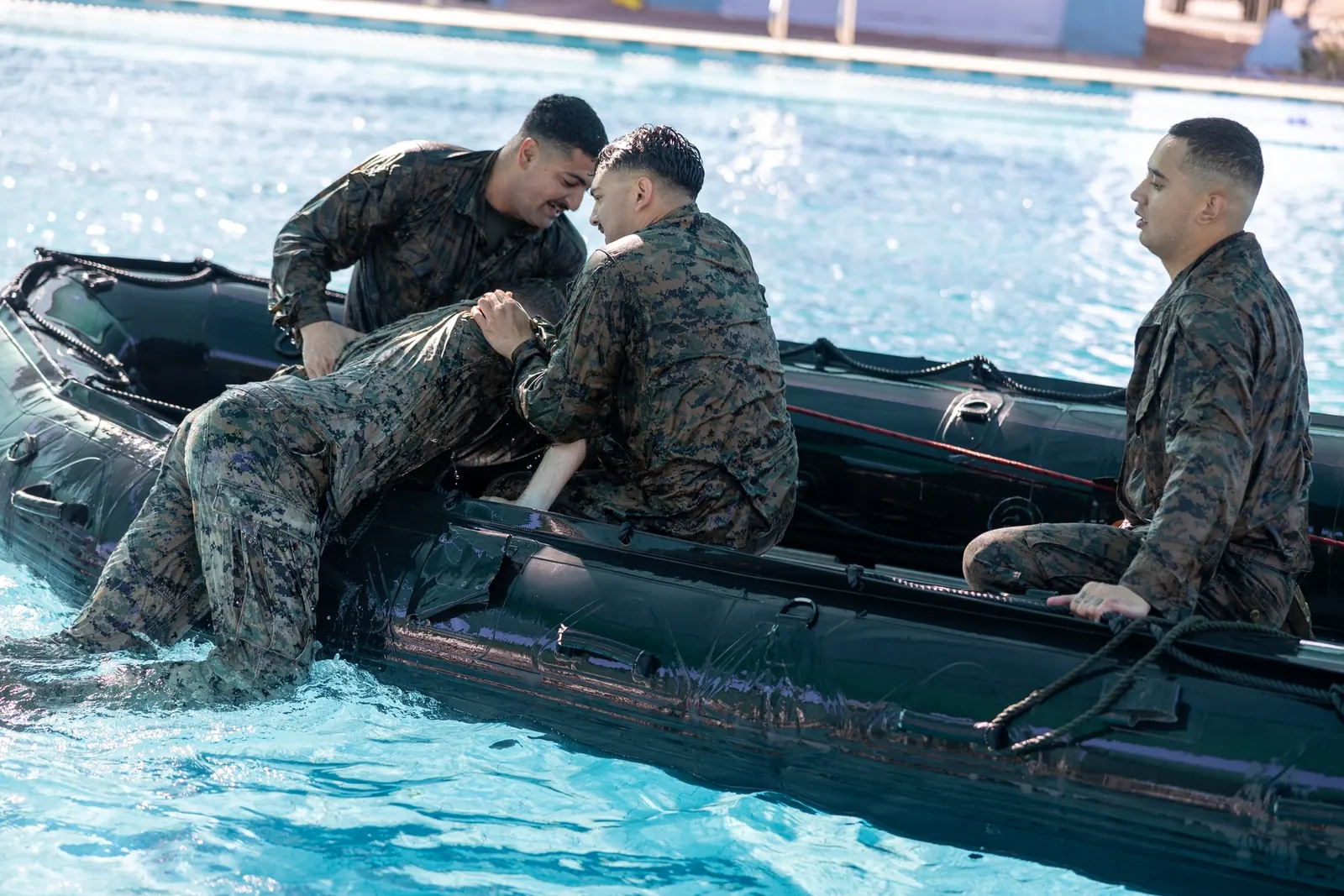
In the described Army training, underwater escape is followed by operating liferafts and survival equipment. This includes pulling another soldier from the water onto a raft. Leaving the cabin therefore brings the person to the next task: reaching available flotation and rescue equipment, keeping themselves and others at the surface and, where possible, boarding the raft. An available raft provides a place for shared sustainment and signalling aids. If it is lost or unreachable, immediately available flotation aids determine the remaining scope for action.
The appearance of U.S. Department of War (DoW) visual information does not imply or constitute DoW endorsement.