

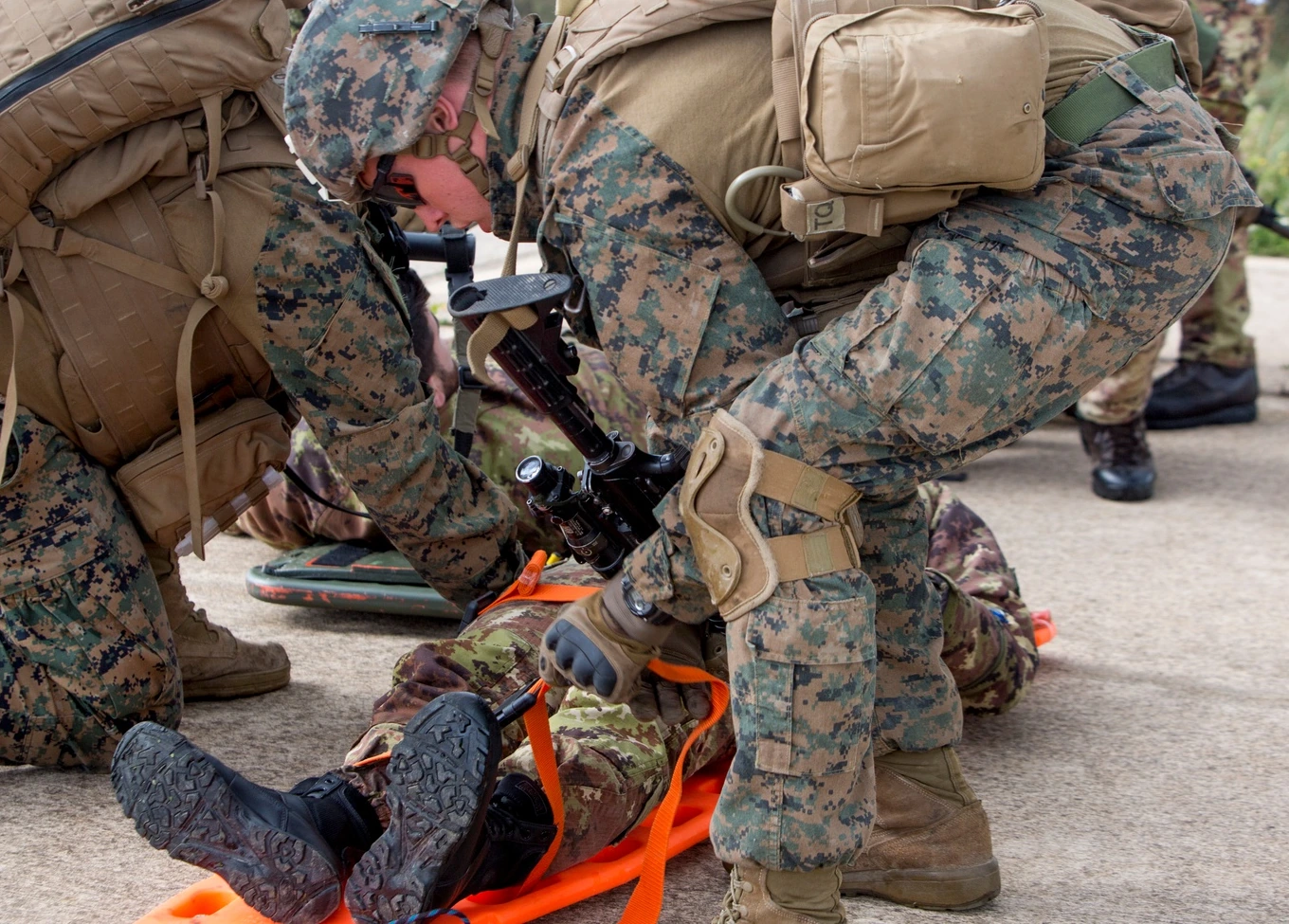
Italian SERE training combines survival in a hostile environment with avoiding capture, protecting information in captivity and taking part in recovery. For aircrew, the starting point may be the loss of their aircraft; paratroopers and ground personnel at particular risk also have to make their own way after separation from friendly forces. Training therefore progresses from preserving equipment and the ability to act through movement on the ground to contact, identity checks and pickup.
Alpha, Bravo and Charlie in the Army
The Italian Army calls its levels Alpha, Bravo and Charlie. A training model used by the Centro Addestrativo Aviazione dell’Esercito, or CAAE, assigns them specific risk groups and tasks. Alpha serves personnel who could potentially become isolated during operations. It covers survival, evasion, capture, conduct in captivity and extraction as a theoretical foundation. Participants prepare to understand their situation before and after capture and the link between their own survival measures and eventual recovery.
In this model, Bravo serves personnel at moderate risk of isolation or capture. Its practical task combines tactical movement through hostile or non-permissive territory with reaching a suitable safe area. Participants establish an improvised bivouac there with the means available. Movement and sustainment are directly connected: the route must lead to a place where the person can protect themselves and recover for the next stage. Brief detention may also be included to introduce conduct after capture in practice.
Charlie prepares personnel at high risk of isolation and exploitation for a continuous sequence of survival, evasion, capture, detention, escape and extraction. At the CAAE, participants include Army Aviation personnel and paratroopers. The centre also offers SERE qualification for aircrew and other airmobile military personnel. The advanced field phase combines fatigue, scarce food and water, and limited protection from the weather with the hostile threat. The person has to preserve their physical reserves across successive tasks.
Army: survival, sustainment and movement
In the SERE component of an aircraft technician training programme, the task starts after a simulated loss of a helicopter: retain personal equipment, identify other useful materials and work with the resulting resources. It also includes obtaining food and water, self-aid and help for comrades, and an improvised rest shelter. The shelter has a specific purpose in the sequence: after movement to evade the enemy, it provides a protected rest period before the person covers further ground.
A field model conducted at the CAAE shows how limited those means can become, with clothing and foot protection improvised from fabric. Participants had to build a night shelter using the few materials available and what the terrain provided, and obtain food. An apple found during movement was shared among comrades. Sustainment is therefore also a team task: the others’ ability to move remains part of one’s own progress.
The static phase provides time for protection, sustainment and rest. In the dynamic phase, the group carries out its movement plan. At the CAAE this involves preparing stages by day and night, terrain points and contacts with friendly personnel specifically assigned to the exercise. One advanced final scenario runs for a week without interruption. Participants cover several dozen kilometres with scarce food and water; simulated capture and detention are also part of the exercise. They therefore cannot leave sustainment until after the march: the next stage already has to match their remaining equipment and physical condition.
Camouflage and tactical movement add another demand to that planning. An exposed crossing can make the body and moving equipment visible; a poorly chosen detour can consume the strength needed to reach the next rest or contact point. Before continuing, the person has to observe the crossing, assess the protection offered by the terrain and decide whether they can use it now. An Army special forces escape exercise sent small groups mainly at night along a planned route through woodland. Darkness changed the movement conditions there; route selection, cohesion and sustainment remained the participants’ own tasks.
Captivity: physical survival and information protection
After capture, the person can no longer choose their own route freely. The CAAE Charlie model includes maintaining self-respect and a controlled, gradual approach to information. What the person says must not put friendly forces at risk. This particularly concerns details from which an adversary could identify helpers, connections or an escape plan. Protecting others therefore remains a personal task even when the individual is held captive.
A concrete Army special forces scenario shows an easily overlooked error: an apparently friendly conversation about parachuting and family worries prompted a participant to reveal that he belonged to the paratroopers. The disclosure arose from a personal remark without an immediate threat. During the same interrogation he declined food and additional water. Protecting information therefore requires attention during ordinary conversation as well; physical sustainment has to continue alongside it.
Air Force: negotiating terrain and preparing for pickup
The SERE-C programme at 16° Stormo serves personnel at high risk of capture or isolation and those whose tasks take them into semi-permissive or non-permissive territory. Their activity there receives limited or no consent; a hostile threat is possible. They include aircrew, onboard personnel, Fucilieri dell’Aria and staff of forward helicopter refuelling points. The latter support helicopters at forward locations under austere conditions; their possible isolation also requires their own conduct on the ground.
The practical field component includes river crossing, climbing and tactical navigation movements. Participants spend several days in unfamiliar terrain without assistance, alternating between static and dynamic phases. A watercourse or steep section affects which route is passable and what means are needed to continue. The scenario connects these terrain tasks with isolation, escape and capture. In the War Path model, pilots also practise camouflage, tactical movement and authenticating themselves to the aircrews involved in recovery.
Navy: field training, captivity and escape
At Comsubin, naval pilots, flight operators and onboard specialists, as well as special forces personnel, receive Charlie training. One model delivered there combines terrain movement, capture, detention, resistance to interrogation, evasion and escape for subsequent recovery in a 72-hour practical phase. The 72 hours refer to that practical component. Scuola Incursori instructors work with naval aviation personnel and members of the Brigata Marina San Marco qualified in interrogation.
What participants can do changes several times during this phase. During movement, they have to sustain their progress; under guard, they have to deal with physical and psychological strain and questioning. After escape, they again face the task of moving through the terrain and preparing for pickup. The captivity phase thus sits between two field tasks whose conditions it changes through exhaustion and the temporary loss of freedom of movement.
Connecting location, identity and pickup
In the Army model, the movement plan leads to contact points with a defined location. Participants practise contact there with friendly personnel assigned to the scenario, then prepare to be located and recognised by an allocated airmobile recovery force. For the isolated person, route and contact point have to fit together: reaching a terrain point helps recovery only when the other side can identify that location unambiguously.
The Italian personnel recovery model links accurate location under Locate with identity verification, authentication, recognition and initial instructions. The person must therefore report their actual position and demonstrate that they are the individual being sought. The location tells the force where to move; authentication establishes whether it has contacted the right person. Participants apply the identification procedure they have practised and direct their subsequent movement according to the initial pickup instructions.
In the War Path scenario, Eurofighters took part in authentication and surveillance of the pickup area; an HH-139 carried the Fucilieri recovery team. The final Air Force SERE phase can also be linked with an HH-139. Such scenarios require allocated forces, a usable means of contact and a shared plan. Until real contact is established and pickup coordinated, protection, sustainment and managing their own movement remain tasks for the isolated personnel.
The appearance of U.S. Department of War (DoW) visual information does not imply or constitute DoW endorsement.