

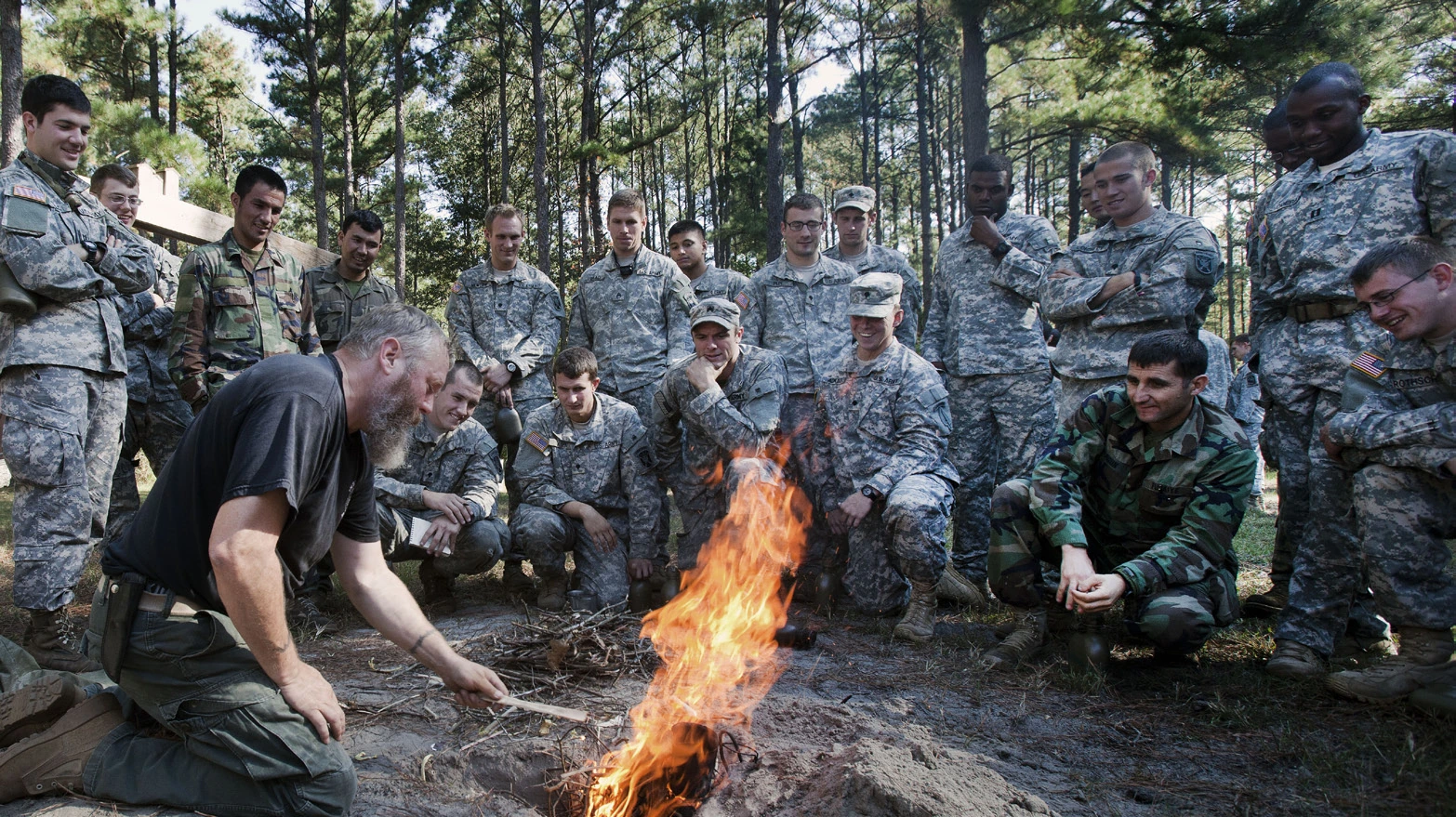
US Army SERE training prepares personnel at increased risk of isolation to survive outside friendly control, evade capture and resist exploitation in captivity. The Level C programme at the U.S. Army SERE School at Fort Rucker is commanded by the 1st Battalion, 145th Aviation Regiment. Army Special Operations Forces, or ARSOF, have also developed a separate course model at Camp Mackall.
For the isolated person, sustainment, movement, information protection and return are connected tasks. They must preserve their physical capacity while an enemy may be searching for them. Capture changes the actions available. During a subsequent recovery by friendly forces, they must be identified, protected and then cared for according to the effects of isolation.
Fort Rucker: mission and actual participants
The Army SERE School's mission covers service members, civilian personnel of the US defence establishment and contractors whose duties place them at high risk of isolation. Its organisational connection to Army Aviation explains the particular relevance to aircrews: a forced landing can immediately separate people from their unit, supplies and intended mission. Attendance nevertheless depends on the risk associated with the person's duties and includes appropriately selected personnel outside aviation.
The Fort Rucker course is listed as 2C-F107/600-F17(CT). It connects the Code of Conduct with survival, evasion, resistance and escape. The military obligations of the Code of Conduct apply to members of the US Armed Forces. Attending the same course does not make civilian participants soldiers or subject them to every military obligation in captivity. Every participant still faces the practical task of surviving isolation with their actual status, knowledge and available means.
Preparation before the course
A reservation in the Army training system ATRRS becomes a secured seat only after the administrative and medical packets have been accepted. These include the commander's authorisation, proof of the Personnel Recovery 102 foundation course and the required SERE physical examination. The records also cover dental status, physical fitness, security status and swimming ability. Health conditions, medication and allergies must be documented before attendance; a problem first disclosed at the entrance screening can prevent participation.
The prescribed equipment is checked for completeness and serviceability. It includes water containers, protection from the weather, load-carrying equipment and a small personal survival kit containing repair materials, items for food procurement and fire-starting material. These serve different purposes: a repaired strap keeps equipment portable, water containers allow a reserve for movement, and tinder helps establish a fire in difficult conditions. Whether fire or food procurement is appropriate during a particular evasion situation also depends on the time required, the evidence left behind and the risk of detection.
Mobile phones and GPS-enabled devices are unavailable as personal aids during the course. This training condition requires students to work with the designated means. On operations, the equipment actually issued and the procedures established for the mission determine which navigation, communication and signalling options are available.
Camp Mackall: the ARSOF course model
An earlier SERE C model at the John F. Kennedy Special Warfare Center and School at Camp Mackall was intended for officers, warrant officers and enlisted personnel in the Army's Active and Reserve component special operations forces. It combined three training phases and a final debrief. That sequence belongs to this ARSOF model; it is not a timetable for the Fort Rucker school.
The first phase combined Code of Conduct instruction with practical fieldcraft. Students learned and practised survival and evasion procedures before applying them during the continuous field phase. In the second phase they procured food and water, established concealment sites and shelters, worked on evasion fires and moved over considerable distances while opposing forces and tracker dogs searched for them. Sustainment therefore took place within an ongoing evasion situation.
The final phase took place in a Resistance Training Laboratory, or RTL: a controlled, simulated captivity environment. It addressed the individual captive and cooperation within a captive group, questioning, information protection and resistance to exploitation. An additional component covered government detention and hostage situations through role-play. Individual and group debriefs concluded the course. Students could examine their field and captivity decisions and correct procedures that had gone wrong.
Survival during evasion
The field task begins with preserving the ability to act. Injury, lack of water, cold or overheating can make a planned route impracticable even when it looks short on a map. After leaving an immediate danger area, the person needs a concealed location to assess their condition, equipment, water reserve and situation. They can then decide which movement is physically possible.
Sustainment also consumes time and energy. Searching for food prolongs a stay in an area; extensive work on a rest site leaves visible disturbance; fire produces light, smoke and odour. The person must weigh the immediate benefit against the signature and delay. The person may have to interrupt movement to obtain water or protect themselves against dangerous cooling. An additional meal, however, does not justify every movement or a prolonged stay at an exposed location.
Rest must be built into movement. Someone who consumes their strength to the point of exhaustion loses the capacity to exploit a brief favourable opportunity or respond to a new threat. A concealed halt also provides time to check foot problems, equipment and the next leg of the route. In a group, injured or exhausted members alter the achievable speed and water requirement; planning must reflect their actual mobility.
Evasion: moving under concealment and retaining judgment
An evasion route leads to a reasoned destination: a suitable recovery area, friendly forces or another safe area agreed in advance. The shortest route may also pass along roads, through populated places and across open heights where the person is more easily observed. Terrain and threat therefore determine the route alongside water, physical capacity and the intended return procedure. An injured person may need a different plan from someone able to cover considerable distances.
Movement takes the person from one concealed position to the next. Before entering an exposed stretch, they observe from concealment, listen for vehicles, voices and other activity, and check where concealment will be available on the far side. Hilltops and ridgelines can silhouette the body against the sky. Shadows and existing vegetation help while they suit the person's location; the concealed areas change as the sun moves.
Signature involves more than uniform colour. Rattling equipment can disclose movement, an alarm can disclose a halt, and a reflective object can reveal a position. Loose items are secured, unnecessary sounds stopped and conspicuous surfaces concealed. Broken vegetation, disturbed ground, lost items and rubbish can also indicate a stay or direction of travel. The person chooses firm footing where possible and disturbs the surroundings as little as practicable.
Poor visibility can both assist and hinder movement. The person sees terrain, obstacles and other activity later and travels more slowly. A concealment site for rest must therefore also support observation: a low silhouette, little disturbance, observable approaches and a usable way out. A well-hidden location that can be left only through a single narrow opening limits the response to someone approaching.
The Army connects this personal situation assessment with Isolated Soldier Guidance, or ISG. For a particular mission, it establishes how isolation is recognised, which actions are intended and how subsequent contact should take place. An agreed separation of a ground team has a different meaning from a forced landing in hostile territory. The mission's isolation criteria and the actual situation matter, including enemy pressure and lost communications.
The Evasion Plan of Action, or EPA, records the intentions established beforehand by the person or group: actions following isolation, intended movement, alternatives if injured, and communication and signalling options. Their unit retains a copy so recovery forces can estimate likely locations and movement. If the threat, injury or terrain forces a change, the person must adapt their plan. A departure is reported when available equipment and connectivity permit.
Captivity: information protection and responsibility for the group
After capture, an enemy may use the person as a source of military information, to identify other people with valuable knowledge, or for propaganda. Resistance is directed against this exploitation. For US service members, the six articles of the Code of Conduct establish the behavioural framework: evade capture where possible, continue resistance after capture, consider escape opportunities and keep faith with fellow captives.
For a US service member who becomes a prisoner of war, the required identity information comprises name, rank, service number and date of birth. Questions about the mission, unit, comrades or personal background can reveal additional information; written statements and recordings can be used for propaganda. Communication about illness, injury, welfare and the condition of fellow prisoners is also permitted. Information protection therefore requires limiting what is communicated and recognising its purpose.
The group has protective responsibilities of its own. The senior military prisoner capable of acting takes responsibility; the others support lawful leadership. Tasks include caring for the sick and injured, hygiene, maintaining collective organisation and preventing conduct that harms fellow prisoners. Special privileges at the group's expense can weaken cohesion. Identifying which captive holds particularly valuable knowledge can direct pressure towards that person.
The US framework calls for resuming information protection and resistance to further exploitation even after a statement has been obtained under coercion. An escape decision also affects fellow captives: their condition, group leadership and consequences for those left behind must be considered. Training addresses these responsibilities in a controlled captivity environment; the isolated person must later implement them within the actions actually available.
Government detention outside armed conflict and hostage-taking create different conditions. Escape from government custody can lead to additional prosecution under local law. In a hostage situation, political or religious arguments can intensify the captors' aggression. Calm conduct and communication limited to health, welfare and release are more likely to preserve room for action. The ARSOF model therefore treated these situations separately; the military duty to escape from wartime captivity is not applied as an identical rule to every form of detention.
Recovery: contact, recognition and pickup
If an available radio or another communication device establishes contact with friendly forces, the person reports their location, the group's number and condition, observed enemy activity, characteristics of the possible pickup site and available signalling equipment. The recovery forces actually available can then judge whether they can reach the site and recover the people there. A steep surface, obstacles or nearby enemies may require a different location or method.
A visible signal initially marks a position. Agreed authentication serves a different purpose: checking that the correct person has been reached. ISG and mission preparation must align the actions of the isolated person and the receiving forces. Without a radio, visual signals using available equipment may remain an option. They require a suitable receiver, line of sight and appropriate timing; a continuously visible marker may also show the enemy where the person is staying.
Until pickup is imminent, the person remains concealed with equipment and signalling devices ready. On contact, they adopt a non-threatening posture, secure their weapon and avoid sudden movements. They approach the vehicle or aircraft only when directed by the receiving forces. Those forces must secure the situation and verify identities; an uncoordinated rush towards them makes both tasks harder. During aircraft pickup, loose items are secured and the crew's instructions followed.
After recovery: care and reintegration
Return to the control of the person’s own or a friendly organisation ends isolation. Injury, exhaustion and the effects of captivity may continue afterwards. Reintegration therefore begins with protection, physical care and medical and psychological assessment. The recovered person is told what will happen next. After a period of control by others, this restores a predictable sequence.
US reintegration distinguishes an initial phase following return to friendly control, a second at a transition facility in the operational theatre and a third at Service level. The extent of the process depends on the person's condition and experience. A brief separation may require substantially less care than prolonged captivity. The process may be completed in any of these phases when the responsible commander approves the reintegration team's recommendation. Further treatment is planned according to individual needs.
Medical care and psychological assessment precede debriefing. Urgent information about people still at risk, the enemy situation or ongoing recoveries serves a different purpose from the later SERE debrief. The latter records what actually helped or failed during isolation, evasion and captivity. Reconnection with family and the unit also forms part of the process. For military returnees, subsequent employment is arranged according to their health and determined duty status.
Participation is governed differently for civilian employees and contractors. Civilian personnel of the US defence establishment whose performance plan commits them to reintegration continue participating until released. Other civilian employees of that establishment and contractors accompanying the Armed Forces undergo the initial phase and are offered the opportunity to continue the process. The responsible agency or contracting organisation participates in coordinating further care and return.
The appearance of U.S. Department of War (DoW) visual information does not imply or constitute DoW endorsement.