

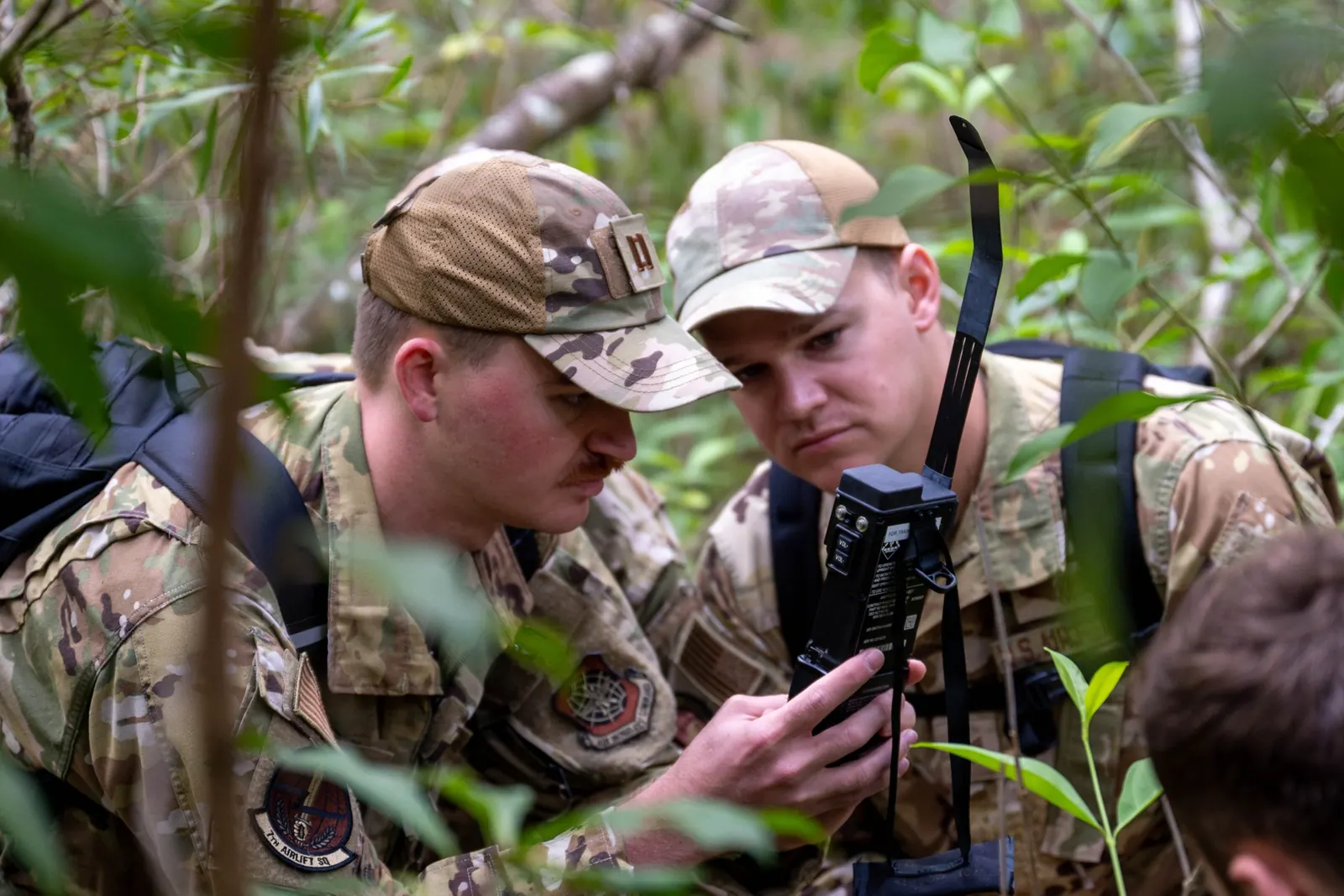
The American SERE system prepares for a situation in which a service member or crew is separated from friendly forces, must survive with limited equipment, and faces the threat of an enemy search or capture. An emergency exit, a cut-off vehicle or a separated small team can cause this situation. Individuals must assess their injuries, the terrain, the threat and their remaining resources themselves.
In the United States, SERE means Survival, Evasion, Resistance and Escape: staying alive, avoiding capture, resisting exploitation and escaping captivity. The training aims to enable a return to friendly control. It connects individual decisions with personnel recovery, the preparation, recovery and subsequent reintegration of isolated personnel. Diplomatic or civil efforts can also bring captivity to an end alongside military recovery. The American Code of Conduct provides the military framework for behaviour; the depth of training follows the risk associated with the individual's duties.
A, B and C: capture risk and exploitation value
Two questions determine the level: how likely is capture, and what benefit could an adversary obtain from the person? A crew member may suddenly be alone in hostile territory after an aircraft is shot down. A special mission can take a small team far from support. Position, rank, knowledge and public significance also influence the person's value for military interrogation or political propaganda. Level C therefore provides more extensive preparation for particularly exposed duties. The levels are not a course sequence that every service member must complete.
| US level | Risk-related audience | Principal content |
|---|---|---|
| Level A | The foundation for all members of the US Armed Forces. | The Code of Conduct, preparation, basic survival and evasion, protection against exploitation, and participation in the individual's return. |
| Level B | Personnel whose duties or assignments involve a moderate risk of capture. | Enhanced preparation; Air Force ECAC includes practical evasion and different captivity settings, including a hostage scenario. |
| Level C | Personnel at significant or high risk of capture and with increased vulnerability to exploitation, including aircrews and special mission forces. | More extensive survival, evasion and resistance training with practical field tasks and controlled captivity scenarios. |
The basic content of Level A includes planning, survival, evasion, resistance to exploitation, captivity resolution and support to recovery. SERE 100.2 includes content directed at military and civilian personnel. Civilian employees and accompanying contractors need appropriate principles of behaviour; military command and prisoner obligations cannot be assigned to them simply by attending a course.
A specific American Level B programme is the Air Force's Evasion and Conduct After Capture, or ECAC. It combines practical evasion tasks with wartime captivity, peacetime government detention and hostage situations. Guided role-play scenarios are complemented by an evasion laboratory and a Hostage Resistance Training Laboratory. Participants must therefore act both before and after capture: avoid capture, recognise exploitation attempts and adapt their behaviour to the particular form of custody. Practical resistance is therefore already part of Level B in this Air Force programme; Level C provides more extensive preparation for the greater capture and exploitation risk.
After an emergency exit: assessing the situation and preparing to move
The Air Force connects post-ejection procedures and parachute landing with survival medicine, personal emergency equipment and subsequent field tasks. After landing, individuals must assess the immediate danger, attend to necessary care, and reach a concealed position if the situation allows it. There, they check their physical condition and equipment, establish their location and decide what to do next. An injured leg, lost water or a damaged radio may require a change of plan. Simply following the originally planned route despite these changes can use up the remaining resources before the destination is reached.
Practical survival takes place under the pressure of evasion. Water, protection from the environment and rest preserve the ability to move on or reach a pickup point. Finding and preparing food, constructing shelter and making a fire consume time and can create movement, noise, light or smoke. Individuals must decide what sustainment is necessary now and how much effort the location permits. An existing shelter may require little work; a longer stay may require better weather protection. A fire can provide warmth while revealing the location. These decisions depend on actual cold or wet conditions, available resources and the proximity of possible search forces.
These land tasks involve several services. Navy field training includes navigation, identifying and preparing edible plants, and maintaining physical capability under pressure. A usable food source first has to be recognised and processed; the time required competes with movement still to be completed. Navy SERE training therefore includes these land tasks as well as sea survival. The Army also prepares personnel at high risk of isolation, including government civilians and contractors assigned to relevant duties. Army aviation makes aircrew an important audience, but training also serves other personnel at risk.
A previously described Level C model of the Army Special Operations Forces, or ARSOF, connected the tasks through three components: academic instruction and practical fieldcraft, a sustained survival and evasion phase, and simulated prisoner-of-war captivity. In the field, participants obtained food and water, built concealed shelters or other shelters, and evaded trackers and exercise enemy forces. The captivity component then introduced individual and collective tasks to resist interrogation and exploitation. Participants moved from limited sustainment and self-directed movement into a situation controlled by a captor.
Concealing, observing and moving
A hide is intended to conserve strength, permit sustainment and allow departure in time. The American mnemonic BLISS combines blending with the surroundings, a low silhouette, an irregular shape, small size and a secluded location. Observable approaches and escape routes are also required. Before settling down, individuals examine where other people could appear and where they could move if threatened. Overhead concealment and minimal disturbance of the ground add protection against observation. A depression may conceal a person, while a drainage channel can become a trap during heavy rain.
During movement, observation must take priority over speed. Individuals use existing concealment, avoid forming a recognisable silhouette on a terrain edge, and stop at concealed points to examine the surroundings. Vehicle noise, voices, smoke, tracks and signs of recent human activity may require an apparently clear route to be reassessed. An exposed section or road is observed from concealment before the movement decision is made. Darkness reduces some opportunities for visual detection, but also makes the ground and one's own direction harder to recognise. Timing depends on the terrain, personal condition and enemy activity actually observed.
Equipment and the way an individual moves provide further clues. Loose objects are secured against rattling, and unintended light and sound signals are avoided. Broken branches, overturned ground cover, lost equipment or conspicuously damaged vegetation may reveal movement. Firm footing and minimal disturbance reduce these signs. This requires attention and may be slower than ordinary walking. Exhausted individuals must therefore also plan the next concealed resting point, rather than spend all their strength trying to cover a route as quickly as possible.
The Code of Conduct: individual responsibility and the prisoner group
The six articles of the Code of Conduct connect military duty with behaviour after capture. They apply to military members of the Army, Navy, Air Force and Marine Corps. Articles I and VI maintain commitment to one's country and responsibility for one's actions. Captivity does not end military membership. The Code provides a moral standard of behaviour. Criminal responsibility is governed by the Uniform Code of Military Justice and the conduct involved; any subsequent review also considers the circumstances of capture and the coercion imposed by captors.
Article II addresses voluntary surrender. When an isolated individual can no longer fight effectively, the duty remains to avoid capture and rejoin friendly forces. This requires an evasion decision, rather than a pointless continuation of a hopeless engagement. Capture by overwhelming enemy strength, when neither evasion nor effective resistance is possible, is distinguished from voluntary surrender.
Article III addresses resistance to exploitation and the use of escape opportunities. Special benefits offered in return for statements, information or a promise not to escape can divide the prisoner group. Prisoners should refuse privileges at others' expense and such commitments to the enemy. An escape opportunity is considered under the leadership of the senior military prisoner; consequences for those remaining behind are part of the decision. Escape initially ends custody. Sustainment, concealment, movement and the return to friendly control must then be managed again.
Article IV makes several prisoners a group with continuing responsibilities. The senior military prisoner capable of acting takes command regardless of service; if incapacitated, the next senior prisoner assumes command. Hygiene, camp sanitation and care of the sick and wounded preserve the group's ability to survive. Where contact is possible, prisoners must coordinate shared tasks and behaviour. They must also avoid helping the enemy select fellow prisoners with particularly valuable knowledge. Obtaining personal relief by identifying a specialist can increase that person's danger and weaken the entire group.
Article V distinguishes required identity information from further exploitable information. A prisoner of war gives name, rank, service number and date of birth. Questions about missions, units, capabilities or fellow prisoners should remain unanswered to the greatest extent possible. Written statements, questionnaires and recordings for enemy propaganda pose the same information-protection problem. Conversations about health and welfare and permitted messages to family are distinct from these demands. Prisoner leadership can represent welfare needs and grievances without acquiring a duty to disclose military information.
Resistance must also resume after coerced concessions. The American framework recognises that physical and psychological coercion may force some degree of compliance. The next interrogation or propaganda demand is a new opportunity to limit further disclosure. Controlled resistance training therefore connects individual behaviour with the collective behaviour of the prisoner group. Information protection, mutual responsibility and recognising exploitation are central tasks.
Appropriate behaviour also depends on the form of detention. In prisoner-of-war captivity, military group leadership and the prisoner-of-war framework apply. Preparation for detention by an unfriendly government outside war involves a different behavioural task: remain calm and avoid aggressive, combative or illegal behaviour that could lead to additional charges or complicate release. Beyond personal identity and the innocent circumstances of detention, conversation is limited to health, fellow detainees’ welfare and returning home. Statements and signatures may serve political exploitation. The American framework discourages escape attempts from this government custody except in life-threatening circumstances, because an attempt may result in further prosecution under local law.
In a terrorist hostage situation, individuals should instead build personal rapport so the captor sees them less as a mere symbol of a country they oppose. Listening and remaining calm may contribute; arguments, patronising behaviour and debates about politics or religion may worsen the situation. If a rescue operation actually begins, hostages take cover, remain stationary where practicable and do not independently attempt to assist the rescuers. The forces must first distinguish hostages from captors. ECAC and additional Government Detention and Hostage Detention training address these different behavioural tasks.
Before isolation: intentions, equipment and identity
Preparation must be in place before communication is lost. In the Army, Isolated Soldier Guidance, or ISG, brings together mission-specific isolation criteria, reporting options, individual actions and subsequent link-up with friendly forces. Individuals therefore know the intended response even without an accessible headquarters. An Evasion Plan of Action, or EPA, records their own plans: potential movement destinations, rally or recovery points, and what they intend to do if injured or still able to move. The unit receives the plan so potential search and recovery forces can work from these intentions.
The EPA includes resources actually available: radios and batteries, visual signalling devices, personal survival equipment, and prepared communication and recognition procedures. Planning also considers alternatives if an intended contact fails. Intentions are updated when the mission changes before deployment. If injuries, enemy pressure or lost equipment subsequently change the situation, individuals must adjust their movement accordingly and communicate any departure when a real connection is available. Without communication, personal safety takes precedence over reaching a planned position that has become dangerous at any cost.
The Isolated Personnel Report, or ISOPREP, serves another purpose. The US record associates personal details and identification features with protected personal authentication information. It supports checks that a contact really is the person being sought. The EPA describes intended actions; ISOPREP helps establish identity. Both are prepared before potential isolation and made available to the responsible organisations. Personal authentication information must be protected against disclosure: an adversary who knows it may make a false contact appear more convincing.
Reporting, signalling and authentication
With usable communication, the receiving friendly forces need more than a position: the number of people, injuries and mobility, observed enemy activity, obstacles at a potential pickup site and available signalling devices affect recovery. Individuals pass the necessary information and maintain communication according to the prepared procedures for as long as the connection exists. If no answer is received, protection, sustainment and personal movement decisions must continue.
Without a radio, a signal mirror, marking panel or other available visual means can make the position recognisable to friendly forces observing the area. Visibility is a decision in its own right: the signal may also reveal the location to enemy observers. Individuals prepare the available device, observe their surroundings and base its use on agreed procedures and an actual opportunity for contact.
Locating and identity checks serve different purposes. A recognised signal or position report indicates a location; agreed far and near recognition procedures and authentication help confirm the correct individual and contact. This is especially important when linking up with forces from another unit. Isolated individuals carry out the agreed recognition signals and their own identification actions. Contact confirmed through these procedures supports the subsequent approach and pickup.
From concealed waiting to physical recovery
When recovery by available forces is possible, the pickup site is assessed for the actual method. Obstacles and terrain matter for a landing; approaches and possible enemy activity matter for ground recovery. Individuals retain a concealed waiting position and escape routes, secure equipment and prepare signalling devices. Under threat, they remain concealed until recovery is imminent. This reduces the time during which they can be detected at an exposed pickup site.
On contact, individuals make their identity as clear as possible while presenting a non-threatening posture: secure weapons, avoid sudden movements and wait for the specific instruction to approach. They do not independently run towards a vehicle or aircraft. Rotors, propellers and loose equipment create additional hazards. A hoist or other recovery device requires familiarisation with that particular device and instructions from the crew actually present.
Through Tactical Recovery of Aircraft and Personnel, or TRAP, the Marine Corps prepares recovery forces for tasks including mission planning, working with aircraft and recovery equipment, and loading and unloading. Isolated individuals keep themselves ready for pickup and communicate their situation. Physical recovery is followed by care and reintegration involving medical, psychological and operational debriefing. If no such force can be employed, protection, evasion and self-recovery where the situation permits remain the individual's tasks.
Emergency exit and survival in water
Over water, escaping an aircraft or vehicle may be the first immediate challenge. The Air Force distinguishes water-training tasks for crews with and without ejection seats. Life rafts, signalling devices and actions using issued equipment connect emergency exit with subsequent locating. Individuals must be able to use the flotation and survival equipment actually available; freedom to move achieved on land cannot be assumed in water.
Marine Corps Underwater Egress Training addresses orientation and exit in controlled water trainers, from a single seat to a rotated aircraft or vehicle mock-up. In the changed position, participants must orientate themselves and find the exit. This preparation for a particular emergency exit complements survival and SERE capabilities. After exiting, flotation, access to available survival equipment and opportunities to signal become decisive.
The appearance of U.S. Department of War (DoW) visual information does not imply or constitute DoW endorsement.