When André Devigny returned to his cell from the German military court on 20 August 1943, he knew that he had been sentenced to death. He had already prepared an opening through the wooden cell door. Homemade ropes and hooks were ready for the obstacles beyond it. But another man was now sitting in cell 107: Antoine Gimenez, whom Devigny did not know. He had to decide whether to trust this fellow prisoner with his plan and take him along. During the night of 24–25 August, both men left the cell. Before Devigny reached the Swiss border, he would face another capture, flight into the Rhône and days in hiding.
An intelligence network between France and Switzerland
Devigny was twenty-seven in the summer of 1943. He came from Haute-Savoie, south of Lake Geneva, and had fought as an officer in the 5th Moroccan Rifle Regiment in 1939–40. A serious wound near Ham in May 1940 sent him to hospital in Bordeaux. After recovering, he wanted to reach Britain and continue the war. Contact with the British consulate in Geneva instead took him first to Morocco, where he worked for a British intelligence service.
He returned to France in the autumn of 1942. Germany's occupation of the southern zone in November and the dissolution of the French Armistice Army ended the possibility of continuing there within a regular French unit. Through the British connection in Geneva, Devigny met Colonel Georges Groussard. Operating from Switzerland, Groussard was building the Gilbert intelligence networks and needed reliable officers in France. Devigny recruited such men and organised the connections through which their information reached Geneva.
The work required frequent journeys and personal exchanges. Devigny collected reports from southern France; other connections ran through Lyon. Along the border, the network needed people who could shelter a courier, pass on a message or help someone cross. Irène Gubier in Gaillard was one of them. Her house stood beside the Foron, directly on the Swiss frontier. Devigny also used these connections to help persecuted people. His Swiss contacts were therefore more than an address abroad: he had helped build the organisation on which he would later depend.
In April 1943, parts of the organisation were betrayed. A German agent had infiltrated the network. Devigny was arrested at Annemasse railway station on 17 April and taken to Montluc prison in Lyon the following day. The man who had carried messages across the border now had to find a way of reaching anyone from a guarded cell.
Imprisonment, interrogation and a failed escape
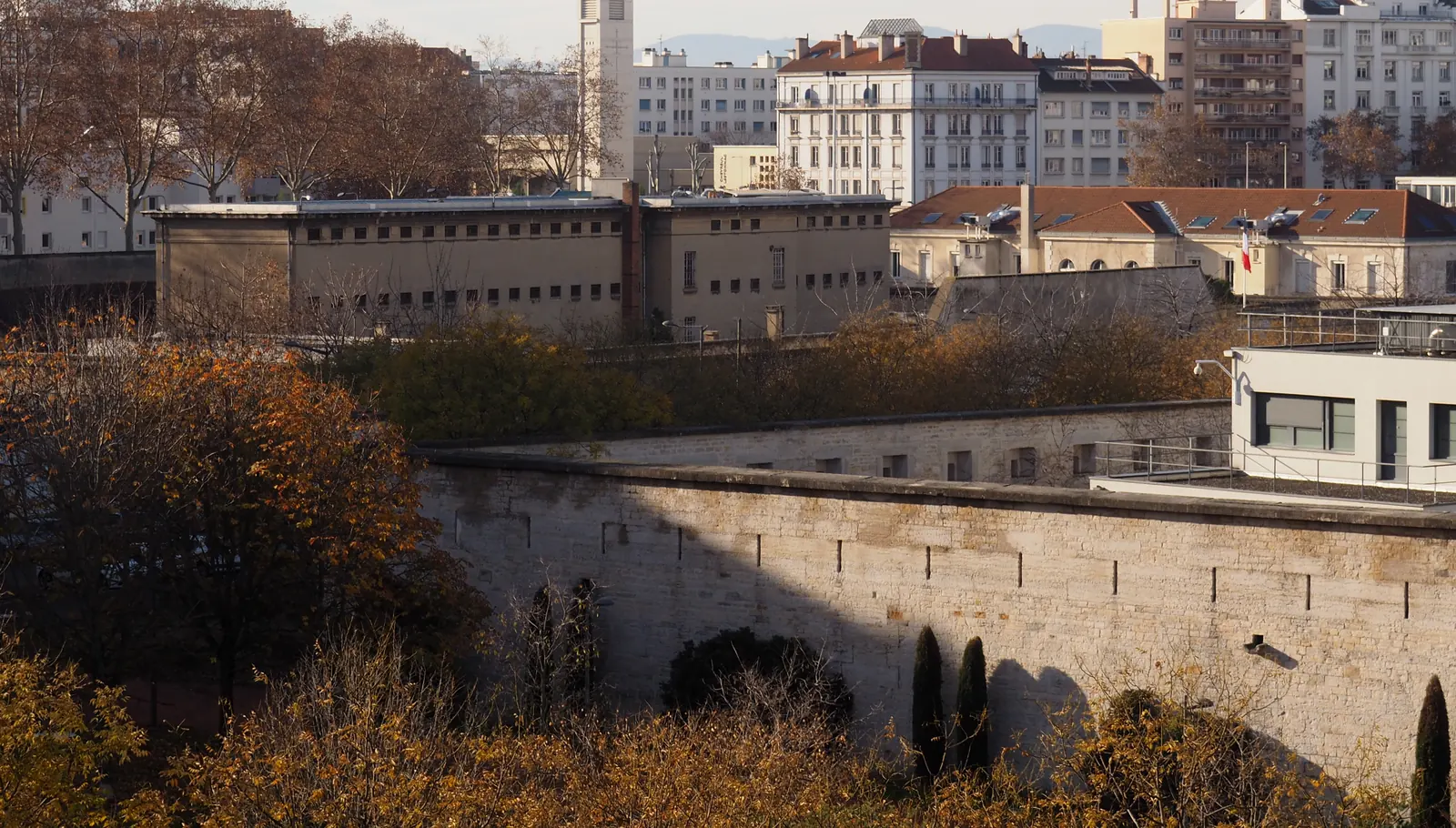
Montluc was a military prison built in 1921 beside the older fort of the same name. The German occupation authorities took full control early in 1943. Its prisoners included Resistance members, political opponents, persecuted Jews and hostages. From here they could be taken away for interrogation, brought before a military court, deported or removed for execution.
Confinement and interrogation did not always take place at the same location. Prisoners were transported in vehicles to Gestapo offices. In Lyon, the headquarters was initially at the Hôtel Terminus near Perrache station, before moving to the military medical school on Avenue Berthelot.
Devigny's links with Groussard and his knowledge of the network's members made him valuable to the investigators. Klaus Barbie had him interrogated and tortured. Devigny did not betray the organisation. Its survival also depended on members knowing only parts of it: arresting one man did not automatically expose everyone else. For Devigny, the danger remained immediate. He knew that people outside the walls could still be traced and were therefore at risk.
He tried to escape during a transfer. A revolver shot wounded him, and he was caught again. Further severe beatings followed at Montluc. First he had to recover from his injuries. His next escape plan began elsewhere: with the cell and the objects that surrounded him there each day.
Fellow prisoners and messages to the outside
Fellow prisoners communicated with Devigny through counted knocks. The number of taps indicated a letter’s place in the alphabet; one inmate used them to ask about his handcuffs. Less closely guarded inmates passed small objects between cell windows, including writing materials and string.
The journalist Charles Bury became a particularly important intermediary. He spoke fluent German and had gained the chief warder's trust. His daughter Elisabeth pressed for permission to bring him a parcel. She obtained an exceptional concession: she could see her father briefly and return for further visits. This gave other prisoners a narrow channel to the outside, dependent on these two people and the visits the guards permitted.
Bury gave Elisabeth letters, including messages from Devigny. In a surviving warning, Devigny reported a traitor in the service, a compromised refuge and a colleague's death. He also mentioned his failed escape and gunshot wound.
Elisabeth delivered the letters to their recipients. On 18 May 1943, the visits ended when her father was transferred to Fresnes prison. He was subsequently deported to Buchenwald and Dora. The Bury channel was therefore no longer available during Devigny's later preparations for the August escape. A connection that had worked in the spring could not simply be assumed to remain open.
A door that still appeared closed
Devigny prepared his breakout in cell 107, on the second floor above ground in the cell block. Its door was wooden. Using an iron spoon, he worked on it until part of the boarding could be removed. He was not trying to break down the entire door. He needed an opening large enough to pass through, with pieces he could put back afterwards.
The ability to restore the door shaped his preparations. A permanently open or visibly broken door would have exposed the alteration immediately. Instead, Devigny could enter the passage and return to his cell while the door still appeared closed from outside. The passage was nevertheless inside the guarded building. From the cell block he still had to reach the roof, descend again and cross both perimeter walls.
That route required material capable of supporting a person. He had no proper climbing rope. He used the textiles he could obtain: bedding, blankets and clothing. He made the ropes from broad strips of fabric, folded them, bound them with wire and used more wire to join the pieces into longer lengths. The wire came from the bed frame.
The hooks were made from metal parts of the frame around the cell light. Together with the ropes, they were intended to allow a descent from the roof and passage over the walls. There were two separate ropes; the longer surviving one measures 10.50 metres. Material was limited, and every item had to remain undiscovered until the escape.
A death sentence and an unknown cellmate
Devigny was informed of his death sentence on 20 August. After months in prison, he now had to expect to be taken away for execution. The opening in the door, the ropes and the hooks were ready.
That same day, he found Antoine Gimenez in his cell on returning from the military court. He initially knew nothing about the man's reliability. A new cellmate could discover the altered door or the hidden equipment. Sharing the plan would make it depend partly on Gimenez's conduct; keeping it secret would leave an unfamiliar observer close at hand. Devigny could not escape from this cell without taking the other man's presence into account.
He did not decide immediately. After several days, he trusted Gimenez with the plan and chose to take him along. His prepared route became a joint escape. Both men would have to leave the cell and cross the obstacles with the same improvised equipment. During the night of 24–25 August, they put the plan into action.
From the cell block across the roof and walls
The two men left the cell through the prepared opening. Their route then took them onto the prison building's roof or terrace. The exit onto this terrace was through a ventilation skylight.
The prepared ropes allowed them to descend from the roof into the courtyard. There a sentry blocked their way. Devigny strangled him.
They still had to cross two successive walls. The hooks and ropes provided the means of getting over these obstacles. When Devigny and Gimenez had passed the final wall, they were outside Montluc.
They were still in occupied territory around Lyon. The journey to the Swiss frontier lay through an area where German offices and armed forces operated. Devigny knew people who could help, but first he had to reach them. Beyond the prison, their shared flight almost failed again.
Their paths divide at Vaulx-en-Velin
North-east of Lyon, at Vaulx-en-Velin, the men fell into German hands again. Devigny broke away by jumping into the Rhône. Gimenez did not escape on this occasion and was imprisoned again.
Devigny hid in mud beside the river for about five hours. After months of confinement, the gunshot wound and the beatings, he then needed somewhere to stay and recover.
A man from Savoy living near Vaulx-en-Velin took him in and cared for him. This shelter interrupted the flight for several days. Only after resting and recovering did Devigny reach Switzerland and the area from which Groussard directed his connections.
Escape did not end the danger to Devigny's family. According to Groussard's later account, the Germans planned to seize Devigny's three-year-old daughter Chantal, who was staying with her grandmother. The network received a warning in time, and Jean Cambus brought the child to Geneva. The organisation whose contacts Devigny had protected during interrogation now helped to move his daughter beyond reach.
The long journey back to French forces
Devigny remained in Switzerland until January 1944. He still wanted to return to French forces fighting Germany. Reaching them required another journey through Europe. On 25 January he entered Spain, where he was imprisoned again. He spent two months in Spanish custody before continuing to North Africa. By the time he reached Casablanca in mid-April 1944, almost eight months had passed since the breakout from Montluc.
In North Africa, he volunteered for the Bataillon de choc. He trained for commando and parachute operations and took part in the landings in Provence in August 1944. Later he fought in Alsace. The former prisoner was serving again as an officer in a regular French unit. He ended the war as a captain and was appointed a Companion of the Liberation on 27 December 1945.
The two ropes from Montluc survived the war. Devigny recovered them after the Liberation and later donated them to the museum of the Ordre de la Libération. His 1956 account, Un condamné à mort s’est échappé, and Robert Bresson's film of the same name made the preparations and the escape night particularly well known. Yet Devigny's journey to safety continued beyond the walls, through renewed flight at the Rhône, a host's assistance and further months before he reached French troops.