

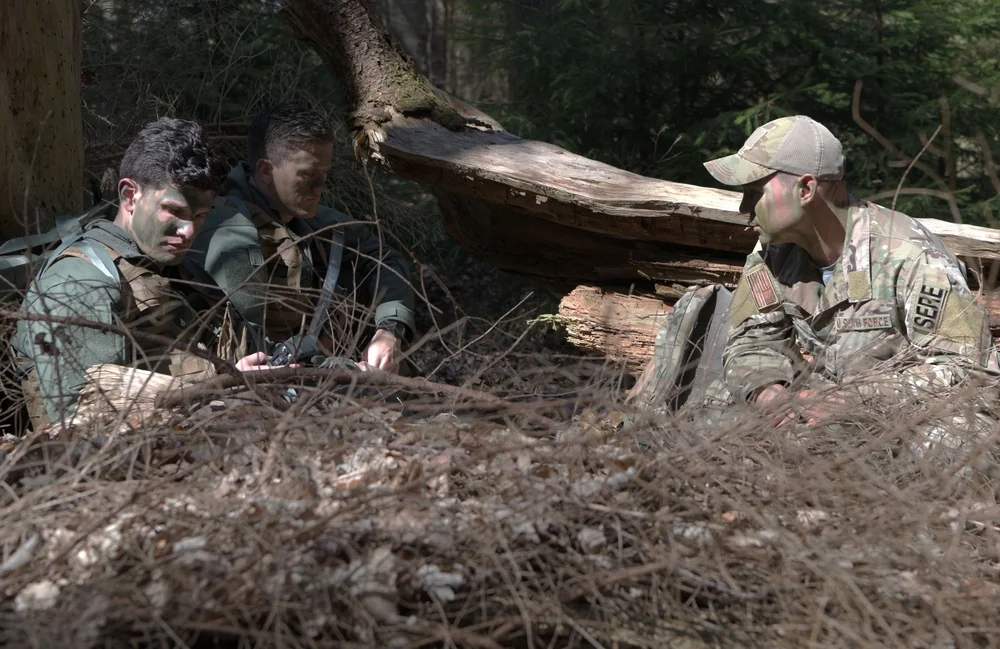
SERE prepares Bundeswehr personnel to stay alive after separation from friendly forces, evade capture and assist in their own recovery. The German expansion is Survival, Evasion, Resistance and Extraction. On land, training combines protection and sustainment with movement under an enemy threat. Aircrew have additional emergency procedures that begin with leaving a damaged aircraft.
Isolation also affects tank crews, mechanised infantry, engineers and artillery personnel. A vehicle may break down, a position may be overrun or a forward team may lose contact with its unit. The usual supply system, immediate protection and reliably reachable command support are then absent. Obtaining water, arranging a rest and deciding on the onward route remain the isolated personnel's own tasks.
German SERE levels and their tasks
The levels differ in risk, content and training format. In the German description, they do not form a course sequence that everyone must progress through. For personnel at medium risk of isolation, Level B combines instruction with application in the field. Level C is intended primarily for special forces and pilots whose employment exposes them to greater risk. A pilot may be alone in enemy territory after being shot down; a small special forces team may operate far from immediately available support.
| Level | German training content | Meaning during isolation |
|---|---|---|
| A | Entirely theoretical foundations covering hazards, survival in a hostile environment and personnel recovery. | The person knows the tasks of survival, evasion and recovery, and the risks of the possible situation. |
| B | Theory and practical survival training, evasion, recovery preparation and conduct during pickup. | Shelter, sustainment and movement must work together with limited resources under an enemy threat. |
| C | More advanced survival and evasion skills, and appropriate conduct as a prisoner of war. | Preparation also addresses the transition from evasion to enemy custody. RtoI additionally prepares personnel at particular risk to resist interrogation. |
Land survival and evasion in sustained field training
German Level B training brings individual skills together in a field situation. Instruction is followed by stations covering emergency shelter, heat retention, fire, water, food and recognition signals. An overnight camp and evasion are then linked: small teams must escape the exercise enemy and reach pickup points independently. Completing a shelter is only one part of the task. The team must be able to rest there, observe its surroundings and still continue afterwards.
After the immediate evasion, the return has to be planned. This includes the onward route, an attempt to establish communications, and obtaining food and water. A shelter follows if time and the situation allow a stay. In the field exercise, movement passes through difficult terrain while the exercise enemy keeps pursuing. In the German example, a separated team gains an overview from an old castle to reorientate itself. A short distance on the map can demand much more time and energy because of terrain, enemy observation and the need for protection.
The work put into a hide depends on the intended length of stay. A team that can stop only briefly has less time to build than one that must remain longer. More substantial wind protection and better use of heat can make the stay easier, but require materials, work and time. Even teams of two or three in the German exercises assign fire watch and enemy observation. The fire needs tending while someone must notice changes in the terrain and an approaching enemy. Even at a quiet bivouac site, not everyone can therefore sleep at the same time.
Managing body heat affects subsequent movement. During shelter construction and night movement, clothing is adjusted before heavy sweating develops. Clothing soaked by exertion contributes to cooling during the following rest. In one German winter training example, the teams have limited clothing, a bivouac bag and little food, with no sleeping bag available. They must divide their energy between movement, shelter, fuel and watch duties.
Water and food are obtained during the evasion itself. German field tasks include water collection and treatment, and preparing limited food supplies. Enemy pressure continues during collecting, building and cooking. A fire provides warmth and helps with food preparation, but needs fuel and tending; light and smoke can reveal the location. The team must decide whether its need for warmth and cooked food justifies the stay and the added risk of detection.
Personal preparation, signals and actual pickup
Recovery preparation begins before isolation. German Level B training covers the Evasion Plan of Action, or EPA, and the Isolated Personnel Report, ISOPREP. The EPA makes intended movement during isolation understandable to recovery forces. The ISOPREP contains information used to identify the person and authenticate their identity. In one German deployed contingent, the personnel recovery point of contact checks individually with each member whether the record is available and completes it together with them if needed. Familiarisation with the emergency equipment actually issued is also part of preparation. A completed record does not transmit a new position during evasion; a changed situation must be reported separately if communications are available.
Ground-to-ground and ground-to-air recognition signals are practised in the field. A signal panel can make the location visible to forces on the ground or in the air; smoke or a mirror can be used where the equipment is available. The choice depends on who can see the signal and what recognition has been agreed. A conspicuous signal helps pickup, but also reveals the place to other observers. In a German Einzelkämpfer exercise, the group marks its location with coloured smoke, waits in a covered position in woodland and leaves that position for pickup. This combines visibility at the decisive moment with protection while waiting.
Showing a location and authenticating identity serve different purposes. A panel or smoke indicates where someone is; it does not establish that the intended friendly person is waiting there. In NATO personnel recovery, identity is therefore authenticated before pickup even when precise coordinates are available. Recognition procedures are agreed beforehand and the associated information is protected. The isolated person must know the agreed procedure and participate without disclosing the information used for it to a possible enemy. Independently changed signals or openly shared recognition information can make reliable identification harder.
A German airborne recovery exercise illustrates the next transition. The deployed forces secure the people they encounter, check identity against known information and separate the target personnel from unknown people. After identification, they protect the person, clarify the ground situation and pick them up using the available helicopter. After landing, the recovered person remains accompanied and is handed over to the designated friendly points of contact. For the isolated person, independent evasion ends with actual transfer into friendly custody. Visual contact, a successful position report or a nearby helicopter come before that transition.
Prisoner-of-war conduct and the additional RtoI module
German Level C includes appropriate conduct as a prisoner of war. Resistance to Interrogation, RtoI, is the additional module addressing resistance to questioning, primarily for special forces and aircrew. When RtoI is included, a phase of “captivity and interrogation” follows the final evasion exercise. The situation changes fundamentally: someone previously able to decide on movement and concealment is now under enemy control. Protecting the person and relevant information is part of German SERE training.
Prisoners of war in an international armed conflict have a specific boundary for compulsory information. During questioning, the required particulars are family name, first name, rank, date of birth and service identification number, the Bundeswehr Personenkennziffer. Information about the mission, friendly forces or recovery intentions is outside those required particulars. Questioning must take place in a language the prisoner understands; coercion to obtain information is prohibited. Prisoners of war must also not be subjected to questioning by media representatives. This legal framework separates personal identification from disclosure of military information.
Representing shared interests is a distinct task within a prisoner group. Prisoners of war can complain about poor conditions and elect prisoners' representatives; where officers are held, the senior officer of the highest rank is recognised as the representative. The representative presents their interests to the detaining power. This does not give prisoners authority to punish fellow prisoners through disciplinary measures. Escape and return also have a specific boundary: legally, escape is considered successful, among other cases, when friendly or allied forces are reached or the enemy's area of control has been left. A person outside a camp fence may therefore remain within enemy-controlled territory and still have to evade.
The Einzelkämpfer course: responsibility for an isolated group
The Einzelkämpfer course prepares junior Army leaders to lead a group operating on its own through enemy-held territory and back to friendly forces. The leader must choose a route the group can complete together. In a final exercise situation, participants select their own route to a rally point. If they cross an open area without protection, the exercise enemy may engage them with simulated fire. They then have to transport a simulated casualty. The consequence affects the whole group: carrying a comrade who can no longer walk independently is added to the original march.
Other tasks require participants to cross obstacles while preserving their limited equipment. Water-obstacle training uses a shelter-sheet package to keep equipment dry while moving it through a river. Fire lighting with improvised means is practised to support sustainment. During recovery, the group also has to come together in a way that lets friendly forces recognise and take custody of it. The EKL therefore centres on leading separated personnel. SERE levels distinguish the scope of isolation preparation; the EKL combines related field skills with the responsibility of a group leader.
Aircrew: from aircraft escape to winch recovery
Sea-survival training at the Marineoperationsschule serves flying personnel throughout the Bundeswehr. Emergency equipment is matched to the aircraft type: the parachute, lifejacket and liferaft each have their own place in the emergency sequence. A jet pilot may reach the water with a parachute and a single-person raft after ejection. Crews of larger aircraft and helicopters also use multi-person rafts and must be able to leave a damaged or overturned airframe.
The underwater escape trainer floods and rotates the cabin. Darkness, the changed attitude and buoyancy make orientation difficult; the familiar idea of up and down becomes unreliable. Fixed reference points on the aircraft lead towards the designated emergency exit. Losing that connection can allow the person to float up inside the cabin and miss the exit. Other training elements cover release from parachute harnesses, handling the issued lifejacket and winch recovery. They are prepared in the training hall using the relevant rescue equipment.
During the subsequent exercise at sea, participants use their rescue equipment in the water and undergo an actual pickup. They reach and deploy their liferaft, help one another board and manage the period until the assigned pickup helicopter arrives. Rotor downwash makes the actions needed for winching more difficult. The person is hoisted from the water into the aircraft. They thus practise their own tasks after ditching: escape from the airframe, survive at the surface with the available rescue equipment, and enter the rescue aircraft when recovery forces are present.
The appearance of U.S. Department of War (DoW) visual information does not imply or constitute DoW endorsement.