

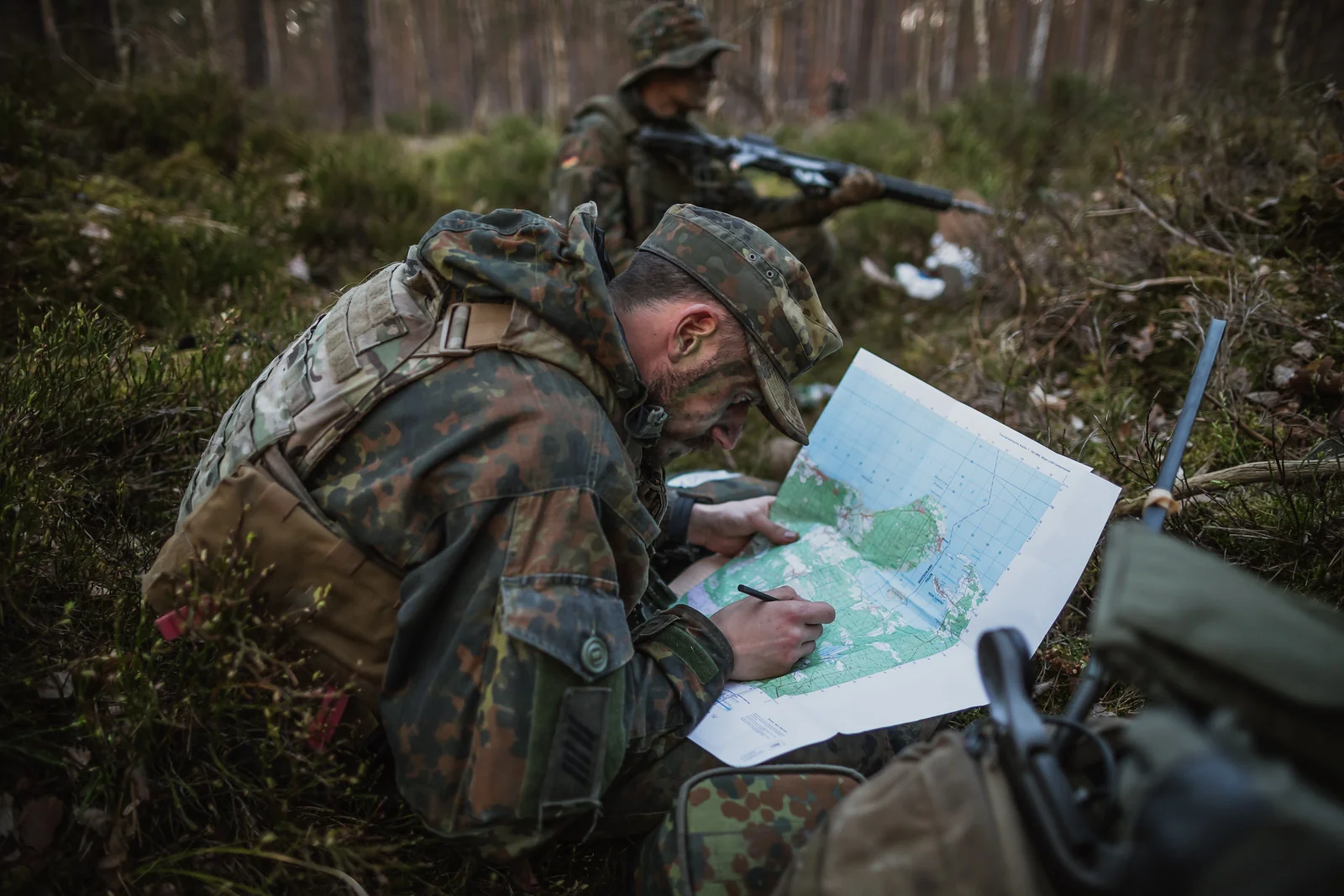
The Bundeswehr Einzelkämpfer course prepares military leaders to bring a group cut off from its own unit back through enemy-held territory. The soldiers must find their own way, overcome obstacles, survive with limited resources and avoid enemy forces wherever possible. The leader is responsible for the return of the entire group, including exhausted or wounded members.
This situation can arise after contact with the enemy: soldiers lose touch with their unit and come together with personnel from other subunits. The people and equipment that remain must be organised into a group capable of acting together. The course therefore combines individual soldiers' skills with leadership of such a group under hunger, sleep loss, the strain of marching and enemy threat.
Mission, participants and course names
The Infantry School in Hammelburg trains Einzelkämpfer personnel for the entire Bundeswehr. The EKL is particularly directed at junior leaders: young officers and non-commissioned officers who take responsibility for other soldiers. It prepares them for a situation in which the normal organisation, supply arrangements and direction from outside can break down. Even a group that has come together by chance needs a shared purpose, a usable route and someone to allocate the available personnel.
Older training descriptions call this basic role “Führer einer auf sich gestellten Gruppe”, meaning leader of a group left to operate on its own; Einzelkämpferlehrgang I or EK1 is also used for it. Under the name Einzelkämpferlehrgang, the Bundeswehr continues to present training in leading an isolated group and bringing it back. The functional name therefore explains what Einzelkämpfer means in this setting. The subsequent course, “Führer eines Jagdkommandos”, has a broader mission: preparing leaders to command a subunit operating separately from friendly forces.
Preparation before the course
Einzelkämpfer preparatory training combines physical training with military skills. One concrete example is the voluntary preparation established by military students at the Helmut Schmidt University in Hamburg. There, physical training and swimming were combined with knots and lashings, navigation marches and evasion exercises. Participants who had already completed training passed their knowledge to the next intake. This preparation took place before the course itself and alongside university study.
These activities serve different functions in the field task. Endurance and strength are needed when marching with equipment; swimming and handling equipment in water become relevant at water obstacles. Navigation marches require soldiers to reach a destination and check their position along the way. The evasion exercise combines such individual skills with the situation of a group moving under threat. A soldier whose attention is entirely occupied by keeping moving has less attention available for route selection, observation and leadership of others.
Practical training and the continuous field exercise
The progression in training content leads from individual soldiers' skills to their combined application in the field. Navigation marches, runs with equipment and overcoming obstacles are combined with the group task. They are joined by water-obstacle training, fire with improvised means and military close combat. In the subsequent group tasks, participants must decide how to use these abilities under enemy threat.
At a water crossing, for example, personal equipment is transported dry through the river in a Zeltbahnpaket, a package made with a shelter sheet. The task does not end at the far bank: the group must be able to continue moving with its equipment. The package serves to transport and protect the material. Current, banks, soldiers' abilities and the condition of their equipment determine whether a crossing is feasible at all.
Close-combat training sits within a survival and evasion situation. Avoiding such an encounter has priority. Contact with an enemy consumes the group's resources and can cause injuries, while its objective remains a return to its own unit. The revised course concept therefore concentrated close-combat training on the content essential to this situation.
The final exercise brings the tasks together. The group is given a rally point and selects its own route to it. Route selection must account for the strain of movement, terrain, sustainment and the enemy situation. After overcoming an obstacle, the group must still be mobile, know its position and remain capable of coordinated action.
Navigation and movement under threat
A rally point provides a destination, but does not yet provide a suitable route. The leader must consider terrain and enemy threat together. A short route across an open area can expose the group to observation and enemy fire; a detour costs time and energy. In selecting its own route, the group must therefore identify ground it can negotiate in its actual condition while avoiding unnecessary enemy contact.
A concrete training example shows the consequence of a poor decision: the group crosses an open area without protection, comes under simulated fire and then has to carry a simulated casualty. What appeared to be a shortcut creates an additional burden. Speed, the allocation of people and the suitability of the onward route now change. The leader must continue the movement in this new situation instead of retaining a plan made for a group whose members could all walk.
In a night evasion task towards a field post, enemy patrols and small security teams made movement more difficult. One group crossed a road almost unnoticed; another revealed itself through footsteps and voices. Enemy contact also occurred close to the intermediate destination. The participants' task is to observe their surroundings throughout the route and adjust their movement accordingly.
Personal sustainment and available resources
Fire with improvised means is a practical EKL task. A soldier must be able to use the material actually available to light a fire for warmth or cooking. In an isolated group this requires fuel, working time and personnel. People gathering material or operating a cooking site have less capacity for other tasks during that period. The leader must organise sustainment and observation together.
German SERE field exercises involving small teams and limited equipment show how concrete this relationship becomes. Soldiers obtain their own drinking water, prepare the food allocated to them and assign fire watch and enemy observation even with only two or three people. In another German SERE example, a sheet is used to collect rainwater. Construction of a rest site depends on the time available and the intended length of stay. These tasks illustrate the shared field problem of SERE and EKL: how can personnel remain capable of acting while moving, without losing sight of the threat during sustainment?
After the immediate evasion, the team must plan its return and organise food and water. A more elaborate rest site can be built only when the situation and remaining time allow it. Supplies, distance to cover and the soldiers' condition therefore belong in the same plan. The leader must determine the next section of the route using the navigation means available and select a rest point where sustainment and observation can be organised.
Leading an exhausted group
Leadership of a group that has come together begins with its actual resources: who is present, who can move, what equipment and supplies are available, and what information about the return route is usable? The next tasks follow from this. The leader establishes a shared objective and allocates navigation, observation, sustainment and, if needed, casualty transport so that the group can continue to function.
A casualty changes this allocation immediately. Those carrying the casualty have less capacity for other tasks, and the route must allow the transport. The remaining equipment must also be carried onward. The leader must recognise when people need relieving, loads need redistributing or the next section of the route needs adjusting. A speed that individual strong soldiers can sustain is not yet a workable marching pace for a group carrying a casualty.
Sleep loss and hunger affect this work alongside physical strain. The group must still check its position, observe its surroundings and understand decisions. The next objective and the tasks assigned to reach it must therefore be stated clearly. After an obstacle or enemy contact, the leader must establish whether every person and the required equipment remain available and whether the plan still fits the group's condition. The leader's own exhaustion is part of this situation: responsibility continues while the leader covers the same route and experiences the same deprivation.
From the rally point to pickup
The return begins with the group's own movement to a reachable rally or pickup point. It must reach that location and prepare for a possible encounter with friendly forces. In a concrete EKL pickup example, soldiers mark their location with coloured smoke. They initially wait in a covered position in the forest and then leave it for pickup.
The marker makes the location recognisable to the receiving force. Its use requires available signalling equipment and an appropriate moment for contact. Colour and use are agreed for the particular pickup. If a radio is available and a connection can be established, the group can coordinate contact through it. Otherwise, it must continue working with the navigation means available and the agreed return plan. The course task thus combines independent evasion with participation in the actual pickup.
Connection to SERE and the Jagdkommando distinction
Survival, Evasion and Extraction appear in EKL as a connected land task: survival preserves the ability to act, evasion keeps the group out of enemy control wherever possible, and the return restores contact with friendly forces. The distinctive EKL emphasis is the leader of an isolated group. German SERE levels instead relate to isolation risk and training content. SERE B combines theory with practical field work; SERE C develops survival and evasion further and addresses conduct as a prisoner of war. Resistance to interrogation is an additional training element particularly for special forces and aircrew. Soldiers need the designated training for this captivity task.
The follow-on course known as EK2 is presented by the Bundeswehr as the course “Führer eines Jagdkommandos”. Completion of the Einzelkämpfer course comes first. Experienced squad and platoon leaders then command a reinforced platoon, separated from friendly forces and regular supply. The subunit receives its own missions, such as reconnaissance or protection of friendly forces and infrastructure. This requires assessment of terrain and the enemy situation, evaluation of information, orders and coordination of the capabilities of subordinate elements.
The practical distinction lies in the mission. In basic EKL, a group cut off unexpectedly must be brought back. The Jagdkommando is led as a separately operating subunit to carry out a mission of its own. Its leader must allocate available personnel and supplies both to that mission and to the subsequent movement.