

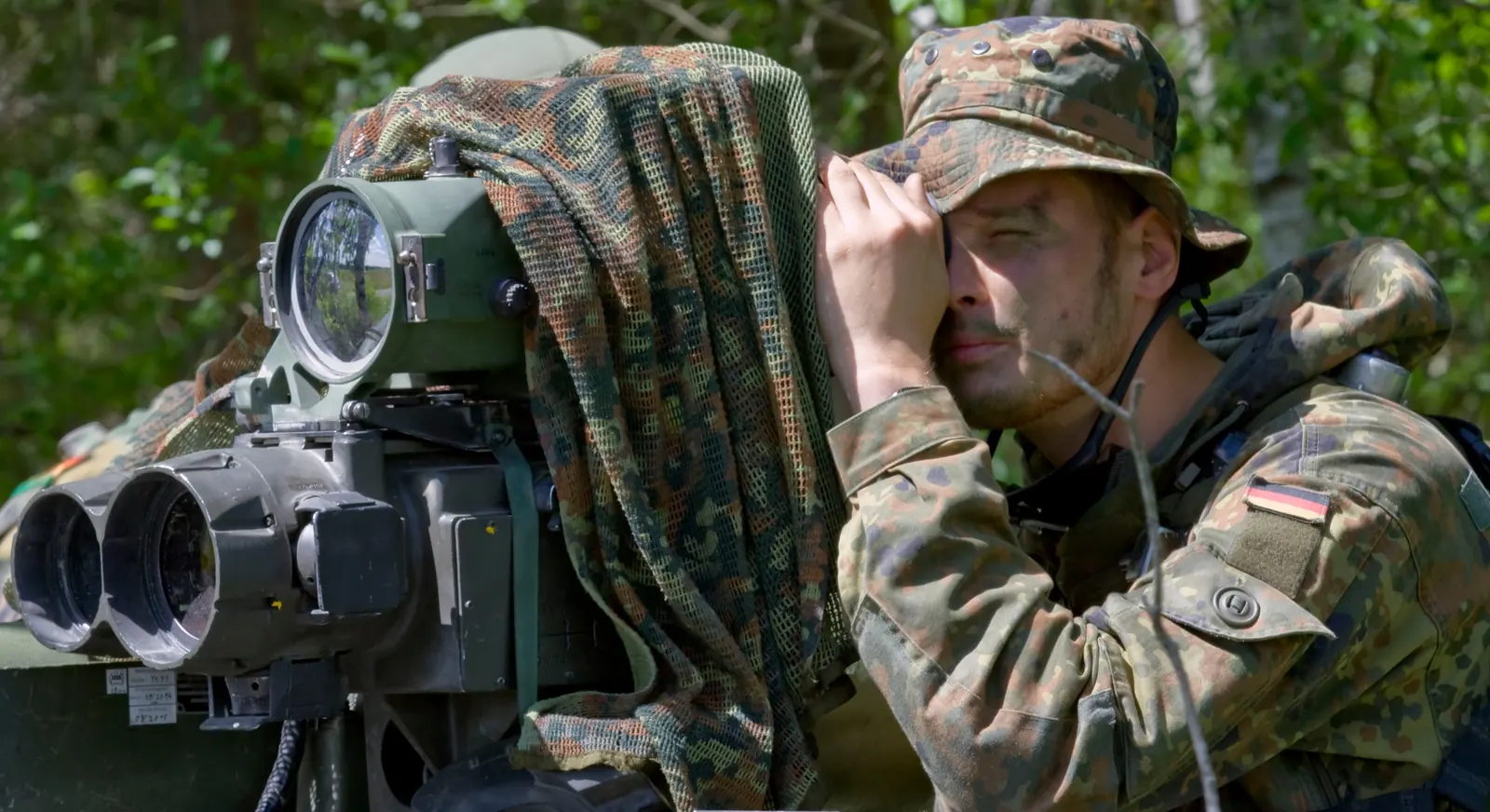
EK2 denotes the advanced part of German Einzelkämpfer training associated with the course “Führer eines Jagdkommandos”, or Jagdkommando leader. Its subject is the independent command of a reinforced platoon, separated from friendly troops and their regular supply system. The soldiers must accomplish an assigned mission while sustaining their personnel, gathering information and coordinating the different elements of their Jagdkommando. This requires assessing the terrain, the enemy and their own capabilities while under physical strain.
The tasks include reconnaissance and information gathering, protecting friendly forces and important infrastructure, and offensive missions. A Jagdkommando may operate on open flanks, in gaps or behind enemy lines. Separation from friendly forces forms part of the planned operational situation. This creates a different leadership task from that of a scattered group whose primary objective is to return to friendly troops.
Building on leadership training and the Einzelkämpfer course
The foundations are laid during military leadership training. The course is intended for experienced squad and platoon leaders; company commanders may also attend. Specialist contributions from other branches can be incorporated, for example from reconnaissance platoon leaders or engineers. The leader therefore has to consider more than the performance of one squad: different capabilities must be employed so that their tasks and results serve the common mission.
Prerequisites are successful completion of the Einzelkämpfer course and a corresponding recommendation from the training staff. The Einzelkämpfer course focuses on leading a group on its own through enemy-held territory back to friendly forces. The advanced Jagdkommando course increases personnel responsibility and the complexity of the situation. The survival and evasion abilities already acquired must now be combined with planning, issuing orders and coordinating a reinforced platoon.
Training from the mission to its execution
Training at the Infantry School in Hammelburg combines reading the terrain, assessing the enemy situation and interpreting reconnaissance with practical mission planning. The participant has to decide on a course of action, assign tasks to subordinate personnel and coordinate their actions. This leadership work is applied in demanding situations under heavy physical strain and with limited resources. The assumed enemy is superior; support is unavailable in these situations.
The leadership process connects this work: establish the situation, analyse the mission, assess the situation, reach a decision, plan, issue orders and check execution. Checking provides information for the next assessment of the situation. In the field, these activities overlap. While one element is executing its task, new reconnaissance findings or a change in the condition of friendly personnel may already affect subsequent planning.
Turning observation into an assessment
At the outset, the leader must clarify the required outcome, its deadline and the personnel and equipment available to achieve it. The leader also determines which information is missing for the decision. Reconnaissance obtains information about the enemy, such as strength, disposition and equipment, and about the condition and location of the terrain. The course requires the leader to draw conclusions from this information for the assigned mission.
Reading the terrain means examining the surroundings for their significance to movement, observation and mission execution. A place that affords a good view may also make it easier for others to observe the personnel there. The leader therefore has to weigh the value of the information gained against the risk of being detected. Personal observations and the reconnaissance personnel’s findings must produce a usable picture: what has actually been identified, what information is missing, and which assumptions are being used provisionally?
Incomplete or contradictory information requires a decision about which uncertainty matters most to the mission. A route assumed to be clear and one that has actually been reconnoitred provide different bases for planning. If an assumption is treated as a confirmed observation, several elements may act on the same false premise. As new information arrives, the leader must therefore review the conclusions drawn from the previous picture.
Building an executable plan with available forces
The assessment also covers friendly combat power: available personnel, materiel, equipment condition and capabilities. In a Jagdkommando, these factors are directly connected with continued endurance. Exhausted soldiers may need more time to complete a task; a failed item of equipment may remove a capability previously included in the plan. The leader must account for this when deciding, instead of continuing to plan around the platoon’s original condition.
Planning arranges available personnel, equipment and tasks in space and time. The leader decides which elements of the Jagdkommando will make which contributions and how those contributions depend on each other. Reconnaissance findings must arrive in time for the next decision; a specialist contribution must be included where the mission requires it.
Reconnaissance platoon leaders and engineers bring different expertise to this work. The Jagdkommando leader uses their assessments and capabilities in the overall plan and delegates responsibility for individual tasks. Composition depends on the assignment.
Communicating individual tasks and the shared objective
Issuing orders turns the decision into tasks for subordinate personnel. They must know the outcome required, the resources they can employ and the applicable time, geographical or legal boundaries. Where several manoeuvre elements are involved, they must also understand how their task interacts with the others. A task correctly executed in isolation may obstruct the overall plan if its timing or location is poorly coordinated.
The German principle of mission command gives subordinate leaders freedom to act within this framework. They can respond to unexpected changes without waiting for a new instruction for every step of execution. This requires understanding the intended outcome and the limits of their mission. Clear orders sustain command during detached operations: the subordinate leader decides how to execute locally, while the Jagdkommando leader retains overall responsibility and coordinates the elements.
Coordinating execution and reviewing the decision
During execution, the leader compares actual progress with the plan. This means tracking which tasks have been completed, which personnel remain committed and whether the assumed situation still holds. Reports that reach the leader and personal observations inform the next assessment. New information about the enemy, delays or the condition of personnel may require a different allocation of tasks.
If an element finishes later than expected, this also affects personnel whose next task depends on its result. The leader must reassess that dependency and alter the subsequent sequence or task allocation accordingly. Checking execution allows the leader to identify deviations and make new decisions in time. A correction takes effect only when the affected subordinate leaders understand what changes for their task; otherwise, old and new expectations about execution continue side by side.
Maintaining command over several days
The demands of training include heavy equipment, little food, sleep loss and tasks extending over several days. Participants must continue to absorb information, make decisions and take responsibility for other soldiers under these conditions. Their own condition therefore forms part of the leadership task. Missing a change in the situation or processing a report incompletely may carry a false premise into subsequent orders. Survival and mission accomplishment draw on the same people and resources; the leader must account for both when allocating them.
The connection with SERE and the instructor role
The connection with SERE lies in remaining able to act while separated from friendly forces, under enemy threat and with scarce resources. In EKL, these abilities serve the return of a group cut off from friendly troops. In the Jagdkommando course, they support independent execution of an assigned military mission. Personnel therefore need to understand which objective governs their situation: returning to friendly forces or executing the planned mission with their Jagdkommando.
Bundeswehr SERE Level C covers survival and evasion as well as appropriate conduct as prisoners of war. Resistance to Interrogation is an additional training component, particularly for special forces and aircrew. That pathway also addresses retaining the ability to act after capture and contributing to recovery. The Jagdkommando course focuses on command of the deployed personnel and their mission. SERE preparation follows the intended employment and its risk profile; Jagdkommando training follows the command responsibility to be assumed.
Graduates pass on their acquired skills as instructors in their own units. They bring the leadership work applied on the course into the training of their subordinate soldiers: using reconnaissance findings to make decisions, fitting individual tasks into the overall plan and accounting for changes during execution.
The appearance of U.S. Department of War (DoW) visual information does not imply or constitute DoW endorsement.