

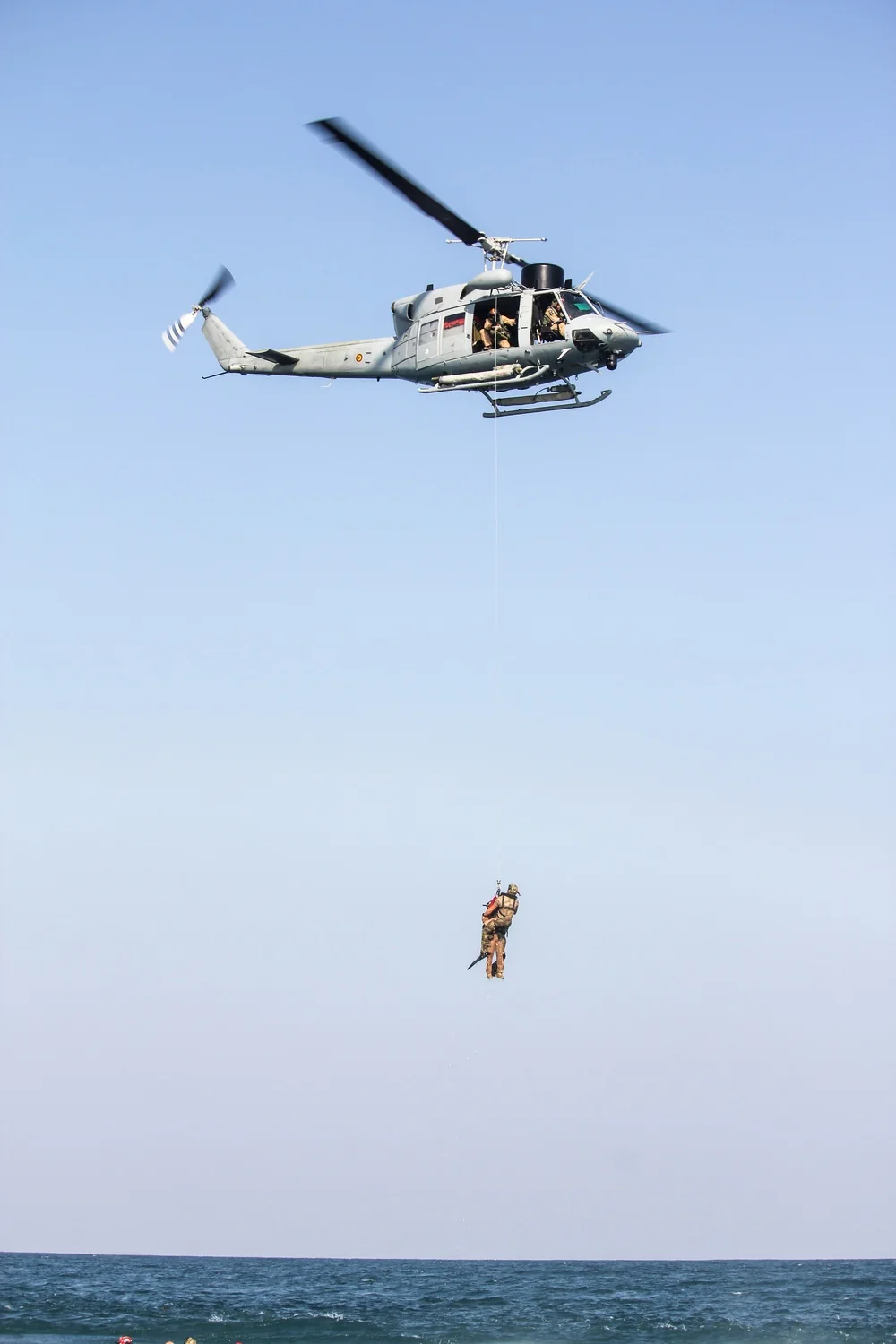
Spanish SERE training prepares military personnel to survive isolation in a hostile environment, evade capture, protect information and cohesion in captivity, and contribute to their own recovery. The Spanish term is Supervivencia, Evasión, Resistencia y Extracción. It involves distinct tasks: remaining mobile with limited resources, avoiding a searching enemy, retaining the ability to act under another party’s control, and enabling a prepared contact with friendly forces.
A, B and C: preparation according to employment
Spain relates preparation to the risk of isolation and exploitation by an adversary. The intended employment matters: duties outside protected bases, a flight over hostile territory and a special operation create different opportunities for separation from a person’s own unit. The services account for this risk when assigning the training level.
| Level | Training form and assignment | Meaning for the individual |
|---|---|---|
| A | Theoretical basic preparation for personnel participating in operations with a low risk of isolation and exploitation. | The individual receives the basic framework for survival, evasion, conduct after capture and participation in recovery. |
| B | Theory with practical components for medium exposure. Possible employment includes force protection and military police when operating outside bases, ordinary transport aircrew and deployment support personnel. | Preparation includes personal practical application; an individual’s actual task determines whether B is required. |
| C / Charlie | Extensive practical training, including capture and exploitation by an adversary, for personnel at high risk. | The individual also has to manage the transition from evasion to conduct under hostile control. |
The specific C audiences include combat pilots, aircrew operating beyond hostile lines and special operations personnel. The Escuela Militar de Paracaidismo Méndez Parada at Alcantarilla is the joint-service reference centre for SERE and delivers Charlie training. Air and Space Force courses address officers, non-commissioned officers and enlisted personnel. The designated outdoor areas supplement the base facilities with the terrain and environmental conditions required by each scenario.
EZAPAC: sustainment under search pressure
One training model of the Escuadrón de Zapadores Paracaidistas, or EZAPAC, begins with special reconnaissance and a task to recover an isolated pilot. The situation deteriorates, leaving the participants themselves as the people who must evade a hostile search. One week of theory prepares them for two practical weeks. Within this sequence, the captivity component expressly designated Charlie begins only after simulated capture.
The enemy patrols paths and roads. Selecting the next stretch of movement therefore becomes a security decision: the direct, easily travelled route may be precisely the area controlled by the search forces. Before leaving a concealed stopping place, enemy movement, exposed terrain and opportunities for the next pause have to be considered together. Someone who steps straight from a hiding place onto an observed path gives up the protection of that location before reaching the next covered stretch.
Between periods of movement, participants have to obtain resources from the terrain, create protection from the weather, find food, treat water and make fire. Their stopping place has to accommodate these activities alongside concealment. A location without accessible water may force additional collection trips; one close to a patrolled path brings each such movement into its observation area. Fire can provide warmth and allow food preparation, but produces light, smoke and smell. Its benefit to sustainment must therefore be weighed against the additional attention it attracts.
In the described sequence, the next pickup window is several days away. The time is used for self-sustainment before participants resume evasion. The lack of regular meals is already weakening them during this phase. A decision to move consequently has to account for the hostile search, their remaining water supply and physical condition, the distance to the next objective and the time until the intended contact. If their remaining capacity covers only part of the journey, resources and pauses have to be planned before departure; a pickup point offers little benefit if the person can no longer physically reach it.
Captivity: identity, information and fellow captives
Spanish conduct rules require a captured combatant to maintain military subordination and discipline among fellow captives. The person should restrict answers to first and last names, rank, personal identification details and date of birth, and strive to avoid answering questions beyond these matters. The duty to protect service matters and personal data also applies. Questions about the mission, other people’s activities or operational details therefore extend beyond the individual’s identification.
Refusing agreements or special favours from the enemy, attempting to escape and assisting fellow captives in doing so also form part of the Spanish framework. A special favour can bind the individual to a concession and separate them from the captive group. Information protection therefore concerns both questioning and the conditions under which improvements are offered. Shared discipline preserves an order that captives can use for direction despite being under another party’s control.
In the EZAPAC sequence, capture is followed by a realistic captivity phase in which the previously covered conduct principles are applied. The individual now operates within the restrictions of custody: the enemy controls freedom of movement, contact opportunities and available means. Charlie prepares personnel for this transition and the risk of exploitation. After an escape, the person has to organise sustainment, movement and the intended contact again; the pickup planned before capture may have been missed or may now be unsuitable at that location.
The Army: connected tasks in the MOE
At the Mando de Operaciones Especiales, the Army’s special operations command, capture, resistance to questioning, escape, evasion and survival using terrain resources are part of preparation for situations that can result from combat. One described model of the Curso de Aptitud Básica de Operaciones Especiales connects planning and executing a special operations mission with a subsequent practical prisoner phase and several days of evasion and escape movement, without a break.
The subsequent movement on foot over several days has to be carried out with the energy and resources remaining after the mission and prisoner practice. Participants must choose stages that they can complete with their remaining strength and equipment, while allowing for food and water collection and rest along the way. Self-sustainment and captive conduct are distinct components of a broader special operations course; its weapons, combat and other specialist instruction has additional purposes outside SERE.
Personal preparation for recovery
A preparation model for Spanish cavalry begins with the information friendly forces will later need and the arrangements the individual must know. The ISOPREP contains information for identification and authentication. It is completed before the operation and retained in the responsible personnel chain. Individuals need to know their entries and be able to provide the intended information for identity checks correctly. The completed document provides a reference for friendly forces; sensitive identity information does not belong in a marker openly visible in the field.
The Evasion Plan of Action, or EPA, sets out intended pickup points, activation times and coordination measures. The patrol leader completes it, familiarises the crews with the procedures and hands in a copy before the mission. For the individual soldier, this becomes specific guidance for that task: equipment to carry, expected locations, directions of movement, communication channels and rendezvous points. The person knows what movement is intended, while the search forces can use these arrangements to focus on the likely location.
This preparation is particularly important if a new position report cannot be sent later. A route and contact window agreed in advance give the individual an objective and friendly forces a starting point for their search. If the enemy or terrain forces a deviation, both the expected position and the time required change. The individual must then decide whether to stay, move on or divert based on current observations, physical condition and the particular mission arrangements. A stay beside a vehicle that was initially useful can become a trap as the enemy approaches; a road route specified for one task may lead into the search in another situation.
Location, contact and pickup
In the prepared EZAPAC scenario, allocated encrypted communications and coordinated procedures enable personnel to be located while moving. An aircraft overhead directs participants towards an area where the pickup forces can operate. Their own task is to establish the intended contact, convey their actual location and match their subsequent movement to the instructions received. A position already transmitted has to remain consistent with further movement so that the forces do not head towards an abandoned location.
After captivity and escape, participants move to a new pickup point. The recovery forces monitor their approach and check their identity before pickup. Authentication links the person at the contact location to the previously prepared identity information and the intended procedure. A visible person or an intelligible radio message alone does not establish whether this is the friendly personnel being sought. The individual therefore has to participate in the agreed identity check and follow the subsequent contact instructions.
EZAPAC ground teams can contribute to location, authentication and protection, support further evasion and lead isolated personnel to a point accessible to the aircraft. Further movement may consequently lie between first contact and boarding. The individual has to maintain contact with that team and follow its coordinated route to pickup, rather than independently running towards an aircraft that appears. In the described exercise sequence, NH90 helicopters carrying EZAPAC personnel conduct the pickup. Allocated communications, an accessible pickup area and forces actually committed to the task make this sequence possible; until contact with them, the individual remains responsible for concealment, sustainment and movement.
The appearance of U.S. Department of War (DoW) visual information does not imply or constitute DoW endorsement.