

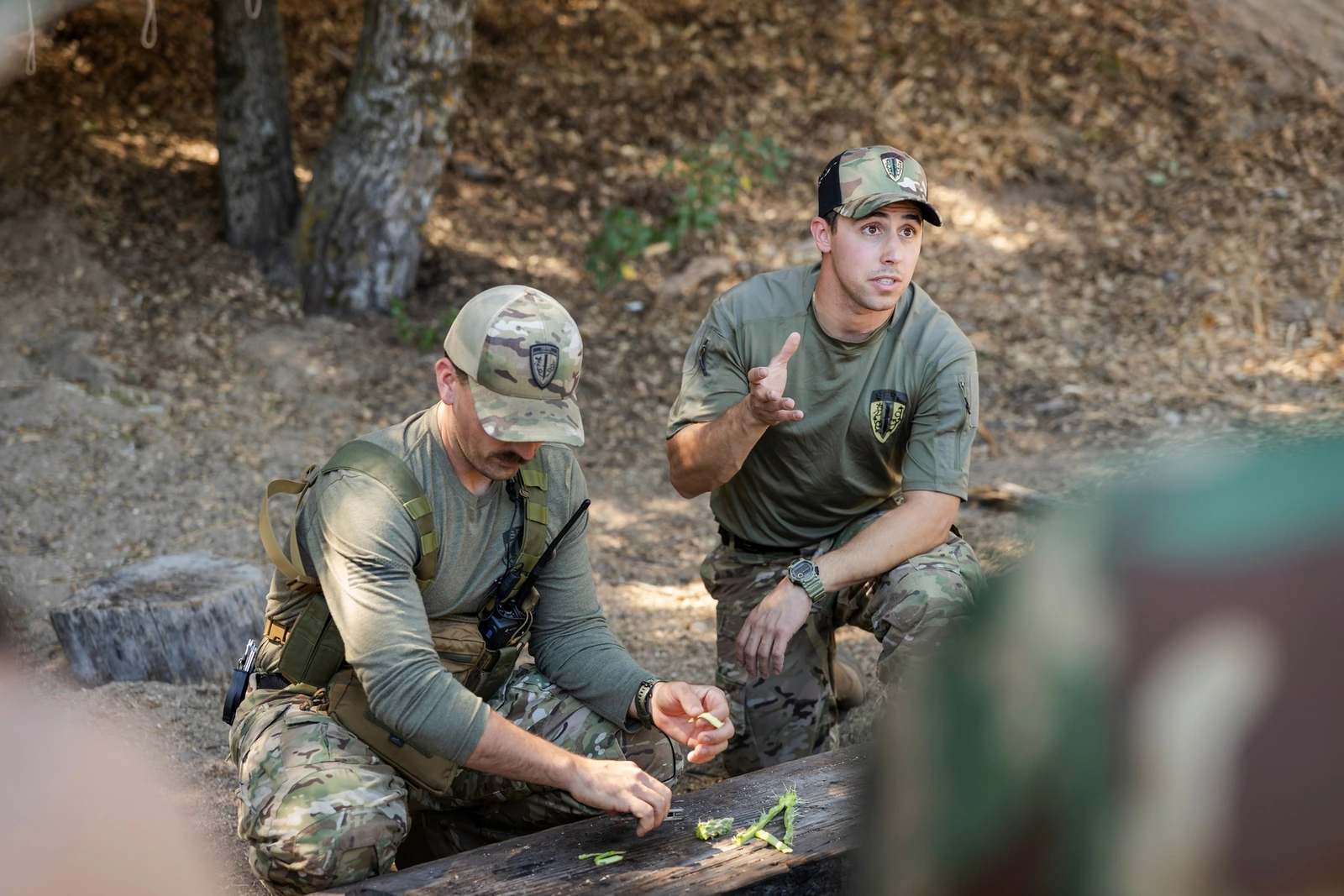
What Navy SERE prepares personnel for
SERE in the US Navy prepares personnel at risk to remain capable of action after losing contact with friendly forces, evade capture and resist enemy exploitation if captured. It includes practical field tasks and preparation for a return to friendly control. A Navy service member can become isolated on land after losing an aircraft or during an operation away from a ship. Navy SERE therefore covers survival and movement in terrain affected by an enemy presence.
The Center for Security Forces, CENSECFOR, organises the relevant Code of Conduct training under Naval Education and Training Command. The two school locations, SERE East and SERE West, have the same functional task: survive behind enemy lines, evade capture, resist exploitation and, where possible, end isolation. The American Code of Conduct provides the common framework for military conduct in captivity. The practical survival problem changes with terrain and environmental conditions.
Participants and risk
Core risk groups include aircrews, SEALs and Special Warfare Combatant-Craft Crewmen, SWCC, the crews of special operations boats. For aircrews, an aircraft shootdown or emergency escape can place people abruptly in enemy-controlled territory. During special operations, distance, small force elements and the mission itself can contribute to separation from friendly support. An enemy may also expect particular prisoners to hold especially useful information about missions, procedures or other people. This creates a need for preparation for captivity alongside the ability to sustain oneself in the field.
The specific training assignment follows duties, mission, area of operations and exploitation risk. Rank alone does not describe that situation. Special operations support personnel and people from other Navy communities may need additional training according to their assignment. Navy SERE also trains Marine Corps personnel; the described programme additionally includes DoD civilians and contractors. American military personnel are subject to the military Code of Conduct. Civilian participants need the behavioural framework appropriate to their status. Attendance at the same school does not give them military command duties or responsibilities for leading prisoners.
Foundations, targeted training and Level C
Within the Navy framework, A, B and C distinguish the required scope of training. Level A provides foundations for conduct during isolation, preparation for it and the relationship with personnel recovery. Level B addresses particular capability gaps in a person or unit. Level C includes experiential training for personnel at high risk of isolation or significantly increased risk of enemy exploitation. The choice of training follows the capability required and the anticipated isolation situation.
| Level | Subject emphasis in the Navy framework |
|---|---|
| A | The Code of Conduct or appropriate civilian behavioural framework, preparation for isolation and basic knowledge of evasion, signalling and recovery. |
| B | Targeted development in one or more areas: preparation, survival, evasion, resistance, captivity resolution or support to recovery. Practical elements depend on the particular gap. |
| C | Practical and experiential preparation for isolation and enemy exploitation at high risk; participants must use skills and conduct within the conditions of the training task. |
A person must preserve the physical ability to act, move or remain concealed as the situation requires, evade capture and support recovery. If captured despite these efforts, the available means and freedom of action change. Protecting information, dealing with the captor and responsibility towards fellow prisoners then become tasks in their own right. Survival and evasion seek to prevent that situation; resistance prepares personnel for its consequences.
Preparation for the field phase
Personal preparation starts with medical and psychological suitability for supervised training. Participants present the required medical and dental records and a completed screening questionnaire. It covers previous heat or cold injuries, injuries, illnesses, medication and conditions that stress could aggravate. Concealing such a limitation deprives instructors and medical staff of information needed to determine permissible training demands and whether training must stop.
Preparation also includes the personal items actually needed. Required medication, including prescribed inhalers or epinephrine auto-injectors, must be available. For the field phase, the school requires glasses when vision correction is needed and prohibits contact lenses. These requirements concern participation in controlled training. High Risk of Isolation, by contrast, describes the operational risk of separation from friendly forces or detention by an enemy during a subsequent assignment.
Instruction and connected field tasks
Subject instruction connects conduct during isolation and captivity, survival skills and support to one's own recovery. In the field, these become concrete activities. Navy tasks include navigation in unfamiliar terrain and firecraft; field instruction at SERE West also covers identifying and preparing edible plants and maintaining physical capacity under stress. The practical question is what means an isolated person actually possesses and how those means can preserve the ability to act until the next decision.
After separation, injuries, available equipment and one's location must enter the assessment. A concealed halt allows these tasks to be addressed with less exposure than unplanned movement. Threat, terrain and the prepared evasion intention then determine whether to remain concealed initially or move on. Movement needs a useful destination: a prepared recovery area, friendly territory or a location offering protection and further options.
Route selection must account for enemy activity as well as navigation. A convenient road may speed movement while also bringing enemy vehicles, observers or checkpoints closer. From concealment, the person therefore observes signs of human activity, listens for vehicles and voices, and checks the next stretch of terrain before leaving cover. Natural visual concealment, securing equipment that rattles, avoiding unnecessary vegetation damage and retaining loose items all contribute. Evasion thus connects finding one's way with judging which movement might alert the enemy to one's presence.
A rest location must reduce environmental exposure while allowing approaches to be observed. It needs ways out; a sheltered hollow can become a trap if water rises or no escape route is available. Water, strength and rest must be managed so that a further journey or an urgent change of position remains possible. Fire can provide warmth and allow water treatment, but light, smoke and smell reveal human activity. Decisions about sustenance and protection therefore remain part of threat assessment. In some situations, a concealed position, adequate rest and foregoing a fire can achieve more than constructing an elaborate camp.
Captivity and resistance
Advanced Navy training connects SERE with the American Code of Conduct. In captivity, the task is to limit enemy exploitation: protect information about friendly forces and fellow prisoners, resist being used for propaganda and preserve cooperation within a prisoner group. For a prisoner of war, the Code identifies name, rank, service number and date of birth as personal information to provide. A question about health or a permitted message home serves a different purpose from questioning about a unit's mission, capabilities or personnel.
A captor can connect information and statements. Details about occupation, unit or comrades can help identify particularly valuable prisoners; a recorded statement can be used as apparent agreement or propaganda. The person's own action is therefore to resist further disclosures and such statements to the extent possible. This also concerns special favours obtained at the expense of other prisoners or tied to an obligation towards the enemy.
Leadership and mutual responsibility continue within a military prisoner group. The senior military prisoner able to act assumes command; others support lawful decisions. Caring for sick and injured prisoners, maintaining hygiene and protecting information about fellow prisoners are concrete contributions to collective survival. A possible escape must also take account of its consequences for prisoners left behind.
Coercion can obtain a statement or another form of compliance. The behavioural framework then requires the prisoner to resume resistance to subsequent demands and limit the next disclosure again. A coerced statement does not create a lasting obligation to cooperate. Controlled resistance training prepares personnel for this restricted freedom of action. Psychological oversight is part of the Navy SERE programme for that purpose; it contributes to the organisation of training as well as preparation for return after real isolation.
Why HRI, radio briefings and instructor training are added
The High Risk of Isolation briefing supplements the designated SERE training with the risks of the particular area of operations. Enemy activity, hostile state action, environmental conditions and equipment failure can separate a person from friendly forces in different ways. Preparation connects these hazards with the mission and personal evasion intentions. For the isolated person, the practical issue is which risks to consider when leaving a location, making possible contacts or approaching a recovery area. HRI describes isolation risk; the briefing supplements A, B or C.
Aircrews also receive instruction on their own squadron's equipment. Before first flight, this includes a squadron-specific survival radio briefing and hands-on work with the device. If the operational radio differs from the one used in the training environment, appropriate additional training is required before deployment. Participants must be able to use the radio actually carried on their body or in survival equipment after an emergency escape. A sequence learned at school is of little use if the operational device has different functions or controls.
Instructor Under Training, IUT, is for prospective instructors. One route into Navy field instruction combines screening, general instructor training and SERE-specific preparation. In the field, instructors must teach skills such as terrain movement or plant identification and oversee their execution within the established training conditions. Having attended SERE as a student does not encompass those tasks. Additional qualification connects subject skills with responsibility for supervised practical training; psychological oversight complements that framework during resistance training.
The person's role in recovery and return
Personnel recovery connects the isolated person's preparation with the work of forces that can recover them. In naval aviation, CSEL, Combat Survivor Evader Locator, is one of the communications systems provided for that purpose. It combines military position determination with secure two-way data communication beyond the immediate line-of-sight radio area. Knowing one's position, transmitting a message and receiving a reply are separate processes. The device, power supply and appropriate communications chain must function for contact; a possible pickup also depends on available forces and conditions at the location.
When contact is established, the person must be prepared to use the agreed authentication procedure. Useful information includes enemy activity, obstacles and characteristics of the pickup site, the number and condition of people, and available signalling devices. A name alone does not authenticate identity to recovery forces. Signals are used according to the prepared arrangement or received instructions. Without radio, available ground-to-air signals can create an opportunity for contact if suitable forces reach the area. A visible signal can also alert the enemy to the location; the person prepares available devices and weighs their use against that danger.
Until pickup is imminent, the person remains concealed. They pack and secure loose equipment, secure weapons and avoid movements that the receiving force could mistake for a threat. They approach a vehicle or aircraft only when instructed. Detection and contact can then become a controlled pickup: the force must identify the right person, assess the site and be able to take them aboard, while the person coordinates their movement with the operation.
After return, physical condition, psychological strain and operationally relevant information are addressed separately. The person describes injuries, symptoms, events and their own actions; medical care and psychological support have different tasks from operational debriefing. NETC organises psychological support and operational debriefing for that return. Follow-up evaluations of returned prisoners of war at the Robert E. Mitchell Center also contribute to understanding long-term effects of captivity and shaping subsequent care.
The appearance of U.S. Department of War (DoW) visual information does not imply or constitute DoW endorsement.