On 27 February 2019, the Indian fighter pilot Abhinandan Varthaman was shot down over Kashmir. He escaped his MiG-21 Bison by ejecting, but his parachute brought him down on the Pakistani-controlled side. Local residents reached him before soldiers arrived. The pilot survived the shootdown, pursuit and blows inflicted during his capture. As the fighting between India and Pakistan continued, the Indian government demanded his release.
From Pulwama to the air battle
Almost two weeks earlier, on 14 February, a suicide attack on an Indian Central Reserve Police Force convoy at Pulwama had killed forty members of the paramilitary police force. The Islamist organisation Jaish-e-Mohammed claimed responsibility. India accused Pakistan of allowing the group to operate from its territory; Pakistan denied involvement. On 26 February, the Indian Air Force attacked a target at Balakot in Pakistan which the Indian government described as a training camp belonging to the organisation.
The next morning, Pakistani combat aircraft conducted an operation at the Line of Control, the military line dividing the two parts of Kashmir. Both states claimed the territory but held different parts of it. This was therefore not an ordinary international boundary accepted by both sides as a final border.
According to the subsequent Indian account, radar detected a large Pakistani formation at about ten in the morning, with aircraft approaching at different altitudes. MiG-21 Bisons, Su-30MKIs and Mirage 2000s were tasked to intercept it. Abhinandan was one of the MiG-21 pilots sent against the formation. The engagement took place close to the contested boundary; after losing his aircraft, he came down beyond his own side’s positions.
Shot down beyond the Line of Control
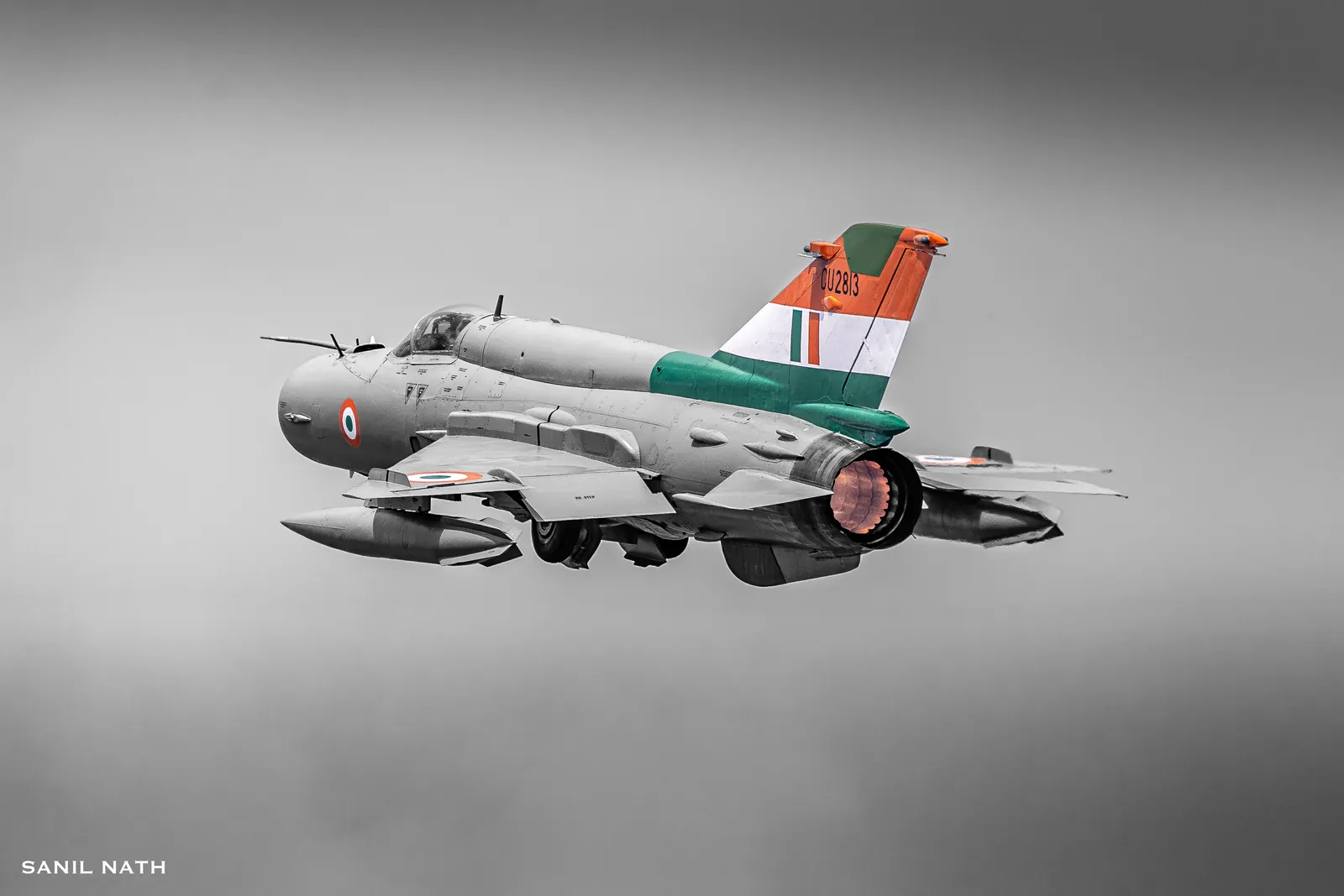
The MiG-21 Bison was an upgraded version of the Soviet MiG-21 fighter, a type which had served in India since the 1960s. Abhinandan's mission on 27 February was to intercept the Pakistani aircraft. The later Indian gallantry citation describes him detecting a low-flying enemy aircraft with his airborne radar and warning the other pilots. He and his wingman then moved to attack. According to that account, he subsequently pursued a withdrawing enemy aircraft before his own MiG was hit. India credited him with shooting down a Pakistani F-16. Pakistan denied that loss; the claimed F-16 shootdown remained disputed between the two countries.
Abhinandan's own aircraft was lost. He activated his ejection seat and descended under a parachute near the village of Horran in the Bhimber area, in Pakistan-administered Kashmir. He had come down in territory controlled by the opposing army.
Residents had noticed the crash and the descending parachute. The local politician Mohammad Razzaq Chaudhry set out with other men. He later recalled that the wreckage and the pilot had come down in different places. The men reached Abhinandan before soldiers arrived. Ejecting had left him little time to get away from the landing site unseen: people on the ground were already watching for him.
Pursuit and capture at Horran
Chaudhry described the encounter in interviews with Dawn and the BBC. Abhinandan had first asked whether he had landed in India. A young man told him that he had. The pilot freed himself from his parachute and shouted a patriotic slogan. Someone in the group answered with a shout in support of Pakistan. The information he had just been given about his location was false. Abhinandan drew his pistol, fired into the air and backed away from men who were picking up stones and following him.
During the pursuit, Abhinandan tried to destroy papers he was carrying. He put sheets into his mouth and others into the water. According to Chaudhry, however, residents snatched some of the documents and later handed them to the army. Chaudhry described the seizure without disclosing what the documents contained.
The men who overpowered Abhinandan did not all behave alike. Some struck him; others tried to stop the attacks. Chaudhry said he wanted the pilot delivered alive to the army and feared that the armed man and those throwing stones would injure one another. Pakistani soldiers intervened. In the published footage, they shielded the bleeding pilot from further blows and took him away from the crowd.
The soldiers took Abhinandan into military custody. Dawn reported that they brought him to a military installation in Bhimber. Little became publicly known about his subsequent places of detention or the journeys between them. The next images showed him as a prisoner before a camera.
A prisoner questioned on camera
Pakistani authorities circulated videos of the pilot on the day he was shot down. An early recording showed him blindfolded, with blood on his face. He gave his name and rank, said he was injured and asked for water. When questioned further, he maintained that he was not permitted to answer. In a later recording, he sat without a blindfold, drinking tea. He thanked Pakistani officers for their treatment.
The recordings reached large audiences in both countries. In India, they also provided evidence that the missing pilot was alive. His family and the public could see that he had survived the shootdown. Pakistan could present the same prisoner as an outcome of the air battle. His captors decided when filming took place and which images reached the public. The apparently calm man drinking tea was still a prisoner. The recordings did not show what happened between them or the conditions under which questioning took place.
Abhinandan answered questions about his identity and withheld further information. The Geneva Convention on prisoners of war expressly limits the identity details a prisoner is required to provide: name, rank, date of birth and service number, or equivalent information. Article 17 prohibits physical or mental coercion to obtain further information. A mission, the composition of a formation and other operational details are outside those required particulars.
The Convention also obliged the detaining power to treat prisoners humanely and protect them from violence, intimidation, insults and public curiosity. India therefore protested against the publication of recordings showing the injured officer and demanded his immediate, safe return. Pakistan said it was treating him according to military ethics. While that public argument continued, Abhinandan remained in Pakistani custody.
The announcement of his release
On 28 February, Pakistan's Prime Minister Imran Khan told Parliament that Abhinandan would be released the following day. He called the decision a peace gesture. After the air strikes and engagement, both states were under international pressure to avoid further fighting. The United States, China and other powers called for restraint.
The Indian Air Force welcomed its pilot's promised return. At the same joint press conference of the three armed services, the army said it had put ground-based air defences on alert and mechanised formations on standby. Firing continued along the Line of Control. The release resolved the immediate issue of a captured officer while the conflict between the states continued.
The Wagah–Attari crossing near Lahore and Amritsar was chosen for the handover. Abhinandan would cross the international border in Punjab. His journey home would therefore take him to a regular crossing point well away from the village in Kashmir where he had landed after the air battle.
The crossing at Wagah–Attari
On 1 March, Pakistani authorities brought Abhinandan from Lahore to the crossing in a convoy escorted by military vehicles. Armed soldiers secured the transport. Several procedures, including a medical examination, had to be completed before the handover. The process took hours. The pilot remained under Pakistani guard until he crossed the border.
Before the handover, Pakistani television broadcast another recording. Abhinandan wore his green flying suit and described being rescued from the residents by two Pakistani soldiers. It was unclear when the video had been recorded.
People carrying flags had gathered on the Indian side during the day to welcome the pilot. By the time he actually crossed in the evening, many had already left. Television cameras showed Abhinandan in a blue blazer and grey trousers, accompanied by Pakistani officials. Indian security personnel received him on the other side. A little over two days after being captured, he was back in India.
His detention was over. Abhinandan was brought to New Delhi for medical care. Air Vice Marshal R. G. K. Kapoor explained that a medical assessment was mandatory, particularly because the officer had ejected from an aircraft. His fitness to fly had to be established before he could return to flying duties.
Back in the cockpit
Abhinandan returned to flying duties. On 2 September 2019, he flew in a two-seat MiG-21 at Pathankot Air Force Station with the then Chief of the Air Staff, B. S. Dhanoa. Their flight in the trainer took place just over six months after the shootdown. He had received clearance to fly in August following another medical examination.
On 22 November 2021, President Ram Nath Kovind presented him with the Vir Chakra, an Indian gallantry award, at Rashtrapati Bhavan in New Delhi. The list of recipients already named him as a Group Captain. The official citation recognised his conduct during the air engagement and captivity.
Abhinandan took premature retirement from the Indian Air Force on 31 March 2026 and joined the Goa-based regional airline FLY91 as a pilot in August. When the move became public in early September, reports said he was training on the ATR 72-600; the airline itself declined to disclose details of his duties on privacy grounds.