On 2 June 1995, Captain Scott O’Grady was flying an F-16 over Bosnia with Captain Bob Wright leading the two-aircraft patrol. O’Grady was 29 and served with the US Air Force’s 555th Fighter Squadron at Aviano in Italy. Their flight supported Operation Deny Flight, NATO’s enforcement of the United Nations no-fly zone over Bosnia. The country beneath them was still at war. South of Bihać and west of Banja Luka, Bosnian Serb air defences threatened aircraft over territory in which a downed airman would also face the danger of capture.
Relations between NATO and the Bosnian Serb forces had worsened in late May. Air strikes against ammunition depots had been followed by the seizure of UN peacekeepers, who were held hostage. This was the crisis in which O’Grady and Wright were conducting their patrol. A shootdown could expose an airman to capture as well as the immediate danger of the missile strike.
Marines waiting in the Adriatic
An American amphibious group was already operating in the Adriatic. USS Kearsarge, Nashville and Pensacola had curtailed an exercise with NATO allies off Sardinia because of the deteriorating situation in Bosnia. They carried the 24th Marine Expeditionary Unit, with ground troops, aircraft and the means to operate ashore from ships at sea. The US Sixth Fleet had sent the group into the Adriatic partly to prepare for the recovery of downed aircrew.
The men had rehearsed their duties together during nine months of preparation before deployment. That work included coordinating transport helicopters, armed escorts and troops during a recovery. Kearsarge put these forces close to the area in which they might be needed. A mission could require the ground team to secure a landing site and search for a missing airman before bringing him aboard.
The first day in hiding
A Bosnian Serb SA-6 surface-to-air missile struck O’Grady’s F-16. The cockpit disintegrated around him. Surrounded by fire, he pulled the ejection handle and escaped the aircraft. Wright watched the burning fighter disappear into cloud but saw no parachute. O’Grady had survived, although he made an error during his descent. He opened the parachute manually too soon, as he acknowledged after his return, and remained visible above the countryside for a long time. Below him were a road, a military vehicle and other cars. People could watch him coming down. He landed among grass and bushes.
He freed himself from the parachute, seized his survival kit and went straight into cover. The equipment he recovered included a map, a survival radio, water packets, a camouflage net and a 9-mm pistol. O’Grady pushed into the vegetation and lay face down, covering his ears with his green flying gloves so that exposed skin would not stand out against the leaves. He later described the bushes as less than dense; he had worked his way into the middle of them.
Within minutes, he could hear people around his parachute. They then spent hours moving near his hiding place. Some passed within an estimated six feet. There was rifle fire, and O’Grady believed the men might have seen something of him and were trying to hit him. He remained face down. From beneath the bushes, he could not establish what the searchers had actually noticed or safely move away while they were so close.
Although he had a pistol, he did not use it to fight a battle during these days. His immediate effort went into remaining unseen. Air Force survival training had prepared him for concealment and movement after dark; the need to use it began almost as soon as he landed.
Moving at night, staying still by day
After dark, O’Grady moved in search of better hiding places. During daylight he avoided movement. A route that looked open on his map was of little use unless he could travel it without being seen by the people on the ground. He remained in an inhabited area, alternating between concealment and cautious movement. Even when there was no search party beside him, someone could approach the place in which he was hiding.
Two cows came close to his hiding places, accompanied by a herdsman who called them with a small bell. O’Grady gave the animals and their owner nicknames and later told the story with humour. At the time he feared that the herdsman would find him. Cattle could wander up without giving him away, but they brought a person who used the pasture. He stayed hidden during these encounters too. He had no empty stretch of woodland in which to spend daylight searching freely for water.
The survival kit contained eight packets of water, each holding four US fluid ounces, for a total of just under a litre. He consumed the supply quickly. After that he found no water source, although he listened for frogs and for the sound of flowing water. Thirst became his most pressing supply problem. His original reserve could not cover the days he would spend on the ground, and the danger of discovery restricted his opportunities to look for more.
When rain came, he could collect some of it. At other times he used a yellow sponge to gather dew, squeezing the moisture into small plastic bags. The sponge allowed him to take up water lying on surfaces and retain drops that would otherwise be difficult to collect. The amounts were small. He once tried wringing out his soaked wool socks but obtained very little. His clothing stayed wet while the water he recovered remained insufficient.
Hunger troubled him less than thirst at first. Later he tried leaves and grass and put a finger into an ant hole to catch insects. The ants escaped quickly. His dry mouth made even the little food he could obtain difficult to eat. These attempts did not produce regular meals. After several days he had found neither a water source nor food that could sustain him for a long stay on the ground.
He generally slept for no more than half an hour at a time. On one occasion a nearby artillery discharge woke him. Rest in a hiding place therefore gave him only brief recovery. Rain had provided a little drinking water but also left him soaked. By the time the rescuers reached him, he was cold, exhausted and covered in mud.
While remaining concealed during daylight, O’Grady monitored his radio. He heard NATO jets two or three times, always during the day, and considered trying to contact them then too dangerous. He knew a search was under way but still had no confirmed link with those looking for him. His caution concerned activities that might reveal his position.
Meanwhile, the largest prepared recovery package aboard Kearsarge remained on alert around the clock. A crisis action team had begun planning after the shootdown. Within an hour, transport helicopters, attack helicopters and Harriers had been armed and prepared while the ground troops drew and loaded ammunition. The men then ate, slept and trained with their equipment within reach or already staged in place. From 4 June, the recovery force had to be ready to launch within thirty minutes. Reports of possible signals reached the searchers without providing dependable voice contact with O’Grady. American leaders also had to deal with both encouraging and misleading information during these days.
Hanford hears Basher 52
In the early hours of 8 June, O’Grady activated a beacon on his survival radio. Captain Thomas Hanford, a friend from his squadron, was flying an F-16 patrol and trying to reach the missing airman. A weak voice finally answered. O’Grady identified himself by his call sign, Basher 52. After almost six days on the ground, he could tell someone in the air that he was alive.
Confirmed contact was established at roughly two in the morning. Hanford could hear O’Grady and speak to him. He knew the pilot and recognised his voice, but also checked his identity by asking about the unit in which O’Grady had previously served in South Korea. The pilot could answer. Hanford could now report that he had spoken to the missing pilot and that O’Grady was alive.
The news went to NATO command and the amphibious group in the Adriatic. Final preparations began on Kearsarge, and the ships moved closer to the Croatian coast. Other F-16 crews relieved Hanford and called O’Grady at intervals to keep in touch. The approaching recovery force would make its own contact and check his identity again before closing the last distance.
The commanders had to decide when to go in. Darkness would have made the helicopters less conspicuous, but the additional protection needed from Aviano and other European bases could not be in place until morning. O’Grady’s radio batteries were running low, his physical condition was uncertain, and the threat in his immediate surroundings was unclear. Waiting until the following night could mean losing the link or leaving him too weak to move. The force would therefore launch as soon as it could do so with the required air support.
The recovery force launches from Kearsarge
The Marines conducted the operation as a TRAP mission: Tactical Recovery of Aircraft and Personnel. Most of its ground element came from the embarked battalion’s 81-mm mortar platoon. First Lieutenant Martin Wetterauer led those men as the security force for the pickup. Communicators, tactical air control personnel, Navy medical corpsmen, a Serbo-Croatian linguist and electronic warfare specialists supplemented the platoon. At the landing site they were to provide security, maintain communications, reach the pilot and give medical help if needed.
Three CH-53E Super Stallions, three AH-1W Cobras and four AV-8B Harriers were assigned. One transport and one attack helicopter would be airborne backups, leaving two heavy CH-53Es and two Cobras to conduct the actual pickup. The Harriers would add support from above. Major William Tarbutton led the helicopter mission from the first transport. Captain Paul Fortunato and Captain James Wright flew the second. This Wright was a Marine helicopter pilot, a different man from Bob Wright in O’Grady’s F-16 patrol.
Wetterauer’s ground team comprised 41 Marines. Martin Berndt, commander of the 24th Marine Expeditionary Unit, and his public affairs officer Michael Jordan put the entire force launched from Kearsarge at 57 Marines and four sailors. That total included aircrew and other personnel carried on the aircraft.
Further land- and sea-based aircraft supported the flight, with a NATO AWACS coordinating the airspace. A reinforced platoon package called Sparrowhawk and a company-sized Bald Eagle force remained ready aboard Kearsarge. They could be sent to reinforce the recovery team if it ran into trouble on the ground. Neither was part of the force that landed near O’Grady. The planners nevertheless had to prepare for a more difficult recovery than a pilot who could run to a helicopter unaided.
Launching began at about five in the morning, and by 5.05 a.m. the helicopters were airborne. They initially circled the ships while the rest of the air-support package reached its positions. The amphibious group had moved close enough to the coast to reduce the straight-line distance to the objective area to about 87 miles. The flight itself would be longer. Known and suspected surface-to-air missile sites required a circuitous route to keep the slower helicopters out of their reach.
At approximately 5.49 a.m., the helicopters crossed the coastline. They flew over Croatia, the Serb-held Krajina and then Bosnia, keeping low. Heavy cloud helped conceal them from the ground but reduced the crews’ view of terrain and obstacles ahead. The Harriers took off from Kearsarge later and caught up with the helicopters. Near the objective, the two Cobras moved out in front to locate O’Grady and protect the transports as they approached.
Through the fog to the landing site
O’Grady could hear the helicopters and used his radio to help the crews come towards him. He now had to mark a place he had spent days trying to keep hidden. He released red smoke. A Cobra crew subsequently dropped a yellow smoke grenade to show the following transports where to land. One escort helicopter circled for protection while the two heavy aircraft came in through the fog.
The landing site was a hillside pasture strewn with large rocks and small pines. Taller trees surrounded it, and a fence divided the available space. Fog hung just below the treetops. The pilots had to fit their CH-53Es between these obstacles. Wetterauer’s Marines left Tarbutton’s lead transport and began establishing security. Fortunato’s second helicopter initially landed on the fence, preventing its rear ramp from opening. He moved the aircraft a few metres and was then able to let more Marines out.
O’Grady was already running from the tree line. He had reversed his green-and-orange survival cap so that the bright side faced outwards, making himself recognisable for the pickup. Soaked and muddy, with a beard, he held his pistol in his hand. He had loaded it during this final stage. After returning, he acknowledged that he had disregarded an instruction from training: he was not supposed to run towards a rescue helicopter carrying a loaded weapon.
A crew member jumped from the second CH-53E, intercepted the approaching pilot and brought him aboard through the opening on the right side of the fuselage. O’Grady had kept in contact, marked his position with smoke and remained able to cross the ground to the aircraft. The Marines returned to their transports and checked that everyone was back aboard. After only a few minutes on the ground, both CH-53Es lifted off and headed west.
The crew began caring for O’Grady during the flight. They wrapped him in a blanket, and Marines sat close on either side to help warm him with their bodies. He drank from a canteen and managed to eat part of a packaged field ration. The pickup site was behind him, but the formation still had Serb-held territory to cross before reaching the ship.
Back to Kearsarge under fire
The helicopters crossed the mountains and entered a broad, open plain. They no longer had the concealment that the terrain had provided on the way in. About thirty miles from the coast, the force came under fire. The crews went lower still and flew fast, manoeuvring evasively while having to clear houses and power lines across their route.
Rounds struck both CH-53Es. The lead transport took a hit in its main rotor; the aircraft carrying O’Grady was struck in the tail rotor and around a cargo door. At least one round entered its cabin, ricocheted and finally hit a canteen. A door gunner returned fire with his heavy machine gun. Anti-aircraft fire and missiles were also reported. The Cobra crews warned the transports about missiles passing close to the formation.
Inside the cabin, Marines continued warming O’Grady while the pilots brought the damaged but still flyable transports through the area under fire. Their escorts stayed with them. Once clear of the threat zone, the commander decided against sending the Cobras back to attack the firing positions. The formation continued towards the Adriatic. Such a pass would have taken it back into hostile fire; the survivor and the recovery team now needed to reach the ship.
At 7.30 a.m., the entire recovery force launched from Kearsarge was back aboard with O’Grady. Nobody had been lost during the recovery. The operation had taken about two and a half hours from launch to return. From the shootdown on 2 June to the pickup on the morning of 8 June, O’Grady had survived almost six days on the ground.
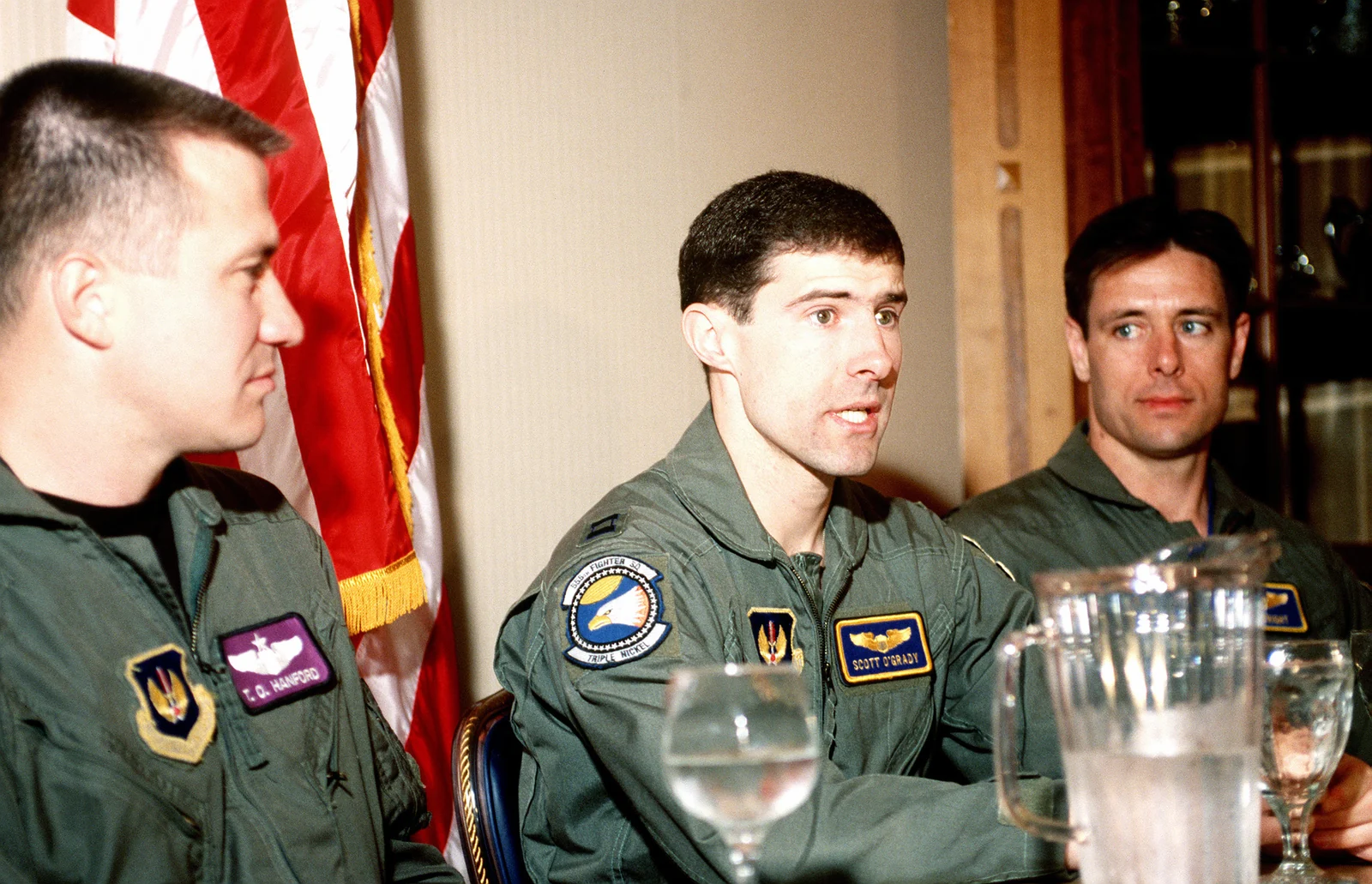
Public announcements and notification of O’Grady’s family had been held back while the helicopters were still over hostile territory. Only after their safe return could the recovery be reported as complete. On 9 June he returned to Aviano. At his first press conference the next day, he sat beside Thomas Hanford, who had established contact, and Bob Wright, who had seen the aircraft go down without spotting a parachute.
When the recording of his radio call was played, O’Grady began to cry and asked for a short break to compose himself. He then described people passing his hiding place, the water packets, his sponge and his brief spells of sleep. He attributed his survival to training, common sense and faith, and thanked the men who had brought him out. Officers at Aviano announced that he would brief instructors at the survival school in Spokane on his experience. He also publicly acknowledged his two mistakes: opening the parachute too early and running towards his rescuers with a loaded pistol.
The appearance of U.S. Department of War (DoW) visual information does not imply or constitute DoW endorsement.