

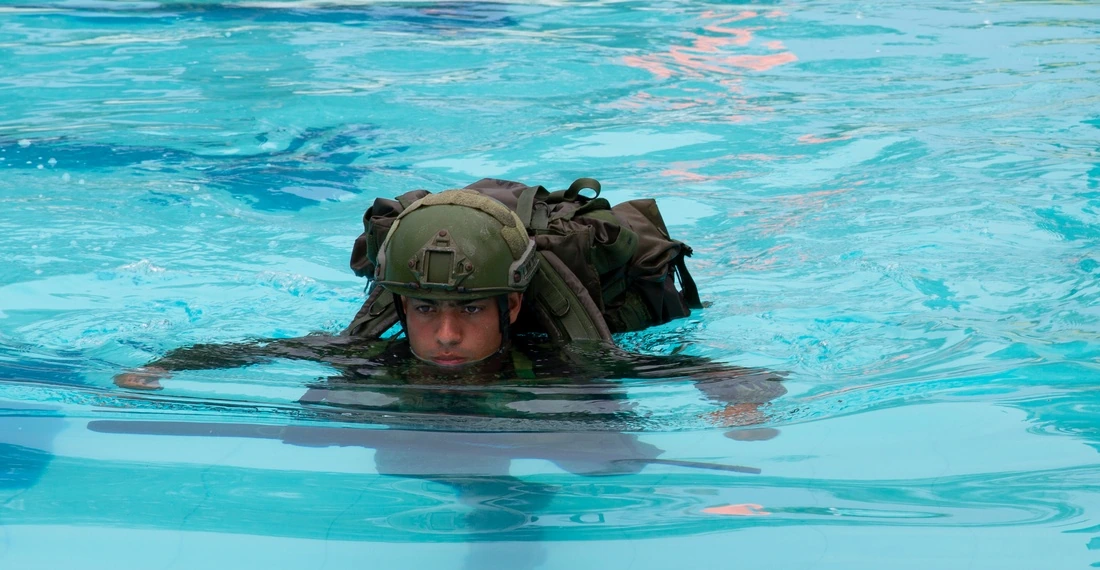
Colombian SERE training – Supervivencia, Evasión, Resistencia y Escape – prepares aircrew to remain capable of action outside their aircraft after being shot down, making an emergency landing or bailing out. Sustaining themselves, moving without detection and avoiding capture support the same objective: returning to a safe area. If captured, the person also has to protect information, survive under someone else's control and prepare for escape. The Fuerza Aeroespacial Colombiana, or FAC, connects these tasks with water survival and the procedures for recovering isolated personnel.
ESIMA and preparation for flying duties
The Escuela de Instrucción Militar Aérea, ESIMA, is based at Comando Aéreo de Combate No. 1 in Palanquero near Puerto Salgar. Its SERE participants include officers and non-commissioned officers with aircrew duties. The school also teaches SERE within professional soldiers' irregular-combat training. In that setting it accompanies casualty care and transport and other combat subjects. The aircrew course concentrates particularly on losing the aircraft and the subsequent situation on land or in the water.
Within the earlier flying training framework, SERE was a prerequisite for clearance to perform flying duties. Personnel with a role aboard received training for the emergency and survival systems; initial and recurrent training were linked to that clearance. Students at the primary and basic flying schools were exempt from this SERE requirement. The framework also prescribed separate training for the relevant parachute, ejection seat, water emergency and emergency evacuation of the aircraft. For the person, this includes the transition into isolation: escape must work with the particular seat, harness, exit and survival equipment before food, water or an evasion route outside can be of use.
Preparation for an underwater escape establishes the route from the seat to the appropriate opening mentally and through practice before the emergency. A reference held with the hand helps the person find that route again when visibility is lost underwater. Harness, exit and survival equipment have to match the particular aircraft. Searching for these releases for the first time inside a flooded cabin consumes time and the available breath. Escape is followed by a new task: remaining at the surface with accessible flotation devices and reaching further survival equipment.
People without a formal flying role also need emergency training appropriate to their work and aircraft. Evacuation and use of the available equipment were part of the prescribed training for personnel who routinely worked aboard without a formal flying post. People carried without an onboard role in aircraft fitted with ejection seats also had to receive suitable instruction in emergency procedures, equipment and ejection. For these two groups, a short pre-flight briefing did not replace practical preparation. Preparation for escaping the cabin also includes passengers.
Instruction, field tasks and mission briefing
The Colombian training model combines formal instruction, individual preparation and the briefing for the particular flight. Instruction covers procedures and survival and recovery equipment. Individual preparation adds SERE and Search and Rescue, or SAR, material and familiarity with the devices. The mission briefing addresses the current situation: what should the crew do after losing the aircraft, which areas are suitable and which contact procedures apply to this mission? Resistance and captivity require their own training component; they are not first taught in a short pre-flight briefing.
In an international ESIMA SERE course, participants practised flotation and water survival, shelter construction, sustaining themselves in the jungle, abseiling and helicopter extraction using rope and ladder. Evasion, conduct in captivity and escape were also included. This range connects different losses of control: aircraft and regular supplies are lost first, while an adversary may subsequently remove freedom of movement as well. The practical tasks therefore cover both the use of remaining resources and the transition to recovery by other forces.
Evasion preparation begins before the mission with a starting point, possible rendezvous points, a primary and an alternative route, and areas for rest and resupply. A rendezvous helps separated crew members only if they previously shared an understanding of its location and timing. An alternative route becomes necessary when the first is occupied, too exposed or blocked by the terrain. The briefing must also clarify whether the person should remain in or leave the accident area, and which signals and identity procedures belong to a possible recovery.
From the accident area to a concealed position
In an area threatened by an adversary, the person's work begins with the condition of the survivors and the equipment actually available after the emergency. Injuries may restrict walking; a survival kit inside an inaccessible wreck cannot sustain further survival. Useful material is therefore selected and secured. The person then needs a position with concealment and a possible onward route. The conspicuous accident area and a suitable place for a longer stay may be far apart.
At the concealed position, injuries, clothing, water, food and rest can receive closer attention. The Colombian approach links rationing to the unknown time until recovery. The person has to plan around the supplies available and weigh further procurement against time, effort and exposure. A water source can provide water while also becoming a predictable destination. Spending a long time working in the open there adds a risk of detection to the task of sustaining oneself.
Fire provides heat, dries material or enables food preparation; smoke and light also make the area recognisable. That visibility is intended when signalling, but during a concealed stay it may bring the adversary closer. The person therefore has to weigh the benefit for warmth and sustenance against the risk of detection. A resting place with existing weather protection reduces the work required without removing the need to observe the surroundings.
Preparation extends beyond the jungle. The sea, dry areas, snow and high mountains require different survival resources. The FAC relates equipment to the environment, topography, tactical situation and risk of the flight mission. Whether equipment remains accessible after the emergency also depends on whether it is carried on the body or stowed in the aircraft. After bailing out or escaping into water, decisions depend on what the person is carrying or can still reach safely; only part of the planned total equipment may remain available.
POEO: repeatedly interrupting movement
A Colombian reminder for observation during evasion is POEO: parar, observar, escuchar y oler — stop, observe, listen and smell. Stopping first provides an opportunity to relate the terrain to the chosen direction again. Observation looks for movement, unusual changes and human activity. Listening may reveal vehicles, voices or other sounds masked by the person's own walking. Unfamiliar cigarette smoke or cooking smells may indicate people nearby. This calls for closer assessment of the situation; the smell alone does not identify who is there.
Movement takes place between concealed observation points. Before a necessary crossing of a track or road, the area is checked from concealment, rather than searching for people or vehicles after stepping into the open. A route may be convenient while also channelling movement, exposing it or passing guarded places. A high silhouette against the skyline, rattling equipment and broken vegetation provide different clues to the same person. Concealment therefore has to include movement, noise and signs left behind.
Lower light or bad weather may hinder visual observation, but also change the person's ability to recognise obstacles and the onward route. Dense terrain screens direct observation while requiring more effort to cross. The person therefore assesses the next section by its actual concealment, the activity detected and their own condition. The longest route away from a road is not a usable escape route if an injury or the remaining water prevents completing it.
A person alone usually creates less noise and fewer signs than a larger group. At the same time, there is no mutual help in treating a wound, observing or carrying equipment. A crew that remains together can share these tasks, but must coordinate movement and rest. Someone already isolated alone must make decisions around their own strength and equipment.
Captivity and the Colombian resistance approach
Colombian SERE preparation addresses the abduction of military personnel by non-state armed groups as well as captivity under opposing armed forces. This includes restraint, separation from fellow captives, inadequate weather protection and controlled access to water, food or medicine. These restrictions directly affect later capacity for action: limited movement weakens physical capabilities, sleep deprivation impairs attention and the sense of time, and an untreated injury restricts the possible onward route.
Resistance therefore encompasses more than answers during questioning. The person needs conduct that allows them to manage daily needs under someone else's control while protecting military information. Asking for water or discussing food is different from revealing a mission, locations or recovery procedures. The Colombian approach considers that distinction. Captives need to organise daily life over a prolonged period without disclosing military information in the conversations this requires.
In the Colombian SERE conduct model, solidarity among captives, protection of military information and avoiding exploitation work together. Preferential treatment can divide a group; public statements may serve propaganda. An existing military captive group also retains responsibility for its members and an ordered chain of leadership. For someone held alone, self-control, observation, preserving physical capabilities and protecting information remain their own tasks.
Further evasion may be necessary after escape. The person therefore has to think beyond leaving the place of captivity: what terrain lies outside, what supplies can be reached, how far will their physical condition allow them to travel and where can they move? Colombian escape preparation connects opportunity and security arrangements with weather, terrain and personal capability. Movement that immediately breaks free of control may subsequently fail through exhaustion, a water obstacle or renewed contact with the adversary.
Signalling, identity checks and the person's situation
Personnel Recovery brings together the tasks of the isolated person and the forces conducting the pickup. The person prepares available signals and communication devices, keeps a suitable area under observation and continues to sustain themselves. Preparation becomes a joint procedure only when forces are actually reachable. A radio needs power and a usable transmission path; a visual signal needs a line of sight to the correct side.
A situation report has to give the forces the information needed for their decision: location, number of people, injuries and ability to move, along with adversary activity, terrain and weather. Agreed contact times conserve the limited battery. Colombian preparation also covers personal answers or numbers for authentication. This checks whether the contact really belongs to the person being sought. The person has to remember the previously agreed details and also check the forces' prescribed recognition signals.
In threatened terrain, radio use and visible signals follow the mission briefing and the contact established. Smoke, flares or displayed markings may guide the correct helicopter while also drawing the adversary's attention. Signals prepared so that they can quickly be concealed again limit the period of exposure. Without a connection, the person still has to maintain protection and sustenance and find a genuinely usable onward route; continuous indiscriminate signalling can make these tasks harder and exhaust the available power.
Landing, hoist and the final movement to recovery
A pickup site has to meet two needs: the person requires concealment and an exit route, while the aircraft needs a usable approach and space for the chosen procedure. A good resting place under dense vegetation may be unsuitable for landing. The hide, the route to the pickup site and the actual pickup area are therefore assessed together. Until the forces actually approach, the person does not need to wait in the open or lay out all their equipment.
If a helicopter cannot land, hoist recovery with suitable rescue equipment may be possible. Colombian training subjects include the penetrador de selva, a folding rescue seat for recovery through vegetation, and other seat, sling and casualty devices. These are lowered from the aircraft and require the correct use of harness, supports and attachment points. They become useful only when a suitably equipped helicopter reaches the location.
During the actual pickup, loose items are secured against rotor wash, weapons are secured and unnecessary movement is avoided. The person approaches the aircraft only on the appropriate signal. For a hoist pickup, the lowered device has to touch the ground first so that static charge can dissipate. The prescribed restraints are then fitted and checked. The specific approach and attachment procedure depend on the aircraft and rescue equipment.
The appearance of U.S. Department of War (DoW) visual information does not imply or constitute DoW endorsement.